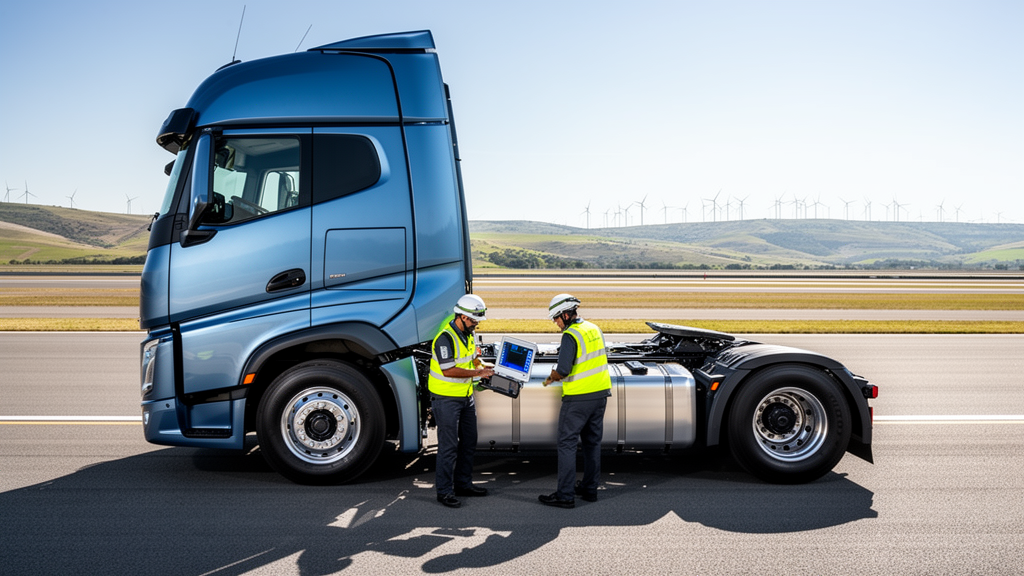
A research team from Linköping University and the Biogas Solutions Research Center in Sweden has formulated a comprehensive multi-criteria assessment framework designed to evaluate the multifaceted sustainability impacts of competing heavy-duty truck technologies. Published in Frontiers in Future Transportation, the methodological investigation led by Jonas Ammenberg, Konrad Smolarczyk, and Roozbeh Feiz addresses a critical analytical gap in freight decarbonisation. Heavy-duty road transport remains heavily reliant on fossil fuels while facing an array of alternative drivetrains and energy carriers, including battery-electric systems, hydrogen fuel cells, biomethane, biodiesel, and advanced internal combustion configurations. Existing environmental assessments often focus narrowly on tailpipe carbon dioxide emissions or single vehicle technologies, which limits fair comparisons across divergent operational paradigms. To resolve this imbalance, the researchers created an indicator-based evaluation tool spanning technical, economic, environmental, and social dimensions, operationalised through sixteen distinct indicators configured to support decision-making without imposing rigid mathematical weighting systems.
The urgent imperative to decarbonise road freight takes place against projected increases in global transport demand and stringent international climate targets, notably the European Union’s European Green Deal commitment to achieve climate neutrality by 2050. Heavy freight transport contributes substantially to greenhouse gas emissions, air pollution, and resource extraction, prompting policy measures that incentivize low-carbon fuels and zero-emission vehicles alongside green public procurement initiatives. Within road freight, transport service providers, shippers, vehicle manufacturers, and infrastructure planners confront competing technologies that occupy disparate stages of technological readiness, commercial infrastructure maturity, and operational capability. Because no single alternative energy carrier can independently scale quickly enough to displace fossil fuels across all heavy transport niches, strategic combinations of technologies are essential. Nevertheless, evaluating options such as biomethane combustion, hydrogen fuel cells, and battery-electric drivetrains demands analytical parity across vehicle performance, total lifetime expenses, supply chain security, and ecological externalities.
Traditional analytical approaches, predominantly life-cycle assessment and total cost of ownership modeling, have frequently yielded fragmented or constrained perspectives when applied to heavy commercial transport. Systematic literature reviews examine how life-cycle studies disproportionately target passenger cars or urban buses rather than heavy-duty long-haul trucks, while frequently omitting upstream mineral extraction, infrastructure construction, and end-of-life phases. Furthermore, conventional environmental assessments typically concentrate on greenhouse gas metrics while underrepresenting social sustainability, localized ecosystem degradation, and qualitative institutional dynamics. Past multi-criteria decision studies in the transport domain have similarly exhibited significant methodological limitations, including inconsistent system boundaries, opaque indicator selection criteria, and a pronounced reliance on vertical, hard aggregation models. Such hard approaches assign prescriptive numerical weights to collapse disparate performance indicators into single composite scores, obscuring fundamental trade-offs and assuming mathematical substitutability across incommensurable ecological and social values.
To overcome these structural limitations, the authors implemented
To overcome these structural limitations, the authors implemented a horizontal, soft multi-criteria assessment architecture grounded in the principles of value pluralism and weak commensurability. In this context, a soft approach deliberately avoids imposing pre-programmed aggregation algorithms or mandatory weighting coefficients that force an automated ranking of technologies. Instead, the framework presents multidimensional performance profiles across all sixteen indicators, preserving the distinct visibility of individual strengths, operational drawbacks, and potential burden-shifting risks. Developed through an iterative participatory process initiated in late 2022, the framework incorporated direct contributions from academic researchers, major truck and bus manufacturers, regional energy and waste utilities, gas sector enterprises, and public procurement agencies. To mitigate potential institutional biases stemming from the authors’ association with the Biogas Solutions Research Center, dedicated external workshops and independent peer evaluations were conducted with outside electromobility specialists, transport sustainability analysts, and logistics scholars.
The resulting framework evaluates heavy freight alternatives across four balanced performance domains, beginning with five technical indicators that quantify functional viability and operational convenience. The technical indicators encompass technology maturity, operational range, fuelling and charging efficiency, payload capacity, and infrastructure availability. Technology maturity evaluates commercial readiness and the robustness of maintenance networks using qualitative descriptive tiers. Range assesses driving distance per full refuel or recharge against an established long-haul fossil diesel benchmark of 1,250 to 1,700 kilometres, establishing proportional intervals where performance matching 90 to 110 percent of diesel is rated Good. Refuelling and recharging efficiency contrasts energy replenishment durations, including queuing time, against diesel’s baseline of 6 to 15 minutes. Payload capacity tracks cargo mass constraints imposed by heavy battery packs or fuel storage systems, while infrastructure availability evaluates the geographical accessibility of suitable fuelling networks.
Economic viability is structured around three dedicated indicators reflecting direct purchase and operational expenditures from the perspective of truck owners and haulage operators. Recognizing that high initial acquisition costs can coexist with low operational expenses, the framework explicitly splits total cost of ownership into capital expenditures and operating expenses over a standardized ten-year operating lifetime. Capital expenditures encompass initial vehicle purchase prices, required auxiliary equipment, available fiscal subsidies, and estimated residual values, benchmarked against conventional diesel trucks. Operating expenses capture recurring costs for energy carriers, routine maintenance, and insurance cover. The third economic metric evaluates vulnerability to critical materials and components, specifically tracking supply risks, geological scarcity, geographical processing concentration, and geopolitical import dependencies related to essential traction batteries, fuel cell membranes, electric drive motors, and onboard storage hardware, thereby isolating financial risks driven by raw material availability.
Environmental performance incorporates five indicators covering climate impacts,
Environmental performance incorporates five indicators covering climate impacts, energy efficiency, atmospheric pollutants, local ecological degradation, and external acoustic disturbance. Greenhouse gas emission savings are evaluated on a life-cycle basis relative to fossil diesel emissions, measuring percentage reductions across standardized thresholds informed by the European Union Renewable Energy Directive, which mandates 60 to 65 percent savings for sustainable biofuels. Primary energy efficiency measures well-to-wheel primary energy consumption per 100 kilometres of freight movement, utilizing asymmetric rating intervals above the diesel reference to account for extensive conversion losses in indirect synthetic and electrolytic fuel pathways. Air quality impact measures compliance with European tailpipe emission standards, Swedish Low Emission Zone Class 3 requirements, upstream energy clean-air footprints, and vehicle weight variations that drive non-exhaust particulate matter from brake, tyre, and road wear. Local and regional impacts on land and aquatic environments assess soil health, eutrophication mitigation, and biodiversity, while noise disturbance establishes rating intervals centered around the 79-decibel regulatory ceiling defined under Regulation EU 540/2014 for heavy goods vehicles exceeding 250 kilowatts.
The social performance domain incorporates three systemic indicators designed to capture broader socio-technical interactions, supply security, and governance environments that standard technical assessments routinely omit. The first indicator assesses socio-technical system services, evaluating how alternative fuel production chains and infrastructure integrate with municipal and regional waste, wastewater, and energy utilities, including beneficial circular synergies from organic waste treatment. The second indicator, security of supplies, analyzes the geographical provenance of energy carriers and primary feedstocks, favoring regional and national sourcing while crediting cross-sectoral resilience benefits, such as organic fertilizer co-production that bolsters domestic agricultural food security. The final social metric assesses institutional conditions and public opinion, characterizing current regulatory stability, political backing, policy trajectory, and societal acceptance from local to European Union governing levels.
During framework development, the research team implemented deliberate delimitation choices, merging, reformulating, or setting aside candidate metrics to preserve analytical practicability while preventing conceptual redundancy. A comprehensive development log illustrates that broad candidate categories were reorganized: operational capacity was formally partitioned into separate range and refuelling duration metrics because they impose distinct logistical constraints, whereas total cost of ownership was separated into capital and operational spending to illuminate trade-offs. The theme of scarce minerals was broadened into component dependency, while separate land and water impacts were consolidated into a unified regional ecological metric. Conversely, driver working environments, workplace safety risks, and global supply chain social hot spots were excluded as standalone indicators because severe site-specific variations and uneven empirical reporting across emerging technologies prevented equitable, standardized comparisons.
Operationalising the sixteen indicators relies on a harmonized
Operationalising the sixteen indicators relies on a harmonized five-level ordinal grading scale spanning Very Poor, Poor, Satisfactory, Good, and Very Good designations. Each performance level is defined through explicit numerical boundaries, qualitative narrative criteria, or hybrid combinations depending on the indicator’s conceptual nature and data availability. Furthermore, the assessment establishes clear distinctions between reference bases: relative scales contrast technologies directly against incumbent fossil diesel configurations, direct scales evaluate performance against intrinsic physical units such as decibels, and contextual scales assess performance against prevailing market and institutional conditions. The authors emphasize that assigning discrete ordinal ratings inherently discretises continuous data, which can conceal minor variations within a single rating tier while accentuating differences near threshold borders. Consequently, analysts are instructed to preserve and report underlying quantitative and qualitative evidence alongside ordinal scores.
To ensure rigorous uncertainty governance, every performance rating must be accompanied by an independent qualitative confidence rating assigned on a three-level ordinal scale designated by low, medium, or high confidence tiers. Confidence levels are judged on evidence consistency, empirical data availability, operational fleet experience, and sensitivity to underlying model assumptions. High confidence denotes robust, peer-reviewed operational data, whereas low confidence signifies reliance on early concept-stage literature, conflicting manufacturer claims, or speculative assumptions. The confidence metric functions alongside the primary performance evaluation without altering its nominal score, transparently signaling to decision-makers where additional empirical field measurements or scenario sensitivity analyses are warranted before committing significant capital investments.
The multi-criteria framework functions primarily as a decision-support and learning instrument rather than an automated prescriptive ranking engine. In an accompanying companion study, the research team applies the developed methodology to compare specific heavy-duty truck alternatives under Swedish and European operating conditions. The resulting indicator profiles enable haulers, transport authorities, and policymakers to systematically identify cross-dimensional trade-offs, mirror-image performance profiles, and potential burden-shifting vulnerabilities across competing clean-fuel technologies. While the operational thresholds reflect European long-haul trucking realities, the structural methodology provides an adaptable foundation that can be recalibrated to alternative geographical domains, fleet duty cycles, and regional energy infrastructures by adjusting baseline reference values, technology alternatives, and regulatory benchmarks.
Subject of Research: Multi-criteria sustainability assessment framework for heavy-duty truck transport technologies
Article Title: Sustainability assessment of heavy-duty trucks, part
Article Title: Sustainability assessment of heavy-duty trucks, part I: a multi-criteria assessment method for comparing alternative technologies
Article References: Ammenberg, J., Smolarczyk, K., & Feiz, R. (2026). Sustainability assessment of heavy-duty trucks, part I: a multi-criteria assessment method for comparing alternative technologies. Frontiers in Future Transportation, 7, 1851772. https://doi.org/10.3389/ffutr.2026.1851772
DOI:10.3389/ffutr.2026.1851772
Keywords: heavy-duty trucks, multi-criteria assessment, freight transport, sustainability assessment, alternative fuels, battery-electric trucks, hydrogen fuel cells, biomethane, life-cycle assessment, total cost of ownership, capital expenditure, operating expenditure, energy efficiency, greenhouse gas emissions, air quality, supply security, transport decarbonisation, technology maturity
News. Researchers Establish Comprehensive Multi-Criteria Framework to Evaluate Heavy-Duty Truck Sustainability. Scienmag