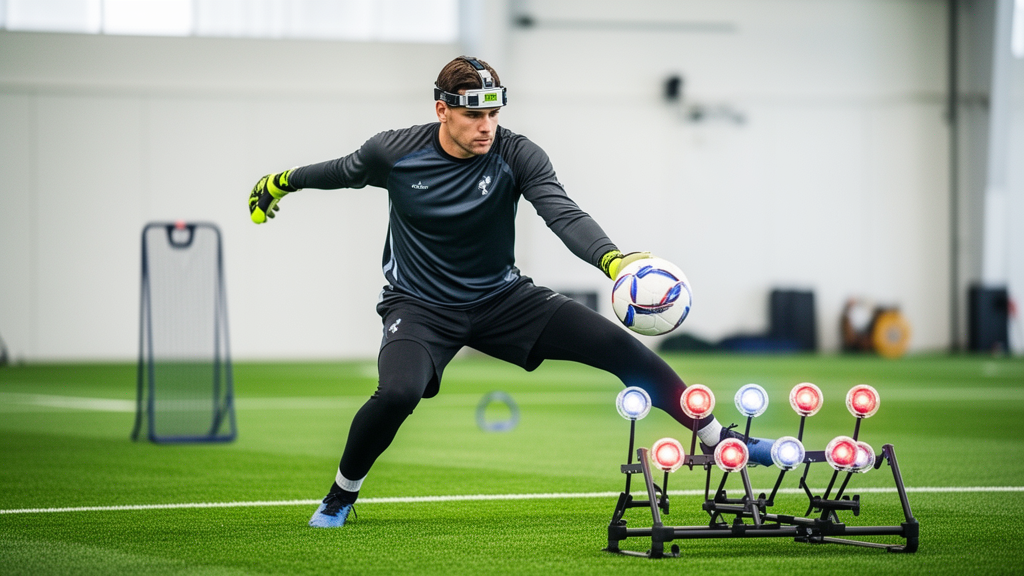
A progressive neuro-athletic training program completed alongside regular soccer drills produces measurable improvements in dynamic postural control, agility, and countermovement jump flight duration among competitive male goalkeepers, according to a randomized controlled trial published in BMC Sports Science, Medicine and Rehabilitation. The investigation examined whether targeted exercises designed to stimulate neural pathways could enhance specialized motor outputs in athletes tasked with protecting the goal. Modern goalkeeping requires rapid sensorimotor reactions, dynamic stability, and explosive movement, yet empirical evaluations of multimodal neural conditioning within this population remain limited. Researchers conducted the trial to determine whether eight weeks of supplementary neuro-athletic training would yield meaningful adaptations in dynamic balance, vertical jump metrics, handgrip strength, and change-of-direction speed.
The study employed an assessor- and analyst-blinded parallel-group framework prospectively registered on ClinicalTrials.gov under identifier NCT07589816. The cohort comprised twenty competitive male soccer goalkeepers from the Turkish Regional Amateur League and TFF Third League. Investigators randomly allocated these twenty athletes into an experimental group of ten goalkeepers and a control group of ten goalkeepers. Both cohorts continued their standard soccer training routines throughout the eight-week period. Participants in the experimental group additionally completed a progressive neuro-athletic program twice weekly. To protect methodological rigor, pre-intervention and post-intervention evaluations were conducted by an assessor blinded to group allocation, and statistical analyses were performed on coded group identities by a blinded statistician.
Neuro-athletic training is structured as a multimodal approach designed to integrate visual, vestibular, proprioceptive, and motor processes. In this study, researchers selected the dominant-limb composite score of the Y-Balance Test as the primary outcome to measure dynamic postural control. Statistical analyses revealed a significant group-by-time interaction for the composite Y-Balance score, showing a p-value of .022, a partial eta squared of 0.259, and an effect size of Hedges’ g = 1.07. Goalkeepers in the neuro-athletic group achieved a 2.74 percent within-group improvement in balance performance. Compared to the control group, the between-group difference in change reached 1.38 percentage points in favor of the experimental cohort.
Secondary outcomes tracked across both cohorts included change-of-direction
Secondary outcomes tracked across both cohorts included change-of-direction agility measured through the T-agility test, handgrip strength, and countermovement jump performance. The T-agility evaluation demonstrated a significant group-by-time interaction with a p-value of .005, a partial eta squared of 0.360, and a Hedges’ g of −1.36. Participants in the neuro-athletic group reduced their agility completion time by approximately 2.77 percent, producing a between-group difference in change of −0.283 seconds compared to controls. In vertical jump testing, countermovement jump flight time also showed a significant interaction effect, recording a p-value of .015, a partial eta squared of 0.288, and a Hedges’ g of 1.16.
However, this positive effect on flight duration did not extend to actual jumping height. The countermovement jump height analysis showed no significant interaction between group and time, yielding a p-value of .669, a partial eta squared of 0.010, and an effect size of Hedges’ g = 0.19. Handgrip strength assessments produced a statistically significant interaction with a p-value of .027, a partial eta squared of 0.243, and a Hedges’ g of −1.03.
The authors emphasized important limitations regarding the interpretation of these findings, notably that the control group received no time-matched active intervention. Because control athletes only continued standard soccer training, the measured improvements reflect the consequence of adding extra neuro-athletic conditioning rather than confirming an isolated effect specific to neural integration methods. The investigators noted that adding progressive neuro-athletic training to regular soccer practice was associated with superior gains in dynamic postural control, change-of-direction performance, and jump flight time compared to routine training alone in trained male goalkeepers. However, they concluded that further randomized trials utilizing time-matched active control groups remain necessary to verify whether these adaptations stem uniquely from neuro-athletic mechanisms.
Subject of Research: Effects of progressive neuro-athletic training on soccer goalkeeper movement performance
Article Title: Effects of an 8-week progressive neuro-athletic
Article Title: Effects of an 8-week progressive neuro-athletic training program on goalkeeper movement performance: a randomized controlled trial
Article References: Demir, O., Mısırlıgil, H., Bayansalduz, M., & Yılmaz, C. (2026). Effects of an 8-week progressive neuro-athletic training program on goalkeeper movement performance: a randomized controlled trial. BMC Sports Science, Medicine and Rehabilitation. https://doi.org/10.1186/s13102-026-02200-y
DOI:10.1186/s13102-026-02200-y
Keywords: neuro-athletic training, soccer goalkeepers, dynamic postural control, Y-Balance Test, countermovement jump, T-agility test, change-of-direction performance, handgrip strength, sensorimotor integration, randomized controlled trial, Turkish Regional Amateur League, TFF Third League, flight time, vestibular processing, proprioceptive training, visual processing, sports rehabilitation
News. Progressive Neuro-Athletic Training Improves Postural Balance and Agility in Soccer Goalkeepers. Scienmag