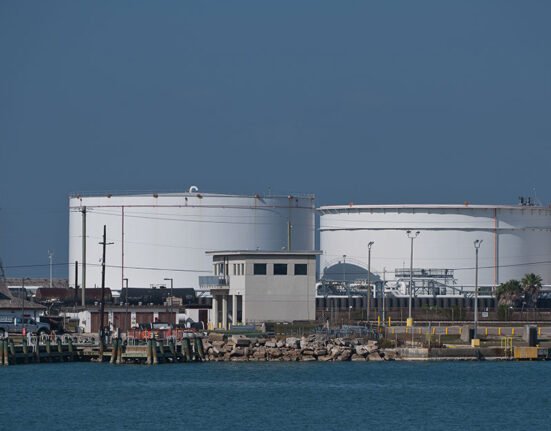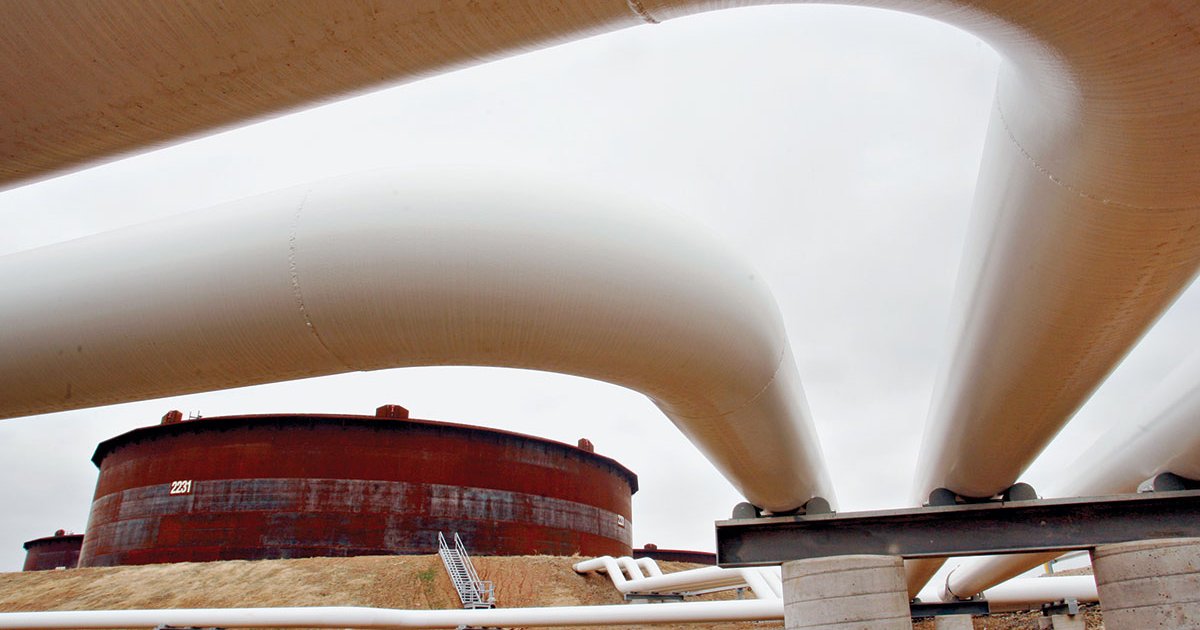
Oil pipelines deliver oil to storage tanks with a capacity of 575,000 barrels at the Enbridge Cushing Terminal in Oklahoma. (Shane Bevel/Bloomberg)
key takeaways:
- Cushing crude inventories fell for eight consecutive weeks to about 20 million barrels, which traders consider the operating minimum.
- US exports hit a record as supply disruptions in the Persian Gulf weighed on global markets, bringing comprehensive US inventories to their lowest level since 1985.
- Oil prices rose on June 17, although pressure from the pending US-Iran interim peace deal remains.
Consumers desperate for oil are extracting so much oil from giant storage tanks in Oklahoma that producers are having trouble keeping track of it.
Stockpiles at Cushing, the largest commercial crude oil storage facility in the US, have declined for eight consecutive weeks and now stand at about 20 million barrels, according to government data published on June 17. This is equivalent to less than two days’ worth of US crude oil production, and is a level that most traders consider an operating minimum.
Even though Washington and Tehran are on the cusp of a peace deal that could fully reopen the Strait of Hormuz, the loss of so much of the Persian Gulf crude supply during the Iran conflict – equivalent to about 20% of global shipments – has left global supply chains extremely strained.
The US has stepped in as the seller of last resort in the global oil market during the last three months and has seen record growth in its exports. But this has come at the cost of severely eroding the domestic buffer against future supply shocks. The broadest measure of US inventories – the total that includes not only the barrels stored in Cushing but also the nation’s strategic reserves, as well as oil that has been refined into fuel – is now at its lowest since data dating back to 1985.
Earlier this week, data showed that the US strategic petroleum reserve, built up after the 1970s Arab oil embargo, fell to about 340 million barrels, the lowest since 1983. The Trump administration is releasing 172 million barrels from reserves to help reduce war-induced fuel prices.
Cushing is a massive complex of oil tanks west of Tulsa that is the most important physical storage facility in the U.S. crude market. It is located at the confluence of dozens of inbound and outbound pipelines that stretch across North America, connecting oil fields to Gulf Coast and Midwest refineries in Canada, Texas, North Dakota and elsewhere. It is nicknamed the “Pipeline Crossroads of the World”.
Storage levels at Cushing play a key role in determining the value of benchmark US oil futures for traders. West Texas Intermediate futures, in turn, help underpin the pricing of millions of barrels of crude oil traded around the US.
The decline in inventory in Cushing is sure to impact the storage facility. When the level drops below the so-called suction line of about 20 million barrels it is difficult and expensive to extract oil from the tanks, and the quality of the crude can be compromised by water and sediment.
Cushing’s role in global oil markets has diminished since the US lifted export restrictions in 2015. Barrels now flow from oil fields in Texas and elsewhere directly to the coast, where they are shipped to foreign buyers.
Still, the decline in Cushing crude inventories helped support the spread between the nearest two US crude futures contracts. The so-called lag in spreads indicates that near-term supply in the region remains tight.
Refineries in the Midwest, which depend on crude supplies from Cushing, processed a record amount of oil last week, according to the EIA, showing that demand remains high domestically even as exports are down following the peace accord.
Oil futures rose on June 17 after two days of steep declines, although prices are still under pressure from the pending US-Iran interim peace deal.