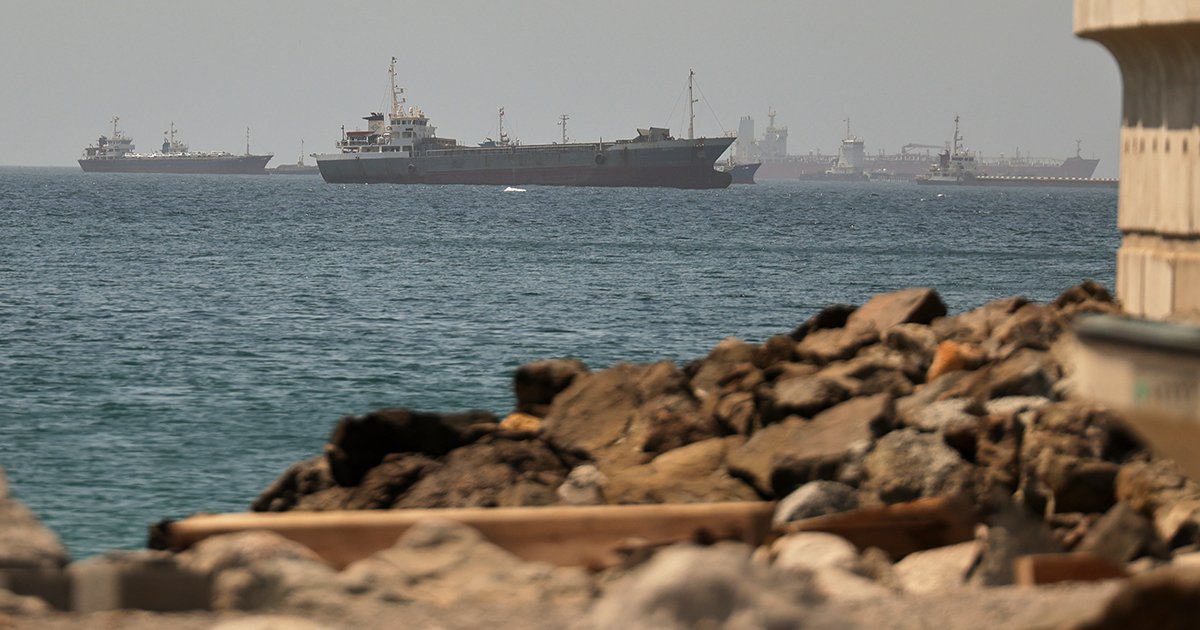
Tankers and cargo ships travel in the Gulf of Oman along shipping routes linking the Strait of Hormuz and the Arabian Sea on June 16. (AP photo)
key takeaways:
- Several tankers exited the Strait of Hormuz on June 25 via a new UN-backed coastal route with Oman, despite Iranian threats against ships using it.
- The alternative route could ease global economic pressure and reduce Iran’s influence in US negotiations as oil prices fall closer to pre-war levels and transit traffic improves.
- The US and Iran are negotiating the details of a 60-day interim agreement while tensions continue, including Iranian warnings and regional conflicts involving Israel and Hezbollah.
Dubai, United Arab Emirates – Several tankers exited the Strait of Hormuz on June 25 using a new route promoted by the United Nations maritime agency. Iran has threatened ships using the route, which runs along the coast of Oman.
Opening an alternative route through the vital waterway would ease pressure on the world economy and remove Iran’s main source of leverage in ongoing peace talks with the United States.
US Secretary of State Marco Rubio, who is on a visit to the Gulf to reassure US allies, said Washington is committed to the new route.
Traffic through the strait has increased but is still well below pre-war levels. On June 25, oil briefly fell below its previous pre-war price of $73 a barrel, a sign that the market believes conditions are improving.
The two sides are still debating the terms of the interim peace deal – ranging from getting ships through the narrow mouth of the Persian Gulf to the future of Iran’s highly enriched uranium reserves.
Iran says ships should only use Tehran-approved Hormuz routes, complicating an IMO-backed evacuation plan through Oman and US coordination.https://t.co/oICuUx3w15
– Lloyd’s List (@LloydsList) 25 June 2026
Under the memorandum of understanding signed last week, the US and Iran agreed to a 60-day period to work out the details. As talks take place behind closed doors, US President Donald Trump and the Iranian leader appear to be sparring in public, exchanging threats and claiming concessions that the other side denies.
Escalating fighting in Lebanon between Israel and Iran-backed Hezbollah militants is threatening a broader ceasefire. Two people were killed in Israel’s first airstrike on Lebanon since a weekend ceasefire took effect on June 24, according to Lebanon’s state news agency.
More ships are passing through the strait
The oil tankers, led by the ship Stoic Warrior, sailed along the coast of the United Arab Emirates and then Oman early on 25 June, and passed very close to the coast off Oman’s Musandam Peninsula. The route was determined by Oman and the United Nations agency, the International Maritime Organization.
North of the route, in the center of the strait, is the Traffic Separation Plan corridor, where ships could move freely before the war, and transport about a fifth of all the world’s oil and natural gas.
Iran said it mined the route after the US and Israeli attacks on February 28 and at least one mine was spotted there.
However, some ships were sailing out of the strait with US military support, the latest effort by the UN agency to free stranded ships. Shipping company Maersk said its containership, Maersk Baltimore, and another chartered ship had also left the strait on June 25.
According to maritime data and analysis firm Lloyd’s List Intelligence, 125 ships transited the strait last week, up from 33 the week before.
June 24 saw 78 transits, the most since the war began, according to S&P Global. The ships carried 10 crude oil tankers, including five outbound large carriers that can carry up to 2 million barrels of oil.
Still, that daily total is down from an average of 130 or more before the war.
Richard Meade, editor-in-chief of Lloyd’s List, said, “Opportunistic operators – and there are many of them – encouraged by low transit risk, or at least perceived low transit risk, have begun to pursue the backlog of stranded cargo created during the conflict.”
Iran says new route ‘unacceptable’
The naval wing of the Revolutionary Guard, apparently reacting to the new shipping route and increased traffic, issued a warning on June 25, which was carried by Iran’s state-run IRNA news agency.
The IRGC Navy has declared the channels designated by Iran as the only safe passage through the Strait of Hormuz.https://t.co/bxWXNsIjAc pic.twitter.com/vzHW9l7w1Y
– IRNA News Agency ☫ (@IrnaEnglish) 25 June 2026
It said the new route was established “without any information or coordination with the Islamic Republic of Iran”, calling it “unacceptable and completely dangerous”.
“The only authorized route to pass through the Strait of Hormuz is the route declared by the Islamic Republic of Iran,” the Iranian force said. “Ship traffic outside these routes is extremely dangerous and prohibited.”
“Violators will be dealt with,” it said without elaborating.
There were no immediate reports of any incidents in the strait. According to the private security firm Ambre, however, on June 24, the Guard threatened a tanker over the radio, with one soldier warning, “You are in range of my missiles and (I) may shoot at you.”
Rubio says US will make sure toll doesn’t happen
Rubio met with foreign ministers of the six-nation Gulf Cooperation Council and assured them that their interests would be protected in any deal with Iran.
Bahraini Foreign Minister Abdullatif bin Rashid Al Zayani speaks with US Secretary of State Marco Rubio at Bahrain International Airport on June 24. (Eric Lee/Pool Photo via AP)
Those countries, including major energy producers dependent on the Strait of Hormuz for exports, came under attack from Iran after the war began.
“There is nothing in this agreement that in any way undermines the security, stability or prosperity of any of our partners in the Gulf region,” Rubio said at the meeting in Bahrain, home of the U.S. Navy’s 5th Fleet.
He later told reporters that the US and Gulf allies would ensure that no duties would be charged on ships passing through the strait.
He also criticized Iran’s hard-liners for “going on the official media and making all kinds of announcements” which he said were not true.
He said the US wants to ensure that the Oman route continues for ships to transit through the strait. “If he stops, we’ll have a problem,” Rubio said.
GCC countries have expressed reservations about the limitations of the US-Iran agreement signed last week, including conflicting claims on the strait and the fact that the memorandum of understanding does not specifically cover Iran’s nuclear or ballistic missile programs.
Bahrain’s Foreign Minister Abdullatif bin Rashid al-Zayani thanked the US for its support, saying that because of the agreement, “today we see a ray of hope for our region” but stressed that it was “extremely important that Iran abides by its obligations.”
Lebanon remains a flashpoint
Israel’s military said on June 25 that one reserve soldier was killed and another wounded in southern Lebanon, where troops are controlling large parts of the country.

Cox Fleet’s Kevin Clark discusses how fleets must rethink their maintenance strategies to remain efficient and flexible. Tune in by going above or RoadSigns.ttnews.com.
At least 37 soldiers in Lebanon or northern Israel have been killed during the fighting, as well as a civilian defense contractor. Two civilians have also been killed in northern Israel.
More than 4,000 people have been killed in Israeli attacks in Lebanon since the latest Israel-Hezbollah war began in March, two days after the Iran-Iran war began and when the Lebanese militant group fired on Israel.
Lee reported from Manama, Bahrain. Associated Press writers David McHugh in Frankfurt, Germany, and Julia Frankel in Jerusalem contributed to this report.