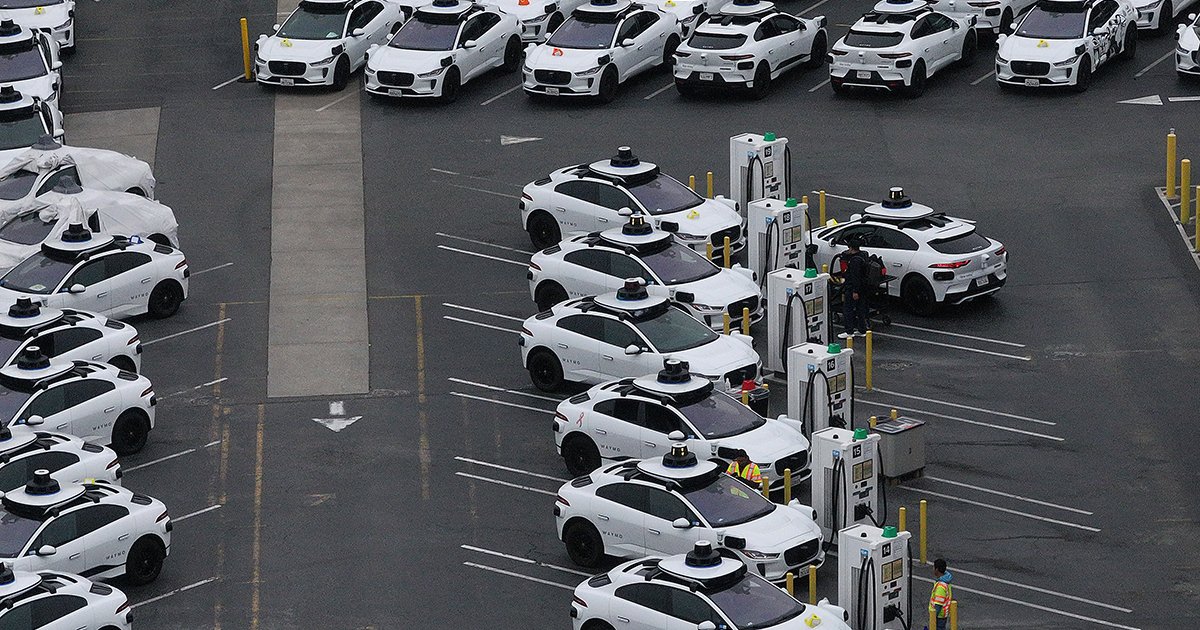
Autonomous cars at the Waymo facility in San Francisco. (Justin Sullivan/Getty Images)
key takeaways:
- NHTSA is developing new safety requirements for autonomous vehicles, including performance testing and standards that define how autonomous cars should behave on the roads.
- The effort follows incidents involving robotaxis in construction zones, near school buses and around emergency responders, which raised challenges for autonomous systems.
- NHTSA plans to remove human-driver-centric requirements like brake pedals and possibly mirrors, as well as seek public and industry input.
The Trump administration is working to develop new safety requirements that govern how autonomous vehicles behave on the road to address the crashes that have blighted the early track record of self-driving cars.
Jonathan Morrison, the top official at the National Highway Traffic Safety Administration, said in an interview that officials aim to finalize the new requirements before the end of President Donald Trump’s current term. NHTSA plans to initially solicit comment from public and industry stakeholders with the goal of identifying “behavioral competencies” for autonomous vehicles along with tests to measure performance.
Read more: Robotaxi passengers are sleeping, causing 911 calls
The goal, Morrison said, is to create objective safety standards “so that the manufacturer producing the vehicle can know with certainty whether the vehicle meets the requirements.”
The effort comes after a series of recent incidents that highlighted how self-driving cars may struggle to handle situations that human drivers typically encounter. Alphabet Inc’s Waymo – the leading operator of paid robotaxi rides in the US – recently recalled thousands of vehicles and suspended freeway operations after its cars were found speeding through construction zones. The company has also faced scrutiny after its vehicles repeatedly failed to slow down or stop for school buses.
Last week, Morrison called on self-driving vehicle companies to fix problems that caused their cars to interfere with first responders. He said NHTSA plans to meet with developers on the issue in the coming weeks.
ADS Developer Letter July 2026
“When someone is arriving at an emergency scene, they’re not bringing extra people to drive the vehicle,” Morrison said. “We want to set up a little bit of a sign that ‘No, this is not acceptable,’ and that’s where we’re going to have the discussion.”
The effort to address the crashes is part of a broader effort by the agency to help self-driving cars reach the road in greater numbers by removing safety requirements written with human drivers in mind. Last month, the agency proposed removing the requirement for manual brake pedals in driverless vehicles, a move that would help Tesla Inc. introduce its CyberCab robotaxi, which the Elon Musk-led company has said it aims to deploy without traditional human control.
“When it comes to vehicles that are never operated by a human, what we want to do with this rule is establish the same performance requirements but get rid of the design-restricting elements,” Morrison said.
🚨 @NHTSAgov Issuing a call to action
Driverless cars will improve our lives but they must be safe and not get in the way of emergency vehicles 🚑🚒🚓
⬇️ @BottomlineFBN @bryanbrenberg @daganmcdowell pic.twitter.com/96rVQpFxhQ
– US Department of Transportation (@USDOT) 15 July 2026
NHTSA is considering removing or modifying other requirements for conventional cars, which Morrison says autonomous vehicles don’t need, like mirrors.
He said, “Is it appropriate to have mirrors in a vehicle that will never be operated by a human? No. It’s very common sense.”
Morrison also said that while steering wheels are not required under federal auto safety standards, the rules include “some indirect references to steering wheels” that may require adjustments for autonomous vehicles.