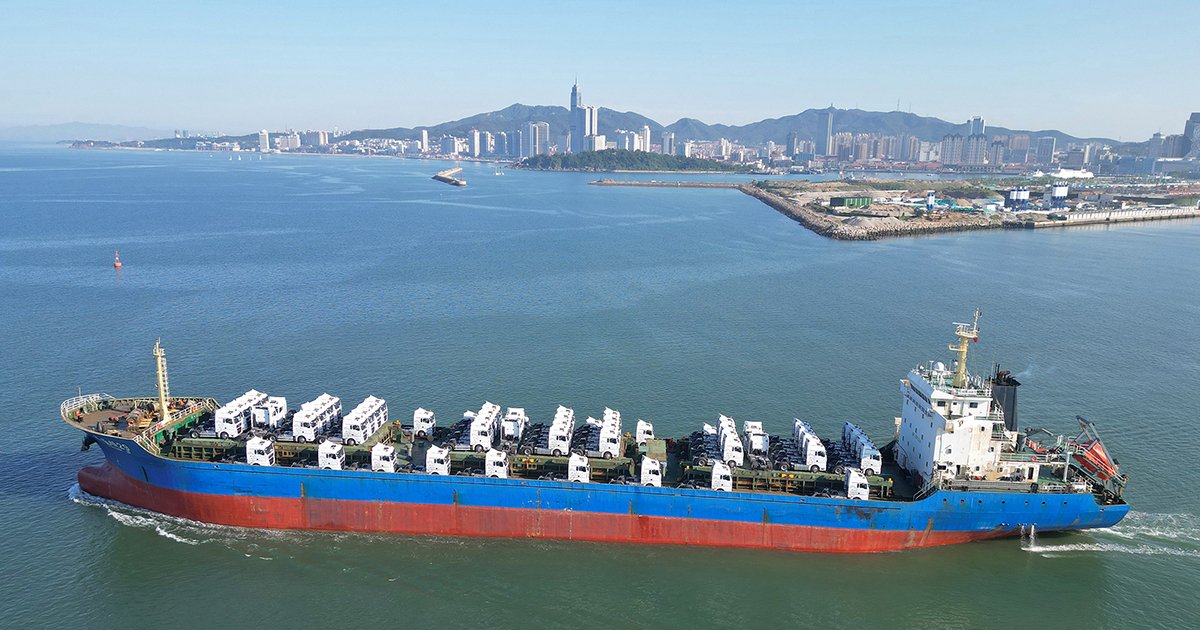
A cargo ship loaded with Chinese-made trucks leaves Yantai port in China’s Shandong province. (CPhoto/Future Publishing/Getty Images/Bloomberg)
key takeaways:
- Mexico’s increase in Chinese heavy-truck imports has become a sticking point in US-Mexico trade talks as both countries review the USMCA.
- Mexican imports of Chinese trucks have increased more than sevenfold in six years, while manufacturers want tariffs of up to 50% on heavy vehicles from non-FTA countries.
- The issue is expected to figure in the July 21 talks as Mexico seeks relief from U.S. truck tariffs and Washington raises concerns about China’s role in North American supply chains.
Mexico’s growing fleet of Chinese-made heavy trucks is becoming a new obstacle in its quest for relief from US tariffs, as Washington presses for assurances that its southern neighbor is not becoming a backdoor for Chinese manufacturers to enter North America.
The value of Mexican imports of Chinese trucks has increased more than sevenfold in a six-year period, according to two people with knowledge of the matter, raising concerns among local manufacturers and US officials. The number of Chinese trucking companies operating in Mexico also dropped to about 23, sparking fresh tensions as Mexican negotiators seek relief from U.S. barriers that have put pressure on one of the country’s most integrated export industries.
The dispute is at the center of a review of the US-Mexico-Canada agreement over whether Mexico can convince Washington that it is aligned with the US against China while protecting its own manufacturers from cheap imports and maintaining access to its biggest market.
Mexican truck makers are seeking a two-pronged solution: higher domestic tariffs on Chinese vehicles and a U.S. approach that treats Mexican-made trucks as part of the North American industrial base, not as a threat to it.
The issue is expected to come up in the third round of bilateral talks between Mexico and the US starting July 21 in Mexico City. The US has said the trade agreement will not be renewed in its current form, although it will remain in force while the three countries continue to negotiate on disputes including automobiles, steel, supply chains and China’s role in North America.
Mexico’s Economy Ministry, in charge of USMCA negotiations, declined to comment.
U.S. negotiators are concerned that Chinese vehicles and parts are entering Mexico and could ultimately benefit North American supply chains, according to the people familiar with the matter, who spoke on condition of anonymity discussing private talks. Those concerns are complicating Mexico’s effort to get relief from U.S. tariffs on medium- and heavy-duty trucks and parts.
Issues will be discussed during the talks, in which America will also be involved. Trade Representative Jamieson Greer will include “steel and aluminum and derivative products, automobiles, economic security, labor, agriculture and electronic payment services,” Greer’s office said in a statement July 17.
According to USTR’s 2026 Auto Report, Washington imposed a 25% tariff on medium- and heavy-duty trucks and parts in November 2025, although the levy on USMCA-eligible vehicles could only apply to the value of non-U.S. content.
Mexico’s heavy vehicle industry is under pressure. Official data showed output in the first half of 2026 fell 13% year on year, while overseas shipments fell 14.5%. The US absorbed 92.3% of those sales, highlighting the sector’s vulnerability to changes in US trade policy.

Alex Fraser from Cox Fleet discusses how fleets should respond when a roadside breakdown occurs, testing their safety, compliance and customer service systems simultaneously. Tune in by going above or RoadSigns.ttnews.com.
Domestically, manufacturers say Chinese rivals are undercutting their prices with low-cost vehicles, while reports remain opaque.
Mexican bus and truck makers are demanding tariffs of up to 50% on heavy vehicles from countries that do not have a free trade agreement with Mexico, primarily China. The current tariff for heavy trucks ranges from 5% to 20%.
Manufacturers have argued that some Chinese units enter Mexico at declared customs prices well below market prices, distorting competition and making locally produced trucks less attractive.
Chinese manufacturers and brands with documented heavy-truck or bus activity in Mexico include Yutong Bus Company, BYD Company, and FAW.