“Not many people these days appreciate that as recently as the first half of the last century, what they called literature was a very different thing to what we have now. There are almost no similarities. Apart from questions of legality, health and safety, etc., there would be no point in revisiting the vast majority of those first-era texts – believe me, we have gone through them with a fine-toothed comb and the functionality is just not there.”
Their guide, who introduced himself as Murphy, continued speaking without looking back as they walked.
“Obviously, we don’t have that much source material left, but from what we do have, it’s clear that neither the risks nor the potential benefits were understood. We know that literature was readily available in a variety of media. Mass produced, widely consumed. However, consumption seems to have been left entirely to the vagaries of entertainment markets.”
he shook his head.
“To them, it’s very much a thing of art. Of the many comments left by the disaster, none made any reference to specific applications. Remember that Spirituality® remained at that time public sector. And there appears to have been a connection; We know that consumers habitually seek some kind of emotional lift from literature. Solace®, if you like. It is no longer easy for us to imagine that Solace® would be difficult to access elsewhere. But there you go. Markets evolve. At that time, as I said, it was one of the oldest arts.”
He stopped and turned and the small group of reporters formed a semicircle around him.
“This is why, at the beginning of the Second Enlightenment, we see signs of disillusionment. I’m not saying anyone had a eureka moment – almost certainly not – but there were embryonic attempts to incorporate literature and the arts in general into a broader human project. To put them to use. It may seem surprising to us now that once established, the early strategies from product placement to search optimization, influencer content, etc. did not sooner give way. Any questions?”
No question. He wore.
“Indeed, the mood at the time was anything but optimistic. It seemed as if they believed they were actually ending—ending a dysfunctional and ultimately futile human endeavor. There was an increased focus on game playing, social networking, and other reality-driven behaviors.
“Pfft. They hadn’t even started yet. The Pinpoint® Role Assignment changed everything. It is now universally recognized as the most important factor in the development of modern literature. There could not have been a Second Enlightenment without it. We would still be thumbing through books like our ancestors, looking for some inherent value in them rather than identifying the countless opportunities they offer – a completely untapped resource, right under our noses. What we have is pretty Little will be possible to accomplish economically, socially and politically or scientifically – remember that Pinpoint® can only be fully understood in the context of the discovery of the Cog® power.
There was a large touch screen on the wall behind Murphy. He swiped through it until Day Diary came up and blocked access to his tour. 4 a.m.: Billy didn’t think many reporters would wake up so early on a Tuesday morning before. It felt a lot like Monday night.
“Obviously, it’s a work in progress,” Murphy said. “You try this, you try that. Essentially, there’s an ad-free element in the early stages of any new field. We’ve been pretty transparent about that. But trust me: Every single false start has provided valuable information. Know-how. That’s what’s so exciting about tomorrow.”
Someone stifled a yawn.
“We are no strangers to controversy,” Murphy chimed in. “Of course, there will always be resistance to change. Pockets of extremism. The recent emergence of Gilgamesh is very worrying, and you all know the problems caused by burning books – people don’t like them.
“The digital purge continues.” He shrugged his shoulders. “We’ll get there. We deeply regret every fatality, we really do, but we had an obligation to step things up in preparation for launch. We have a responsibility to our users. Those are some pretty fancy shoes to wear, sir.” Murphy’s eyes were fixed on Billy’s feet. “We’re probably going to mess them up for you today.”
He continued walking. They lined up behind him.
“It’s too early to guarantee that we’ve found the definitive application. But early signs are very, very encouraging. You’ll have to forgive us for being a little pleased with ourselves at Gripping Tales®. No previous incarnation of Applied Lit® has been offered on this scale. Maybe we have a few slips. Tony, do we have any of those plastic slips for this guy’s shoes?”
They were at the end of a long, brightly lit corridor. Murphy stood outside a pair of metal double doors, low but wide. He seemed like someone who had a lot more to say. A tall man wearing a white coat pressed a pair of plastic shoe covers into Billy’s hand.
“It’s amazing,” Murphy said, “if you stop to think about it. Anyway, it is to me. Before Pinpoint® there was no way anyone could see it this way. The thing we had all learned to think of as a historical illusion – a heresy, even – could be revived in such a way that it would play such a useful role in our lives. However, with foresight, from the moment the cog® drives was introduced, it was just a matter of timing. Who knows what other old arts we might revive – under carefully controlled circumstances, of course – and put into use?
He spread his legs and folded his hands.
“We have been struggling with this thing for centuries, but finally, friends, literature finds itself perfectly adapted in the form of Gripping Tales®, now the fourth largest auto-sector brand in the country and set to revolutionize road safety legislation domestically and across the world. We also have our eye on the colonies. I know, I know – early days, but we don’t think small here. Mind your brain.”
Murphy opened the door and, one by one, they walked into a huge, low-ceilinged hangar, ducking their heads to pass under a cluster of cable runs. On either side of them, the outer walls may have contained loading docks – floor-to-ceiling openings that catered to the empty night. The space extended so far that it could not be seen clearly due to machinery and personnel taking up floor space. Instrumentation arrays were aligned along each dock and operatives in orange and green overalls stood in swarms, nodding and tapping data on tabs.
Billy was the first to say anything, as he bent to pull the plastic slips over his shoes. They were fancy indeed – a pair of two-tone Hennessy brogues, which had cost him a hundred and forty bucks – but apart from the house slippers, they were the only ones he had left in his old room while he was in Jane’s room. And they weren’t the only problem. Passing for his usual sports jacket was the upper half of the navy blue velvet suit that Ma had purchased for her prom. Underneath was a ruffled oyster-white shirt, originally from the same outfit. It had now been six weeks since Jane had thrown him out, living at Vince’s was no good and coming back to Ma was getting old. Not least because it was lakeside, which meant a ninety-minute drive. He went to Jane several times for his clothes but she never opened the door.
“It’s very peaceful here,” he said. His fully buttoned overcoat and scarf were to be removed only when absolutely necessary. His cap was tilted right back and the visible hair – thin and blonde – was wet on his scalp.
Murphy smiled.
“You think so,” her gaze fell on Billy’s visitor badge, “Mr. Stringer? You usually make a lot of noise while you study?”
__________________________________
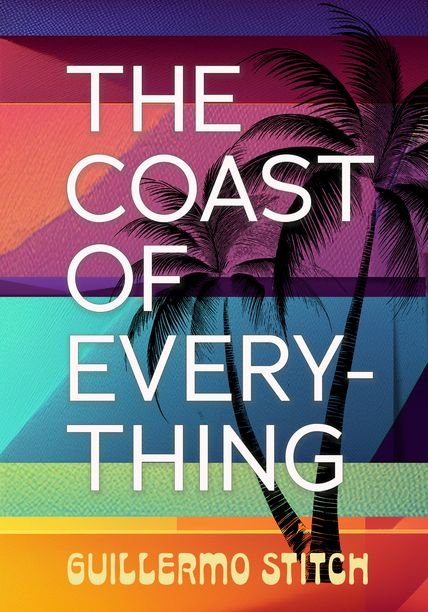
From coast of everything by Guillermo Stich. Used with permission of the publisher, Sagging Meniscus Press. Copyright © 2026.