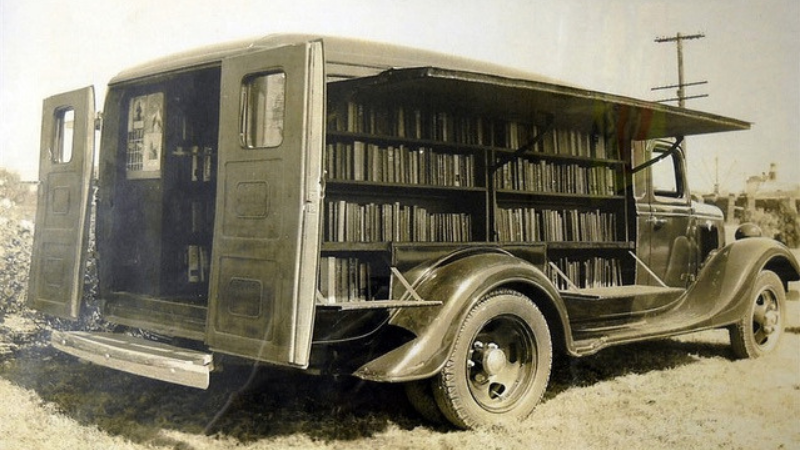
When I was a child, the public library in my small Alabama town, a one-story frame building that had once been a train depot, was off-limits to me. This was the early 1960s, more than a decade before schools were integrated and “public” buildings became accessible to all. As black children, my siblings and I could only use the bookmobile that came during the summer months and parked in front of our community’s elementary school.
Article continues after ad
However, the bookmobile was amazing. Its interior felt cavernous, like the interior of the school bus my uncle drove, except that instead of bench seats, there were bookshelves inside. Every summer for three years, between the ages of three and five, I read the same book. As an adult, I have searched for this book from time to time to satisfy my curiosity over my alleged memories, but only recently did I find what I was looking for.
As the youngest of five children, I spent many years at home while my older siblings went to school. Kindergarten programs didn’t exist at the time, so lucky kids like me learned to read, write, and recite famous speeches like the Gettysburg Address from our older siblings.
My mother had sent us on the bookmobile with orders that we bring home at least two books and be prepared to discuss them with her at the dinner table when they finished reading.
My mother, a high school dropout (she later earned a GED), decreed that we all go to college. Very few people from an all-black high school in our county went to college – even though Alabama, ironically, has the highest number of historically black colleges in the country. According to the 1960 U.S. Census, illiteracy rates in Alabama and four other Southern states were among the highest in the country—and before the Civil Rights Voting Act of 1965, literacy tests were required to register to vote, as part of a systematic effort to suppress voting by descendants of former slaves.
But there will be no illiteracy in our family. Thanks to my mother’s efforts, all my elder siblings could read and write by the time they entered first grade. However, as the only left-handed child, my mother and I could not make the kind of progress she had achieved with my siblings, so the task of teaching me to read was entrusted to my eldest brother. Luckily, he found a way.
My mother had sent us on the bookmobile with orders that we bring home at least two books and be prepared to discuss them with her at the dinner table when they finished reading. She dressed us for the bookmobile, because white people would never judge us for not being clean or well-groomed.
My reading journey began with a story that spanned more than 5,000 miles, from Denmark to Alabama. When my siblings looked for new books, I always saw the same thing: decoction of marsh crow. It was a Danish folktale by Ib Spang Olsen, an award-winning author and illustrator, about a witch and her family who create spring in the swamp. I lived inside this story all summer, with my treasures hidden under the table or bed, transported to an imaginary world that suspended time and space.
In the open meadow of the book, I had been a part of the magic of spring, with the silly little boys who blew butterflies out of their ears and the girls whose hair was growing flowers. I was fascinated by this book for a longer time than any other Christmas toy, including the dolls we buried in the backyard and the teddy bear who lost his ear in an unfortunate accident.
But eventually, as my reading skills improved, I beat out my witch’s story. By 1968, after the implementation of “School Choice,” we were bused to the one black elementary school in the county. By the end of 1971, schools were integrated – instead of a 30-plus minute bus ride to and from two white schools, we went to our town school – and the public library was finally open to us. We immediately recognized that we had read most of the books on the shelves, from blue biographies to cookbooks outlined in red. my sister still has betty crocker cookbookLast checked out in 1967.
Olsen achieved what every writer dreams of: She found her ideal readership. In this case, it was a child waiting to be charmed by a good story.
i forgot about it decoction of marsh crow For years. But then one day, when I was surfing the internet instead of writing, I found an article referencing Cron in a Netflix show Magician. Three witch sisters live in a swamp and one is named “Bruwes”. It all came back quickly. I found a copy of my beloved book on eBay and ordered it before calling my two older sisters, who got less enthusiasm than I expected. He read this book to me several times and he did not like it. He endured repeated re-readings only for fear of parental scolding. To him, Marsha Crone, like his younger sister, was simply annoying.
This was not the same version of the book I had loved as a child – it lacked the original cover, it was much larger than I remembered, and there were no color illustrations. But I kept searching.
I ordered a second copy, this one bearing the Peoria Public Library stamp. When I saw the size my heart skipped a beat. It was even smaller than the Little Golden Book: a four-year-old child could manage it perfectly. It was less than pristine size, but the cover illustration was perfect, throwing me back into my happy childhood memories of a simpler world without television, telephone or Internet.
On the final page of the book, Crone sniffs the air under a starry sky and decides it is time to start brewing again. But my favorite page was the one describing the ingredients of her wine, and whose verses echoed like an old song I once knew:
“As the marsh crone cooks, many good things go into the cauldron. She uses moonlight, sunset glow, dandelions and cock’s crow; willow spears, evening dew, foxes’ ears and leeches spew…”
Ib Spang Olsen created magic in the country of Denmark – a country we didn’t know existed. Magic made its way to the bookmobile and it was just the right size for a preschool child. Olsen achieved what every writer dreams of: She found her ideal readership. In this case, it was a child waiting to be charmed by a good story.
I was attached to this book as if it were my own, and that was the best part of it. My desire to be taken on a journey again and again meant that the printed word never failed to fill me with a sense of wonder. Reading this story and other fairy tales made me believe that I could write. My first micro-fiction of one line, I hate green beans, Made on a writing tablet with blue guidelines, using a thick preschool pencil, and was a complete failure. My mother laughed and gave me an extra portion which my elder brother ate when he turned his back.
But since then I have never stopped writing. I believe I am destined to write a book that will have the ability to cross oceans, leap under starry skies, and ignite another person’s imagination.
The reality of the world will be revealed within the next five years. Integration closed community schools; Girls like us died in the Birmingham church bombing; The march on Selma crossed a bridge to the future; My father joined a union; TVs became standard features of the living room; The bookmobile went away one summer and never came back. But my desire to experience and create a great story has never ended, and never will.
__________________________________


A Cakewalk to Memphis Written by Brenda C. Wilson, available from Redhawk Press.