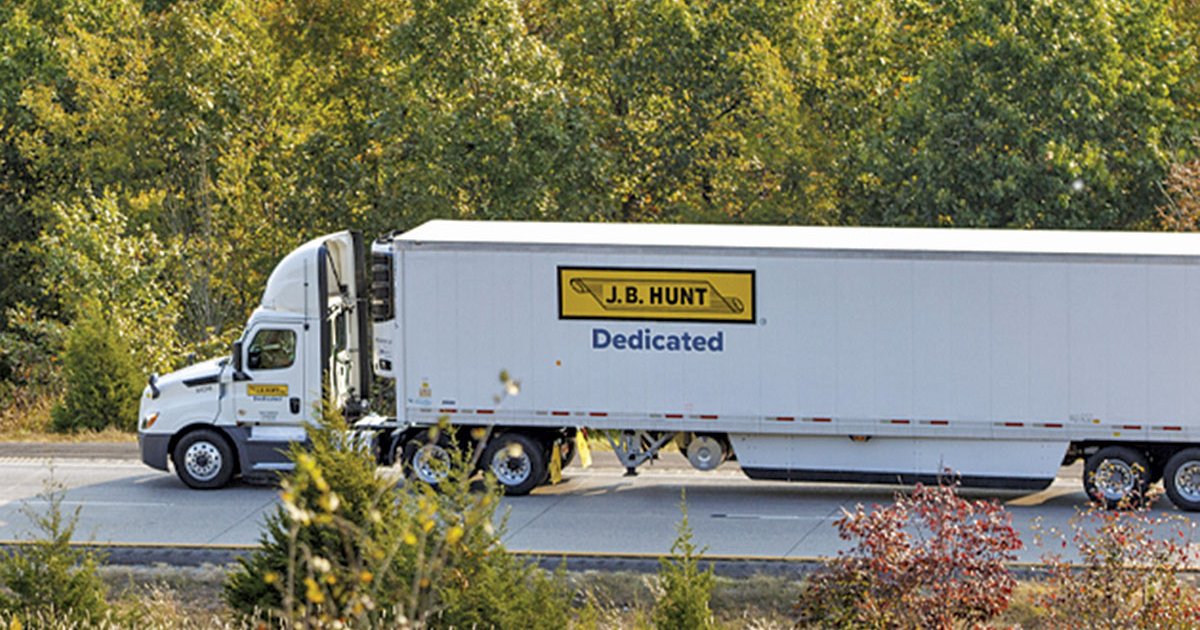
JB Hunt wants to replace the private fleet with a dedicated carrier, an objective aided by the Montgomery ruling. (JB Hunt Transport Services)
key takeaways:
- A Supreme Court decision allows lawsuits against brokers over carrier selection, potentially increasing liability risks and tightening freight capacity.
- J.B. Hunt executives say strong carrier-vetting practices and safety performance will allow the company to benefit from changing market dynamics.
- Dedicated contract transportation is gaining momentum as shippers seek stability, with JB Hunt targeting significant fleet growth this year.
According to a senior executive at J.B. Hunt Transport Services, dedicated carriers can expect a boost from the Supreme Court’s decision in Montgomery v. Carib Transport II in May.
The decision comes as J.B. Hunt was already expanding its dedicated operations, executives and colleagues told attendees at the Wells Fargo Industrials & Materials Conference.
J.B. Hunt is ranked No. 3 on Transportation Topics’ Top 100 list of the largest freight carriers in North America, No. 2 among truckload/dedicated players and No. 1 in the intermodal/drayage segment of the freight market.
Spencer Frazier, executive vice president of sales and marketing, said at the June 9 conference call that the Montgomery decision, as well as regulatory initiatives expected to cut carrier capacity, is poised to boost J.B. Hunt’s dedicated operations.
Frazier said the decision will encourage shippers to ensure they have the safest people possible while managing and mitigating risk, as well as creating value.
In the Montgomery decision, the Supreme Court decided that a truck driver who was seriously injured when his parked tractor was struck by another tractor could file a lawsuit against the brokerage that executed the load.
Driver Shawn Montgomery sued Caribe Transport II as well as CH Robinson, arguing that the brokerage should share liability because it hired the carrier despite knowing about several accidents involving the driver and the Pennsylvania-based hauler.
Two members of the high court said in a concurring statement that the decision could increase insurance costs for freight brokers, while market observers last month said it would exacerbate an ongoing capacity crunch by keeping high-risk drivers and carriers out of the market for fear of liability.
J.B. Hunt has no need to worry, executives said at the Wells Fargo conference. The company is ranked No. 4 on the TT Top 100 list of largest logistics companies and No. 3 among freight brokers.
The senior vice president of intermodal operations said, “We consider ourselves above the industry from a carrier-tested standpoint. We don’t use conditional carriers and we don’t tender loads to them, and a carrier has to be in service for at least a year before they tender loads there.” bill dietrich.
Dedicated contract carriage is intended to provide greater stability to shippers, especially compared to the spot truckload market.
Lowell, Ark.-based J.B. Hunt’s dedicated operations were already growing.
“Our dedicated business has probably had one of the most impressive performances at double-digit returns. I believe it’s been over 10 years, and the portfolio continues to go from strength to strength,” Frazier said. “Our pipeline is significant. We’ve got a goal of growing 800 to 1,000 trucks again this year. That pipeline is growing.”
JB Hunt wants to replace the private fleet with a dedicated carrier, and Montgomery’s decision will help the carrier’s cause there as well.
Managing risk and brand is part of the proposition to potential clients, Frazier said, adding that J.B. Hunt’s security is currently as good as it has ever been.
“And this is something that really is a private fleet, if you don’t have the talent and the technology, it’s very hard for them to meet the safety challenges and then invest in the equipment,” he told conference attendees.
In another boost for the company, a rival truckload carrier told attendees that rate strength is becoming more clearly visible in dedicated contract renewals.
Chris Wikoff, chief financial officer of Werner Enterprises, said, “In a way, we may not have the slope and momentum that we’re seeing in (dedicated), whether it’s in one-way spot or one-way contract, but the momentum is there. We’re seeing those increases; it’s going to be gradual.”
J.B. Hunt & Werner isn’t the only top 20 for-hire carrier eyeing dedicated truckload growth, with Schneider executives telling conference attendees its excitement for the acquisition was growing. Schneider ranks 10th among TT100 available for rental and 7th among truckload/dedicated carriers.
Werner in January acquired privately held dedicated carrier FirstFleet and related real estate for a combined $282.8 million. The carrier said at the time that the deal would position the combined company as the fifth-largest dedicated carrier in the country in terms of power units and increase its dedicated revenue by approximately 50%.
Omaha, Neb. Based Werner was ranked 18th in for-hire TT100 as well as 8th among truckload/dedicated carriers prior to the January deal. FirstFleet ranks 67th in available TT100 for hire and 16th in the truckload/dedicated segment of the market.