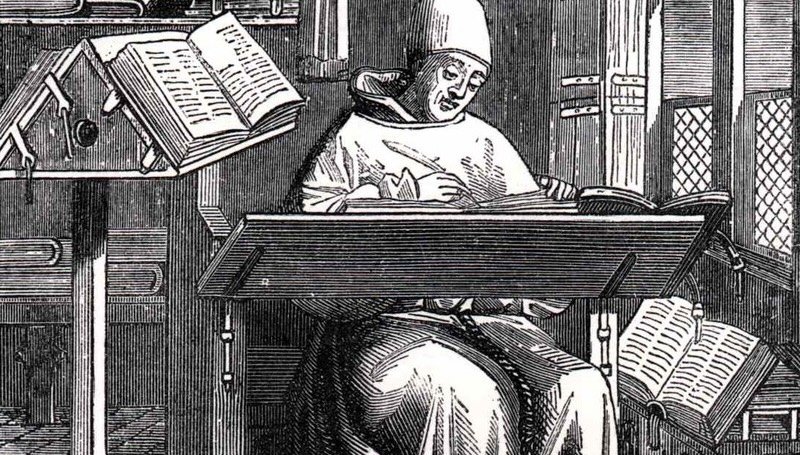
Since monastic life depended on books, it was natural that monks and nuns came to produce them. Many monasteries included a scriptorium, a dedicated writing room where books were carefully copied by hand. In Northern Europe, the scriptorium was often located next to Calfactorium (warming room), where a fire was kept burning, allowing scribes to go inside and warm themselves if necessary. Most of these books were for the monastery’s own use, although some monasteries produced codices for sale.
Article continues after ad
Today, we are grateful that these monks preserved the cultural heritage of antiquity, but preservation was only a byproduct, not the primary motivation of their work. Nor were they engaged in “art for art’s sake”. In the monastery, every activity was oriented toward a single purpose: communion with God. This affected all aspects of monastic life – prayers of course, but also food, work, sleep and conversation. Books and education were no exception.
Monks and nuns copied texts to prepare Bibles and prayer books for worship, but also because writing was seen as a spiritual practice. Abbot Rabanus Maurus wrote in the ninth century: “The fingers rejoice in writing, the eyes in seeing, and the mind in probing the meaning of the mysterious words of God.” Cassiodorus, a monk and scholar, compared clerical labor to a spiritual battle against the devil and praised those engaged in this noble work: “A pleasant purpose, a laudable zeal, preaching to the people by the hand, freeing the tongue with your fingers and quietly liberating mankind and fighting with pen and ink against the lawless snares of the devil.”
Today, we are grateful that these monks preserved the cultural heritage of antiquity, but preservation was only a byproduct, not the primary motivation of their work.
Here, Cassiodorus emphasizes two points worth highlighting: first, that writing is hard labor, and, second, that reading is salvific, rendering the writer’s labor a blessed act. Starting with the exertion, we can see that writing was physically demanding; Another monk lamented, “One cannot know how much effort is required. Three fingers write, two eyes see. One tongue speaks, the whole body toils.” The scribe carefully inscribed each line with a pen made of swan’s feather, while in his other hand he held an erasing knife which was used to sharpen the pen and remove any mistakes. At the same time, the scribe had to press the unrolled parchment onto the desk. Overall, it was a laborious process. Productivity varies depending on the writer’s skill, attention to detail, page size, and writing style. A professional scribe might complete about three to four pages per day – yet few monastics wrote full-time, as they had to balance other duties in the monastery.
Before even a single word could be written, many preparations were necessary. First, the animals whose skins would become parchment—usually sheep or calves—had to be slaughtered; A complete Bible requires the skins of about five hundred sheep. These hides were then processed, cut, sorted and lined. Furthermore, Shastri was not satisfied with merely writing; Ideally, the text should be presented in beautiful calligraphy and decorated with symbols or images drawn by monks skilled in this art. While the earliest complete Bible, the Codex Sinaiticus, lacks illustrations, by the fifth century illustrations began to accompany biblical texts, increasing their visual and spiritual impact.
The most famous depiction of life in the Scriptorium is probably Umberto Eco’s Name of rose. In both the novel and its film adaptation, the scriptorium is portrayed as an important space where writing is a mechanical, joyless labour. Laughter and jokes are banned, and the writing is presented as difficult and slightly depressing. Historical evidence supports this portrayal to some extent, with weary monks leaving sarcastic marginal comments. “Just as the sick yearn for health, so writers yearn for the end of the volume,” reads one such marginalia. Another implores, “St. Patrick of Armagh, save me from writing.” However, given his well-known passion for books, it seems ironic to seek relief from Patrick.
But there were other experiences too. In contrast to these serious accounts, an anonymous ninth-century Irish monk’s scriptorium offers a more light-hearted view of life. In a playful poem preserved within a manuscript where he practiced various writing exercises – including imitating Virgil – this monk celebrates the joy of his work. His poetry is a delightful blend of humor and wit, reflecting the spirit of his daily routine. Here is the full poem, a fascinating glimpse of the mix of effort and joy found in his call:
Me and Pangur Ban, my cat
‘This is a task we are on:
hunting rats is his joy
I sit up all night hunting for words.better than men’s praise
‘This is sitting with a book and a pen;
Pangur bears no ill will towards me
He, too, uses his simple skills.‘It’s a pleasant thing to see
How happy we are with our actions,
When we sit at home and find
Entertainment of our mind.Sometimes the rat goes astray
In the manner of the hero Pangur;
Sometimes my deepest thoughts set
Takes on a meaning in its web.‘He has his eyes fixed on the wall
Full and fierce and sharp and cunning;
‘Break the wall of knowledge’
I try all my little wisdom.When a mouse comes out of its den
Hey! Then how happy is Pangur?
Hey! What happiness can I prove?
I feel good when I solve doubts!So in peace we do our work,
Pangur Ban, my cat and me;
We find our joy in our arts
I have mine, and he has his.practiced every day
Pangur is skilled in his trade;
I keep gaining knowledge day and night,
Transforming darkness into light.
The poem depicts writing as a joyful quest for enlightenment, for the transformation of darkness into light. Here, we find none of the frustrations that characterize Echo’s scriptoria. Instead, we meet a monk who enjoys his work, delighting in the knowledge gained through it. Closer to God through the pen. As Cassiodorus said, the scribe’s work was difficult but also liberating.
This ideal is exemplified by some manuscripts where the text is so small that it is barely legible. These books indicate that the act of writing has intrinsic value, even if it does not result in a readable book. By copying the texts, the monk incorporated the words, absorbing them similar to the process described by the Greek orator Quintilian, who emphasized internalizing classical texts as the foundation of oratory and writing. As discussed in the previous chapter, the assimilation of classical texts was a cornerstone of Greek education, where literates were expected to carry these texts with them as a resource for life as well as work.
As we have seen, the Church adopted this pedagogy, and it survived in medieval monasteries, especially in relation to Scripture. The message of the Bible was seen as not only informative but also salvific, and the monk who memorized its words filled his soul with divine wisdom. Therefore, writing was more than book production; It was a spiritual discipline. Monks and nuns wrote not only to produce books for others to read, but because it was believed that the act of writing brought them closer to God. As soon as the scribes’ pens scratched the parchment, the words were imprinted on his soul. The purpose of the lessons was to shape the heart and liberate the body so that, in a sense, they were writing themselves into heaven.
____________________________
From Reading Matters: A History for the Digital Age By Joel Halldorf. Copyright © 2026. Available from NYU Press.