Anwesh Koley, Executive Editor, ELE Times
The automotive industry is moving rapidly toward electrification, digitalisation and intelligent mobility. Connected vehicles and EVs are disrupting India’s automotive industry with smart mobility solutions. It is inevitable: The next phase of growth for mobility in India is (and will continue to be) fuelled by the connected vehicles, autonomous driving, electric and shared mobility. From electric vehicles and artificial intelligence to Industry 4.0, automotive industry stakeholders are playing a crucial role in augmenting technology for the next phase of mobility transformation.




With India emerging as the fifth largest global car market, it possesses the potential to ascend to a position among the top three in the coming years. The Indian Government has been pushing towards the introduction of EVs through policies including Automotive PLI, FAME 2, and ACC Batteries scheme in creation of the local EV manufacturing ecosystem. There is a need to focus on technologies that are disrupting the future of mobility and drive the smart vehicle ecosystem In India.
Even though lithium-ion batteries have led to a revolution in the electric vehicle segment, the future is expected to be even more revolutionary. It is so because more efficient solid-state batteries would be available on a large scale. The future electric cars would be driven driverless. They would run in a grid of driverless cars. They would be controlled with real time access to data pertaining to traffic, lane, GPS, and other parameters. Such parameters would be available on a real-time basis.
The Future Lies in the Software
With technology advancements in autonomous driving, AI is driving connectivity and shaping a future where mobility is more interconnected. Sanjay Gupta, semiconductor technology expert and Founder, INDRIS, says, “The critical significance of AI and communication technologies e.g. 5G in revolutionising AI-Cabin and connected vehicles cannot be overemphasised.”


Most automotive industry decision-makers agree that investments in digital technology allow for the effective attainment of business objectives but recognise that remaining competitive requires a commitment to constant innovation. “As we embrace cutting-edge technologies, we’re not just driving innovation; we’re shaping a future where vehicles become intelligent companions, seamlessly integrated into our lives, enhancing safety, comfort, and efficiency like never before,” avers Gupta.
Automotive technology suppliers are leveraging their decades of expertise across multiple technology categories to provide high-performance computing for effective multitasking. Indian e-mobility partners are widely collaborating with the world’s top automotive brands to create a more intuitive, immersive, safe, and comfortable driving experience. The convergence of AI and 5G in connected vehicles is the key to unlocking a future where mobility is seamless, connected, intelligent, and tailored to every individual’s needs. It’s also a paradigm shift where every vehicle becomes a node in a vast network of real-time communications.


According to Ramachandran S, Practice Leader at HFS Research, “Micromobility is the future of electrification of transportation, specifically in cities, for last mile deliveries and short trips. However, micromobility needs better infrastructure and governance mechanisms for its sustainable and safe growth.”
Next-Generation Mobility Advances Transformation in the Automotive Sector
Technology innovations are powering transformative changes in the automotive ecosystem. Automakers and businesses across the automotive value chain must out-innovate to gain a competitive edge amid transportation mobility changes and business model shifts. This transformation is driven by three major factors: technological advancements, increased connectivity and ever-shifting customer demand.
From Hardware-Driven to Service-Centric Business
The industry’s future looks much different than today: the near future will reflect a combination of electric, hybrid, and autonomous or self-driving vehicles. As a result, the industry is transitioning from a hardware business to a service-driven and software-based one. The digital automotive value chain will continue gaining importance and shaping customer service delivery expectations.
Better Connectivity Powers Enhanced Capabilities
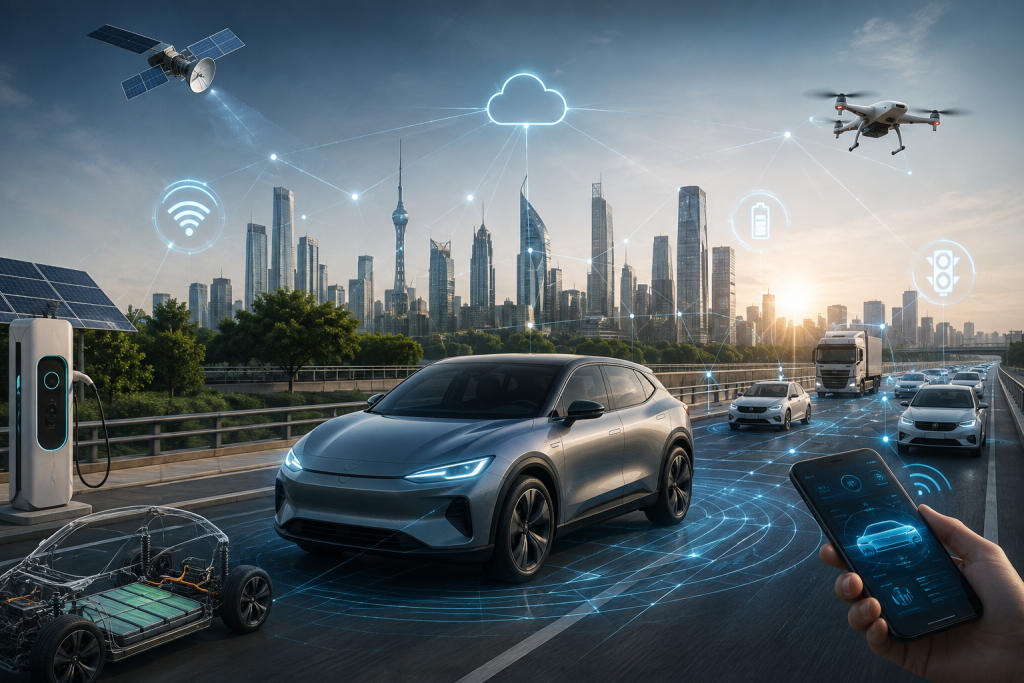
Next-generation connectivity refers to types of connected systems within vehicles, including internal systems like GPS and entertainment, as well as sensors for measuring tire pressure, weather and road conditions. Other transportation mobility solutions, such as autonomous vehicles or rideshares, increased, driven partly by improved infrastructure, including wireless networks. Today’s vehicles can have over 100 microprocessors, which will continue to grow as autonomous and self-driving vehicles become more prevalent in the market.
The Constant Pressure to Innovate
Advancements in technology and connectivity are forcing organisations across the automotive supply chain to rethink the end-to-end customer experience, changing the design and production of vehicles and how they are marketed and sold to consumers or fleet managers. For example, automotive enterprises must meet new and rising consumer and fleet manager demands for higher levels of safety and personalisation while also exploring new digital possibilities for the retail experience. Moreover, the environmental impact of fossil fuels and highly variable fuel costs combine to drive billions of dollars of investment into the increasing demand for EVs and hybrid vehicles.
Nurturing a Holistic Technology Ecosystem

Aditya Ganjapure, Co-Founder & COO, Green Tiger Mobility, says, “Need of proper commute arises in a growing population and economy like us. Connected and smart mobility plays a vital role in technological growth, easy transportation and things like getting critical data of rider behaviour, vehicle health, SOS and vehicle prognostic. BMS with an integrated telematics system is the only way for moving towards it.”
As automakers move from distributed, domain-based ECU architectures toward zonal and cross domain E/E systems, legacy designs are increasingly limiting their ability to deliver software defined functionality at scale. Ensuring deterministic timing across distributed compute and networking has become a critical challenge, directly affecting system performance, integration complexity, and time-to-market.
5G & AI is revolutionising the automotive industry in India. Electric Mobility is a top priority of the Indian government with a target of 30% electric vehicles by 2030. “Vehicle connectivity and the associated digital technologies will play a key role for effective and safe deployment of micromobility in our cities,” avers Ramachandran. “Electric mobility, intelligent vehicle systems and digital connectivity are reshaping not only vehicles but also the skills required to design, manufacture and maintain them,” opines Vinkesh Gulati, Chairman, ASDC.

With positive policy support, industry alacrity and growth-driven innovations, designing quality platforms to empower industry leaders in terms of interacting, connecting and exchanging ideas, is leading to a positive change. It therefore becomes critical to build a forward-looking skill ecosystem that aligns with these evolving industry needs. “ASDC is working actively to build a forward-looking skill ecosystem that aligns with these evolving industry needs,” says Gulati. The council has developed several specialised job roles focused on electric mobility and related technologies, covering the entire EV value chain.
The Roadmap for Mobility Technology
Emerging technologies such as ADAS, AI, cybersecurity for software-defined vehicles, electric vehicles, in-vehicle connectivity, and connected vehicles are at the forefront of the automotive industry. The ‘softwarization’ of the automobile or the Software Defined Vehicles (SDVs), has garnered the attention of domestic and global thought leaders of the automotive sector. SDVs require a fundamentally different approach to vehicle architecture that delivers deterministic timing across both compute and network at scale.
Even as you read this, industry leaders are engaging in conversations around emerging innovations in passenger cars connected mobility technologies along with software integration in connected vehicles and EVs that are disrupting the automotive industry.

The automotive industry is undergoing rapid transformation with the rise of electric mobility, autonomous technologies and connected vehicles. Anuj Sidharth,Deputy Director, Marketing & Corporate Communications, MediaTek India, says, “At MediaTek, we drive innovation in smart vehicle technology through our MediaTek Dimensity Auto platform solutions, designed to provide a wide range of flagship-grade technologies needed for the future of intelligent and always-connected vehicles that will revolutionise user experiences.”
Demand for innovative technology features, such as connectivity, high-performance computing, driver assistance/autonomous-driving and safety, along with latest trends, such as electric vehicles and increased efficiency norms, are placing an ever-increasing emphasis on the role that software plays in a vehicle. We have seen renewed focus on emerging two-wheeler tech trends, hardware-software integration, emerging roadmap in EV charging technology and SDV and autonomous driving megatrends that are sure to define the next decade.
Little wonder then, that the above-mentioned next-gen technologies coupled with connected mobility, digital cockpit, AI-powered in-cabin experience, hardware-software integration & emerging roadmap in EV charging technology, are the cornerstones for R&D across the globe. Electric powertrain systems, battery technologies, sensor integration, software applications and data-based diagnostics are complementing research initiatives towards a connected future.
Charting the Indian EV & Connected Vehicle Trajectory
India is one of the world’s leading automotive growth hubs and as such a key focus market for us. New-age technologies in-vehicle such as intelligent automotive systems, Generative AI-powered cabins, driver assistance systems, connectivity, cloud computing are fast-tracking automotive solutions with incredible experiences and advancements in vehicles.
To address these imperatives, semiconductor companies are leveraging their industry-specific expertise in smartphone, connectivity and multimedia technologies. The idea is to strengthen the automotive portfolio and drive key capabilities. These include impressive Generative AI, high-performance computing, extensive feature integration, and innate energy efficiency. Technology suppliers and software solution providers are increasingly collaborating with OEMs to deliver immersive, advanced in-vehicle user experiences with cybersecurity capabilities and enhanced connectivity.

“Development speed is a decisive competitive factor for the automotive industry and has become even more important with software-defined vehicles,” saysThomas Schneid, Vice President Software, Partner & Ecosystem Management at Infineon Technologies. “While hardware-dependent MCU evaluation has been a bottleneck for many engineering teams, cloud-based platforms are making it significantly easier for customers to get hands-on with microcontrollers early in their development cycle. This is particularly helpful when evaluating entirely new MCUs.”
As new disruptive technologies take centre stage, India is leading the future of automotive advancements and disruptions. Technology innovations are driving the future of intelligent, always-connected vehicles. After witnessing dominant growth in the smartphone and smart devices market, the semiconductor fraternity is gearing up to expand its focus on the automotive sector. The emphasis is on leveraging indigenous expertise in technology to deliver a smarter life-on-wheels, drive the wider mobility ecosystem, and deliver never-seen-before experiences and automotive capabilities.
The Road Ahead for e-Mobility and Connected Vehicle Technology
Today’s vehicles are increasingly becoming sophisticated digital systems equipped with advanced electronics and software capabilities. From two-wheelers to passenger cars and commercial vehicles, the integration of electronic components has increased significantly. Electric mobility will continue to expand, supported by improvements in battery technology and charging infrastructure.
At the same time, research into alternative energy solutions such as hydrogen fuel cells and solar-powered mobility is progressing steadily and may influence future mobility solutions. Rapid advancements in computing power, vehicle connectivity and communication technologies such as 5G are enabling new possibilities. Manufacturers can now monitor vehicle performance, track location and anticipate service requirements through remote diagnostic systems and connected vehicle platforms.
Technology is also transforming logistics and transportation. Since road transport forms the backbone of India’s supply chain, digital tools now allow fleet owners, drivers and logistics managers to monitor vehicle movements, optimise routes and respond quickly to operational challenges. As we stand on the cusp of a new era in automotive innovation, the importance of connected vehicle technology cannot be overstated. These technologies are set to revolutionise the driving experience, enhancing safety, connectivity, and convenience for drivers across India.