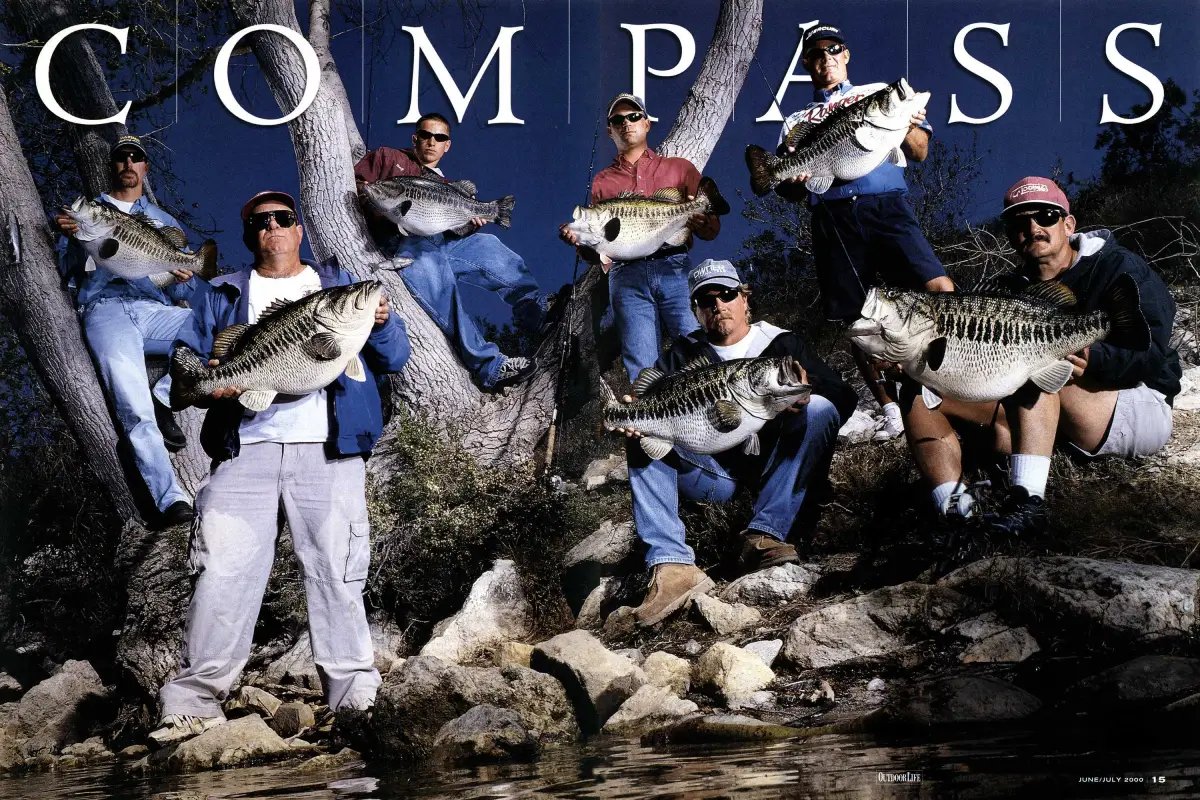
California seems to be a good place for cults. There are the ever-present Moonies and Hare Krishnas, and a lot of cultishness has always surrounded hard-core LA rock bands. Even closed Silicon Valley computer software minds form a cult of sorts. Then there’s the Southern California Big Bass Cult. It all started, largely, with the introduction of Florida-strain largemouth bass into Southern California waters. The first fish were introduced to San Diego County in 1959, and the offspring of these fish were planted in San Diego and Riverside Counties in the 1960s and early 70s. Florida-strain bass became larger than the Northern-strain fish that were already in Southern California lakes, and lake records began falling throughout the region. In 1973, Dave Zimmerly caught the first fish weighing more than 20 pounds in California: a 20-pound, 15-ounce fish from Miramar Lake. By this time, nearly every major reservoir in the area contained Florida-strain fish, and most fishermen thought it was only a matter of time before the world record fell.
Interestingly, another near-record was not taken until March 4, 1991, when Mike Araujo landed a 21-pound, 12-ounce fish on Castaic Lake—eight ounces shy of George Perry’s world record. Just seven days later, Bob Crupi caught his 22-pound, ½-ounce monster in Castaic Lake. It seemed like the Holy Grail of bass fishing was within reach again. Fishermen throughout Southern California and across the state began to focus solely on trophy fish and developing techniques for catching them.
With each big fish, more people converted, even Pilgrims: Porter Hall, a very successful Florida bass guy, joined the cult in 1991, when he moved from Florida to Southern California to chase record bass after reading about big fish in Lake Castaic. He ultimately landed an 18-pound, 5-ounce largemouth at Lake Casitas. Paul Duclos’ unofficial 24-pound fish caught in 1997 furthered the big bass mystery (“The Biggest Bass of All Time?” story was published in the June 1997 issue of Outdoor Life).
Duclos was and is a dedicated catch-and-release fisherman – he even released fish without official weight. Yet that individual fish reinforced the staunch belief that a record fish, or perhaps more than one record fish, exists. Now, in the decade since The Biggest Fish, the cult continues to change as veterans re-examine their faith and new disciples emerge in a self-contained world shaped by ecstatic fishing.
“Bass gave me life,” says Bill Murphy, a 61-year-old California bassing guru. “If you have something like bass fishing, you’ve got to keep your attitude straight.” His 1992 book, In search of giant bassThere is a capstone lesson about trophy-bass techniques. Murphy’s biggest was a 17½-pounder, and he estimates he’s caught about 10 bass over 10 pounds each year for the past 40 years—that’s a two-ton bass, an almost biblical accomplishment.
Bob Crupi is also a fisherman who is certain to be canonized, as he is the only man in the history of fishing to have caught two bass weighing more than 20 pounds: the 22-pounder already mentioned, and a 21-pound, ½-ounce fish caught in March 1990, also in Lake Castaic. Yet Crupi has reservations about bigger fish these days. “There aren’t that many trophy bass anymore,” he says, referring to the giant bass he once caught in numbers.
Yet California devotees continue to fish. Mike Long is one of them.
Longbow fishes over 200 days a year and has caught over 200 bass over 10 pounds. He has caught three bass weighing more than 17 pounds from his home waters, Lake Poway, including a lake-record 17½-pounder. He set records at Lake Sutherland and Lake Mission Viejo this spring and set a Lake Cuyamaca record in June 1999. His best performance is a 17-pound, 15-ounce fish from Lake Murray in March 1999 – he was looking at the huge bass and a pair of small fish hits.
“My goal this year is to make the cover of Western Outdoor News and catch a 20-plus-pounder,” Long says. “I haven’t even done it yet.” It’s a single-minded state akin to that of a champion golfer or a presidential candidate—an act of supreme focus and ego driven by the anticipation of spiritual satisfaction that is unmatched by anything else. And it’s a beautiful thing.
Veteran bass angler Butch Brown agrees. “There’s a lot of satisfaction in catching an old, old bass that’s been there a long time, and maybe getting a chance to catch a 20-plus-pounder — it’s really something special,” says Brown. “That’s why I keep going out.”
And whereas any other cult depends on personalities, rules and empty promises, the California big-bass cult depends on the fishermen themselves and what they do – namely, catch big fish. Troy Folkstad, son of bass pro Mike Folkstad, admits that his father and Bill Murphy were his childhood heroes – an ideal based on achievement. Troy now guides for big bass on waters throughout Southern California. He admits to having an “addictive personality” and says, “More than anything, I would like to catch a world-record largemouth.” Like father, like son.
Read Next: How to Fish with a Glide Bait: The Most Modern Way to Catch a Giant Largemouth Bass
Greg Glogow is a 16-year-old sophomore – he’s on the water almost every day after school, usually at Lake Castaic. His biggest bass is a 13-pound, 10-ounce fish from the lower lake, and he has caught 11 bass weighing more than 10 pounds. He says, “I really want a 23- or 24-pounder. I know I’m going to get it.” When you ask Glogow about other types of romance, he laughs. “Girls take up a lot of my fishing time. Girls are fun, but 10-pounders are more fun,” he says, not entirely joking. This is the nature of a trophy-fish disciple – self-denial paired with an all-or-nothing commitment. But is Bob Crupi right—are the big bass declining? How long can this army of cultists last? “The world record still stands (in these lakes). But the chances of catching it are slim,” says San Diego City Lakes biologist Larry Bottorff. Duclos’s giant fish was released four years ago, so is one of the largest fish still swimming around. It can’t be alone.