Walter P. Chrysler didn’t start making cars right away. He founded the Chrysler Corporation by being in the right place at the right time. He also had money, which he earned from his habit of solving problems and streamlining the assembly line to make cars.
Inspired by Chrysler’s sterling reputation in the railroad industry, Charles W., then president of Buick at General Motors, Nash hired Chrysler in 1911 to streamline Buick’s manufacturing and quality control. Chrysler became so good at it that when company founder William Durant gained control of General Motors in 1916, he promoted Chrysler to president and general manager of Buick. The boss made the right move, as it didn’t take long for Buick’s production to increase from 45 cars a day to more than 200.
However, Chrysler and Durant often feuded over cost-cutting and expense, leading to Chrysler abandoning Buick over trivial matters related to frame construction. In 1919 he sold his GM stock, earned $10 million – $192.5 million in today’s money – and never looked back.
It was during this time that what we know as Chrysler (now part of the Stellantis global umbrella) began to take shape. Less than a year after leaving Buick a very rich man, Chrysler was hired by the creditors of Willis-Overland, a successful automaker and military contractor that had begun losing money after World War I. And soon after, in 1921, the Maxwell Motor Company rushed to help. Chrysler, ever the shrewd strategist, managed to turn both companies around, one of which led to the birth of Chrysler Corp.
The rise and fall of Maxwell
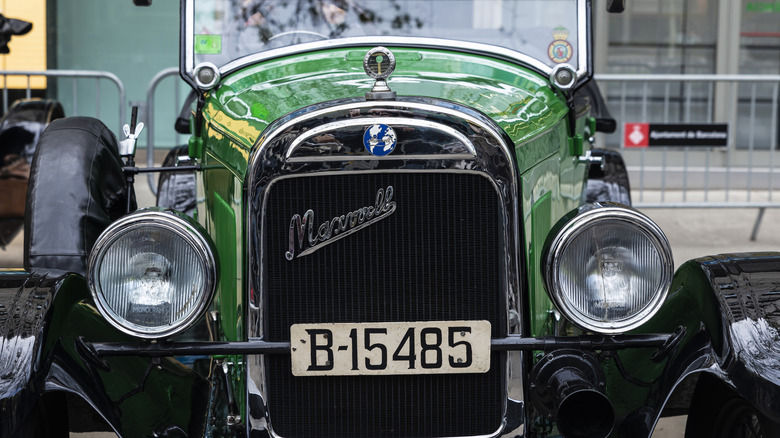
Maxwell may not be as prestigious as old-time American automakers like Cadillac or Duesenberg, but its heyday from the 1900s to the early 1920s was marked by innovation and quality. At one time, it was one of the top three American automakers, behind General Motors and Ford. Maxwell was one of the first to introduce a front-engine layout, three-point suspension and thermosiphon cooling. Its first car, the Maxwell Runabout, debuted in 1904, and was later renamed Maxwell-Briscoe, which also became known as Maxwell Motor Company and Maxwell Motor Corporation during its short lifetime.
Maxwell vehicles were among the best racing cars of the era, and by 1909, Maxwell had sold more than 9,000 cars; It was making 100,000 chassis per year by 1917. But problems began during the post-war depression of the 1920s. Maxwell was left with an overstocked inventory of new cars he couldn’t sell as bills mounted, and ended up with insurmountable debt. Walter P. Chrysler took a controlling stake in Maxwell in 1921 with a plan to revive the ailing carmaker.
From Maxwell to Chrysler
Shortly after acquiring Maxwell, Chrysler hired ex-Studebaker engineers Carl Breyer, Owen Skelton, and Fred Zeider to create an entirely new car that would lead the industry in innovation. Chrysler unveiled the Chrysler Six in 1924, and it debuted with four-wheel hydraulic brakes and a high-compression six-cylinder engine, a first in a passenger car. In addition, the Chrysler Six had aluminum pistons, full pressure lubrication, replaceable oil and air filters, tubular front axle, and standard shock absorbers.
As expected from the sub-$2,000 base price of the revolutionary Chrysler Six, it became a huge hit and Chrysler sold over 32,000 during its first year of production. Inspired by the success of his first car, Walter P. Chrysler reorganized Maxwell into the Chrysler Corp. in 1925, with Chrysler absorbing all of Maxwell’s assets during the transition.
But Maxwell’s cars survived in the form of the 1925 Chrysler 58 four-cylinder model and the Series 50 and 52 produced in 1927 and ’28, which were essentially Maxwells with new names and affordable price tags. The Chrysler Series 52 ultimately formed the basis of the first Plymouth, the Model Q, which appeared in 1928, so it’s safe to say that the Plymouth’s sporting roots are as real as Maxwell’s racing lineage.
The only Chrysler you can buy today is the facelifted Pacifica minivan, and the automaker is a far cry from its days of game-changing innovation. Plymouth closed in 2001, but its iconic vehicles like the “Gentleman’s Muscle Car” GTX and Hemi Cuda earned a loyal cult following that still endures.