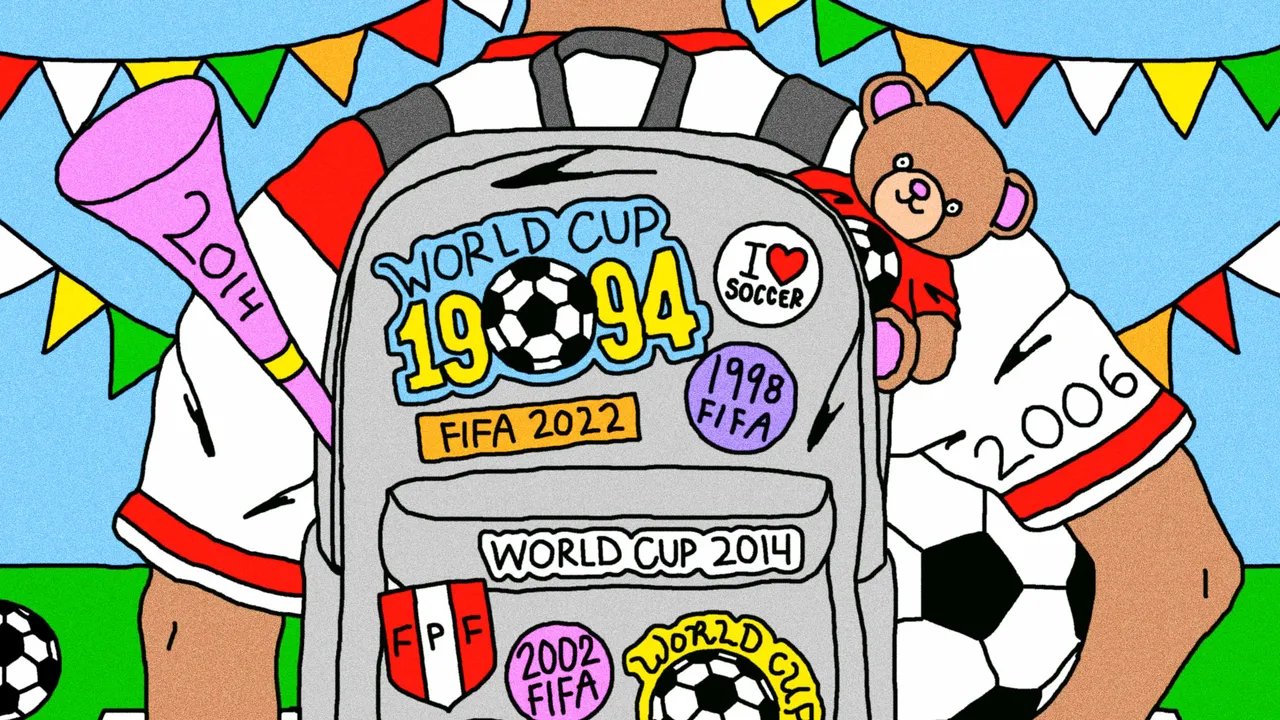
Every four years during my childhood, I would watch my father, named Juan Pablo, pack a bag with rolled-up tech pants, a little toothpaste, and a soccer jersey to fly to a distant stadium with thousands of others who, like him, had gathered all their money to watch the World Cup. What he did there, why it was so important and how he managed to accomplish it was a mystery to me. Plus, during those summers, we subsisted on sandwiches and cereal – not that I ever noticed.
But in 2006 I got a glimpse. That year, for the only time in my life, the World Cup happened and my dad didn’t go. He was awaiting residency paperwork and could not leave the United States.
I watched him watch football history unfold on our TV: Italy and France in the final, in thrilling extra time. Italian center back Marco Materazzi took a dig at French team captain Zinedine Zidane. Zidane responded with a now-famous headbutt, leading to the referee red carding him. My father fell to his knees in our carpeted one-bedroom house in suburban Miami and cried into his hands. France isn’t even my dad’s team; He is South American. My elementary school brain scrambled to understand.
As this year’s World Cup and Father’s Day approached, I decided to finally try to find out why this particular sporting event brought my dad all over the world and to his knees. “I got football fever watching my team Peru play in the 70s,” he told me when I called him. At that time, my father was just 13 years old. He was a native of Lima who loved going skateboarding to his friends’ houses to hanging out at the nearby playground. He was bad at football, but that didn’t diminish his love for the game. In 1978, Peru qualified for the World Cup and reached the second group stage, until Argentina defeated them 6–0. While we were talking, I noticed without thinking that a group of teenagers were playing football on a field near my office.
“Hija, When we were qualifying the whole country stopped at every game. There was collective excitement in the streets when we won a game indescribable. It was like the best news in the world. If it was a Sunday, no one worked the next day,” he recalled over the phone. “When we lost, there was an atmosphere of gloom everywhere for several days.”
When he was a lanky 16-year-old, Peru again played against Argentina, but this time in Lima. “Maradona was playing,” my dad said, still fanatical to the point of boyhood. The local excitement and the soccer stadium’s loose security arrangements were the perfect setting for a stampede, which occurred and my dad was promptly crushed to death.
“An older man made room for me and I heard him say, ‘Oye chiquillo, levantet!”—Translation: Hey child, get up!—“I just got up and kept running.”
When he ran to find his friends after the stampede, policemen were hitting the heads of people entering the stadium with batons. “It was a disorganized, Third World experience,” he said. “Things have got way better.”
He could not make it to the World Cup in America until two decades later. It was just a few years after he and my mother immigrated to Miami, amid food shortages, widespread domestic terrorism, and political instability in Peru. By 1994, they both had jobs and were living in a small apartment in colorful South Beach, sharing a wall with a nighttime drag queen. Miami’s raucous, bloody cocaine era was just coming to an end, his English was getting better, and life was beginning to feel a little more stable.