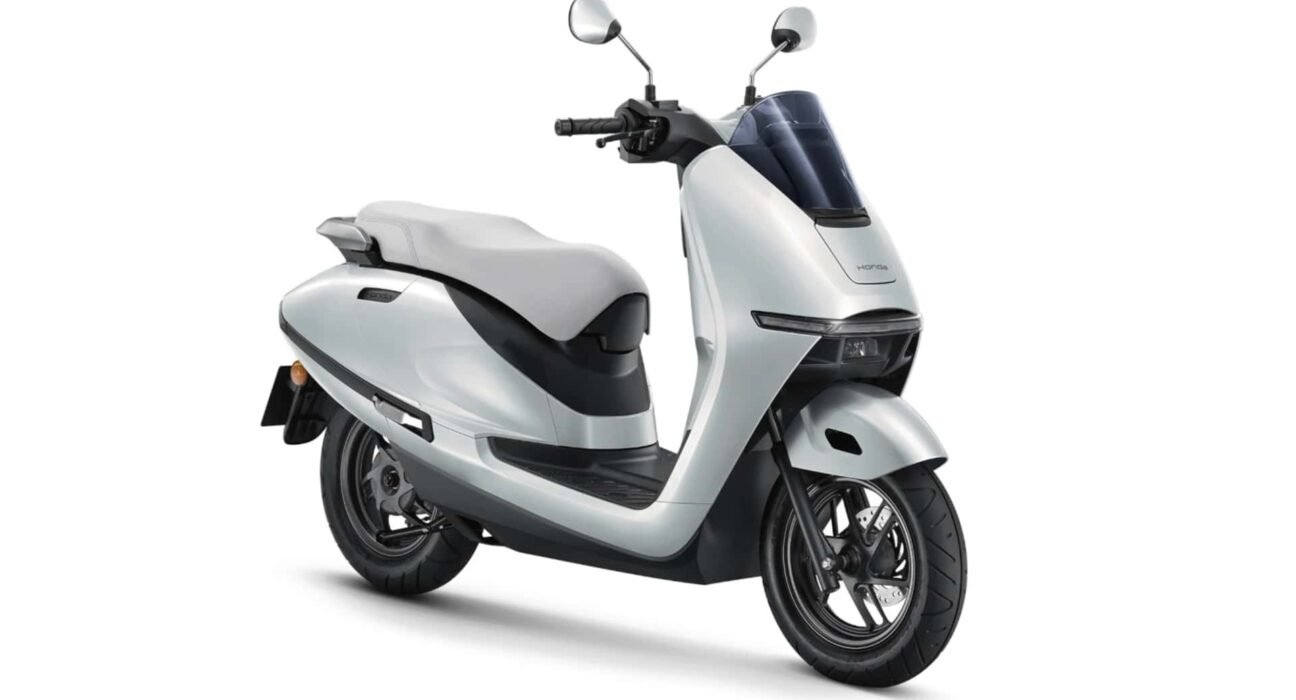
Honda is preparing to launch its UC3 electric scooter in Vietnam in early September, moving production from Thailand to its factory in Phu Tho province. On paper, it seems like a simple manufacturing shuffle that includes an electric commuter that most American riders have probably never heard of. Zoom out, however, and Honda may be testing something big in Vietnam: an electric successor to its overall Super Cub strategy.
This doesn’t mean UC3 will become the next Super Cub. More likely the UC3 is a scout sent ahead to find out where the potholes, charging stations and consumer objections are hidden. Honda launched it in Thailand and Vietnam with a fixed lithium iron phosphate battery, a six-kilowatt motor and a claimed range of about 76 miles. That’s roughly equivalent to a 110cc gasoline scooter, putting it squarely in urban transportation territory rather than electric weekend-toy land.
Photo by: Honda
The real goal is what comes next. Honda Vietnam says the country’s best-selling electric two-wheelers cost less than 30 million dong, or about $1,140, and the company reportedly wants its upcoming model to compete around that figure. This is an important detail because Honda did not initially win over much of the world by selling exotic transportation to wealthy people. It did this by creating simple, accessible machines that ordinary people could buy, use, repair, and run absolutely everywhere.
That was the Super Cube formula. Honda didn’t just make a successful motorcycle. This created a flexible transportation platform that could be manufactured locally, adapted to different markets, sold through vast dealer networks, and driven by people who did not particularly care for motorcycles. The bike became successful partly because it required almost no explanation. Put fuel in it, press the starter, avoid driving into the vegetable cart and continue with your day.
Vietnam could help Honda recreate that formula with batteries. It’s a huge motorcycle market with dense cities, millions of daily riders, rising fuel costs and domestic EV manufacturers already growing at serious volumes. VinFast says it delivered 406,453 electric scooters and e-bikes to Vietnam through 2025, so Honda isn’t setting out to educate the market from the start. It’s coming because someone else has already proven that there is money on the table.


Photo by: Honda
Local production is where it gets interesting globally. Manufacturing the UC3 in Vietnam will help Honda shorten its supply chain, identify which components can be obtained domestically, and rapidly adjust production should demand increase. More importantly, it gives Honda a repeatable approach that it can eventually adopt elsewhere. India, Indonesia, Thailand, the Philippines, Latin America and parts of Africa need affordable urban transportation far more urgently than they need another six-figure electric pickup with a refrigerator in the dashboard.
Honda is already aiming to launch around 30 electric motorcycle models globally and sell four million electric two-wheelers annually by 2030. The company has also identified India and Southeast Asia as key starting points for its expansion, which makes sense. Electric motorcycles can use much smaller batteries than electric cars, typically cover shorter daily distances, and do not require their owners to recondition a kidney just to participate in the energy transition.
Of course, Honda still needs to solve a lot. Charging access varies across countries, many riders don’t have private parking, and competing battery standards could turn an entire industry into a two-wheeled version of a phone-charger drawer. Honda is currently supporting the UC3 with CHAdeMO-based charging, while also developing swappable battery systems elsewhere, suggesting it is not yet committed to a universal answer. This is probably wise because the problems of a suburban homeowner in Manila and a delivery rider working twelve-hour days are very different.
Photo by: Honda
UC3 may never become a household name. This is not necessary. Its job could simply be to help Honda figure out how to make an affordable electric scooter locally, support it through existing dealers, and scale this formula in countries where two wheels are essential for transportation. Honda built an empire by giving the world an affordable motorcycle that almost anyone could use. Vietnam is probably the place where it will learn how to do this again in the electric age.