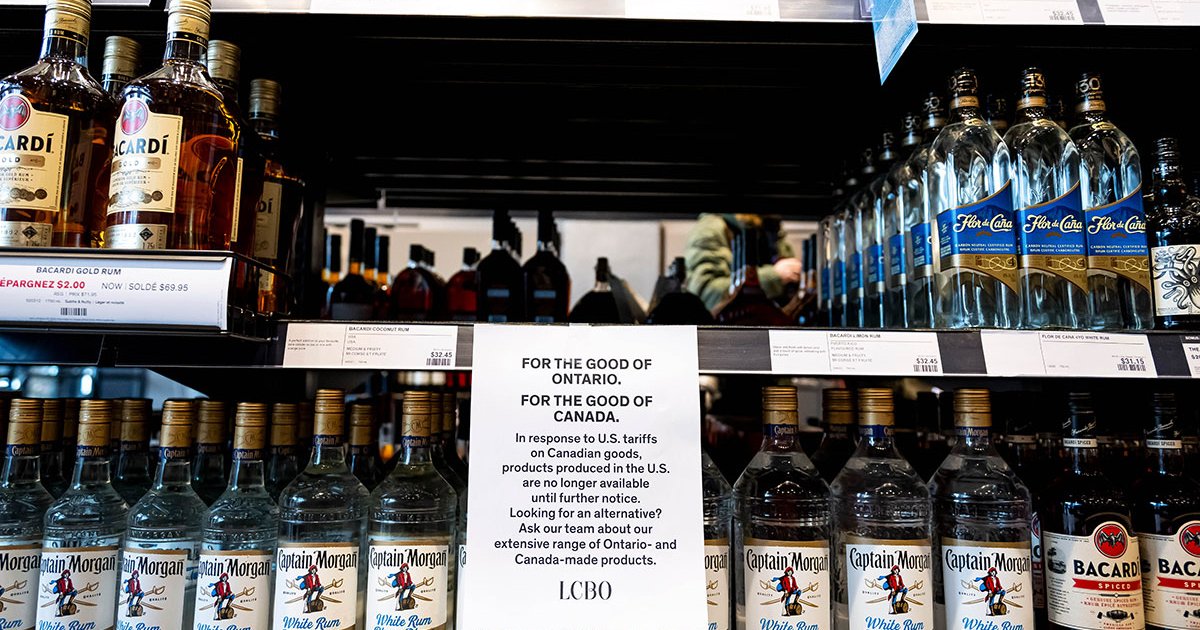
Bottles of American-made rum were removed from the shelves of a liquor store in Toronto. (Christopher Katsarov Luna/Bloomberg)
key takeaways:
- The Trump administration used another tariff threat to pressure Canadian provinces to end the US alcohol boycott, but Ontario and British Columbia refused.
- U.S. wine producers have lost millions in sales due to provincial restrictions, while Canada has a clear bargaining chip in broader trade talks.
- Prime Minister Mark Carney said provinces should decide individually whether to lift restrictions as part of the overall U.S.-Canada agreement.
President Donald Trump’s administration is using another tariff threat to put new pressure on Canadian provinces to end their boycott of American wine. But provincial leaders are not backing down.
Ontario Premier Doug Ford said he will not lift his province’s ban on the sale of American wines and spirits in government-owned stores unless the U.S. removes sectoral tariffs on autos and steel. “We need to negotiate through strength, not through weakness. And we need to throw everything on the table,” he told reporters in Charlottetown, Prince Edward Island, on July 21.
Canada is still looking for a comprehensive trade deal with the US and appears to be using alcohol as a bargaining chip. Prime Minister Mark Carney told reporters that any decision to lift restrictions “will be taken by the provinces individually, and should only – in my judgment – be taken as part of an overall agreement.”
Several Canadian provinces, including Ontario and Quebec, removed American wines and spirits from government-run stores after Trump launched a trade war last year, causing American winemakers to lose millions of dollars in sales. Even though the share of wine in trade between the two countries is very small, the initiative is very visible and is troubling the White House.
Canada is “highly discriminatory on dairy products, American wine,” Treasury Secretary Scott Besant told Fox Business Network on July 21, dubbing the new tariff threat “a reciprocity of what they’ve done to our great American companies.”
Besant defended the 50% Canada tariff as “reciprocity”.
US Treasury Secretary Scott Besant said the Trump administration’s new 50% tariffs on selected Canadian imports are a reciprocal response to what he described as discriminatory Canadian trade practices, citing the sanctions… pic.twitter.com/WLQ9EvwCx7
– Washington Eye (@washington_EY) 21 July 2026
Other provinces are also unwilling to back down. “There is no possibility that American wine will be shut down again,” British Columbia Premier David Abbey told reporters in Charlottetown.
Before Carney’s comments, Saskatchewan Premier Scott Moe said he expected the prime minister to ask provinces to lift their alcohol restrictions in order to have smooth discussions with the U.S. administration. Saskatchewan and its neighbor, Alberta, allow the sale of American liquor in government stores.
“This will be a decision that each province will have to make, but the request must come from the federal government,” Moe said. “They are at the negotiating table.”
International trade lawyer Mark Warner argued that there was no legal basis for the provinces’ actions.
“The alcohol ban is problematic because it’s kind of a blunt instrument,” he said, adding that removing the measure could help advance trade discussions with the U.S. with minimal economic impact.
“If Canadians won’t buy American bourbon and Californian wines, you don’t need a ban,” Warner said. “Put it back in the store and no one will buy it.”