
The electric truck maker raised more than $100 million in a convertible note and senior bank debt three weeks after a $240 million equity round, and the reason is a single purchase order from an investment-grade customer.
Harbinger, the Los Angeles electric truck maker, just added more than $100 million of debt to its balance sheet, split between a convertible note and senior debt from Palmer Luckey’s Erebor Bank. The cause is a binding FedEx order worth more than $300 million: once a startup has a customer that big, its next dollar should come from a lender, not a venture fund.
Picture a FedEx delivery yard in late 2027. The diesel box trucks that rolled out at dawn for a decade are gone, swapped one for one with electric trucks built in Garden Grove, California. Nobody in that yard cares how those trucks were financed. But the reason they exist on schedule, if they do, comes down to a decision Harbinger announced on Tuesday: stop selling pieces of the company to pay for trucks a customer has already agreed to buy.
The easy headline here is the cast. A bank founded by the guy behind Anduril is backing a truck company run by a former Anduril engineer. That is a fun dinner party fact. The more useful story is about what a lender is actually underwriting when it writes this check, and why a FedEx purchase order changes the math on how a hardware company should raise money.
What Happened
On November 24, Harbinger said it had raised more than $100 million in new financing The package has two pieces: a convertible note from Pinegrove Venture Partners and senior debt from Erebor Bank, which is now Harbinger’s primary banking partner. The companies did not break out how much came from each
Luckey put the pitch plainly: “Harbinger is exactly the kind of business we built Erebor to back.” He also argued that traditional lenders have had trouble meeting the capital needs of companies building real technology and creating US jobs.
Co-founder and CEO John Harris framed it as a matter of fit. Scaling an industrial company, he said, takes a different financing mix, and the production ramp and truck deliveries should not lean entirely on equity. He pointed out that big vehicle and aerospace manufacturers have used debt for this job for a long time.
The timing is what makes this interesting. Less than three weeks earlier, on November 5, Harbinger closed a $240 million Series D co-led by Tiger Global, Capricorn’s Technology Impact Fund and Ridgeline, with FedEx participating again. A company that can raise a quarter of a billion dollars in equity does not take on debt because it is desperate. It takes on debt because it has decided which money should pay for which job.
The Backstory
Harbinger was founded in February 2021 by John Harris, Phillip Weicker and Will Eberts. Harris had been principal mechanical engineer and head of Sentry Tower hardware at Anduril, the defense company Luckey co-founded, where he helped take an autonomous system from prototype to volume production.
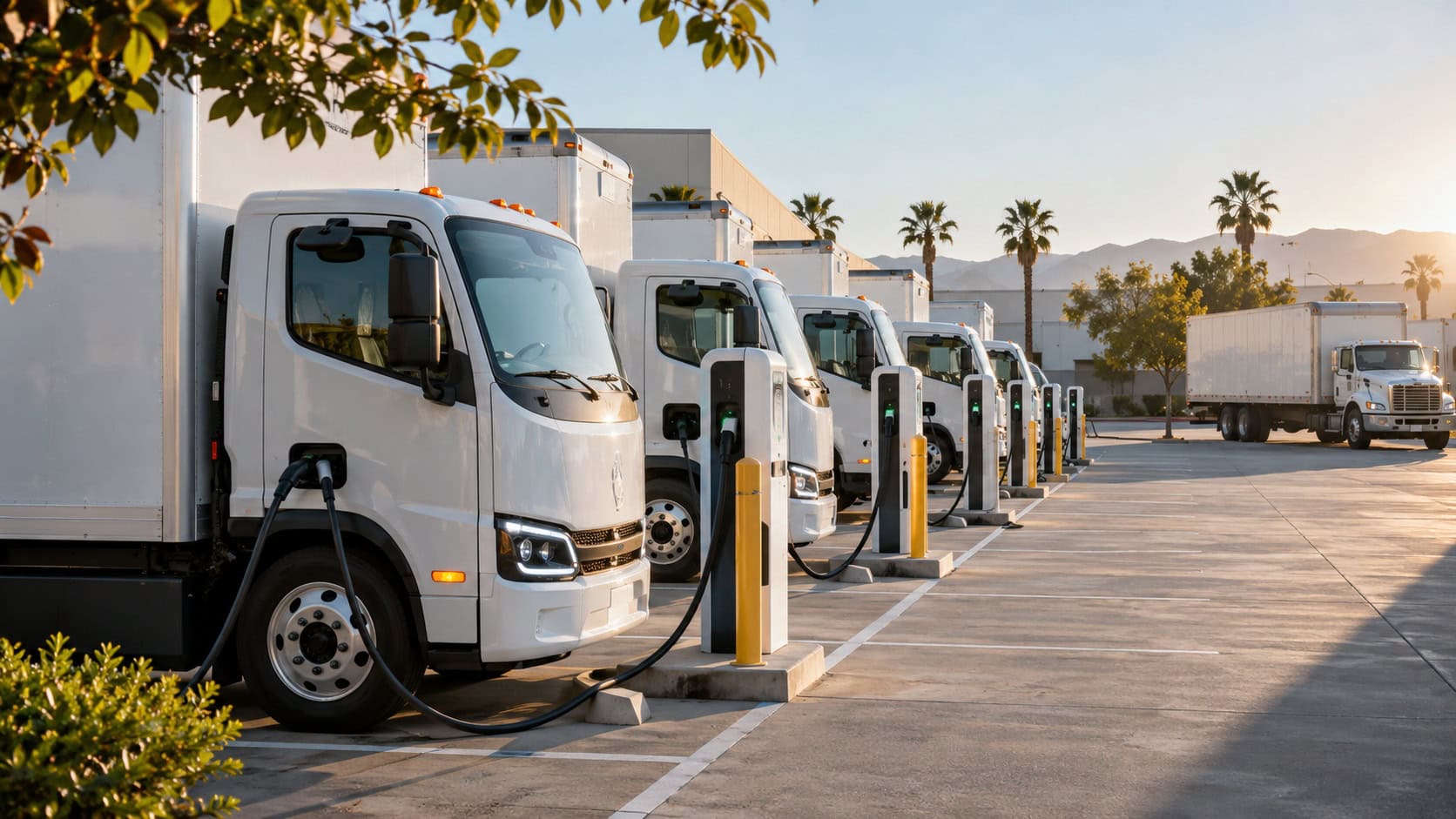
The company builds medium-duty electric and hybrid chassis, the Class 4 through Class 6 frames under delivery vans, box trucks, RVs and ambulances. It designs its own drivetrain and battery system in house and assembles at a plant in Garden Grove, which opened in 2024. From early on, the company has claimed acquisition-price parity with gas and diesel chassis, a claim most electric truck makers have avoided making out loud.
- Series A: $73 million, closed in 2023, co-led by Ridgeline and THOR Industries.
- Series B: $100 million in January 2025, co-led by Capricorn’s Technology Impact Fund and Leitmotif.
- Series C: $160 million in November 2025, co-led by FedEx, THOR and Capricorn, which took total funding to $358 million.
- Series D: $240 million in November 2026, which Harbinger says brings its total past $650 million since founding.
Production followed. Harbinger announced start of serial production in April 2025 with more than 100 units built. Harris told Bloomberg in September 2026 that the company had just finished its 1,000th vehicle.
Then came the order that changed the balance sheet conversation. On September 30, Harbinger announced that FedEx had placed a binding order for 2,000 all-electric trucks, valued at more than $300 million, for pickup and delivery routes in the US and Canada. All 2,000 are due by the end of 2027. FedEx had started with 53 trucks a year earlier, alongside its Series C check, and FedEx senior vice president Paul Melander now sits on Harbinger’s board. Harris called the delivery window “unprecedented for the industry” in comments to Transport Topics.
That FedEx order is the hinge for everything that follows. It is also where the FedEx business model shows up: a parcel network lives and dies on cost per stop, and FedEx is working toward an all-electric pickup and delivery fleet by 2040.
What the Debt Is Actually Buying
Start with what a lender sees when it looks at Harbinger. Not a vision deck. A signed order from FedEx, a company rated BBB by S&P and Baa2 by Moody’s, both investment grade. A venture investor is betting the company becomes huge. A bank is betting the company stays alive long enough to get paid back. A binding order from a creditworthy customer is the thing that turns the second bet from a guess into a calculation.
Here is that calculation, using only the company’s disclosed minimums:
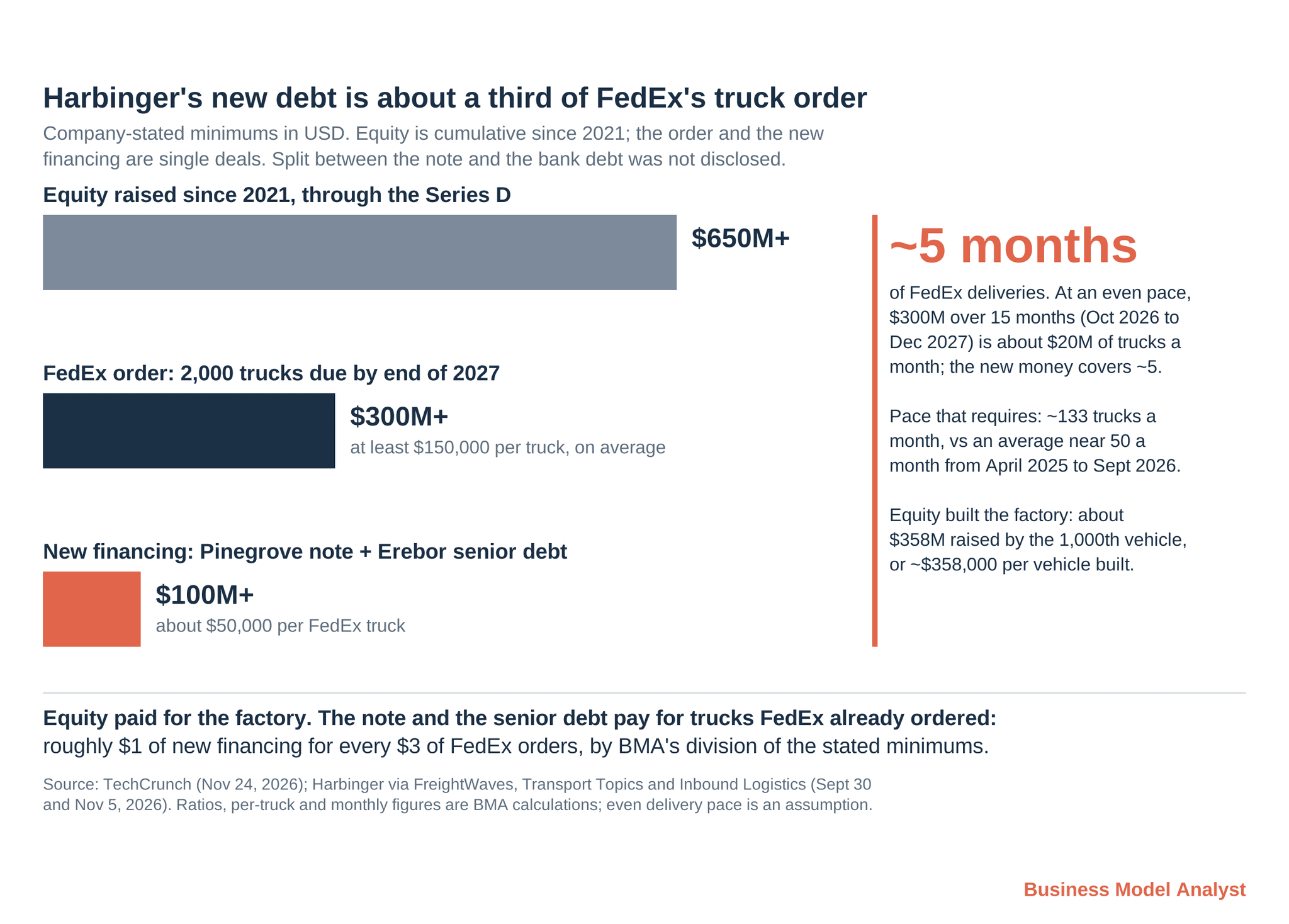
- The order works out to at least $150,000 per truck. That is $300 million divided by 2,000 trucks, an average across a mix of models the companies did not itemize.
- The new financing is about one third of the order. More than $100 million of note and senior debt against more than $300 million of contracted FedEx revenue. Roughly $1 of new money for every $3 of trucks FedEx has committed to buy.
- That is about $50,000 of new financing per FedEx truck. About a third of each truck’s average order price.
- It covers roughly five months of FedEx deliveries. If the 2,000 trucks ship evenly from October 2026 through December 2027, that is 15 months and about $20 million of FedEx trucks a month. The new money equals about five of those months.
Five months is not a random number. It is roughly the shape of a manufacturing working capital gap: a truck maker buys battery cells, motors and steel months before it ships a finished truck, then waits again to be paid. That gap is the part of the ramp that equity is worst at funding, because every dollar of equity spent on inventory is a dollar of ownership sold to cover a timing problem.
Now compare that with what the equity bought. By the time Harbinger finished its 1,000th vehicle, it had raised about $358 million in total. That is roughly $358,000 of equity per vehicle built, more than twice the average price FedEx is paying per truck. Nobody should read that as waste. That money paid for the drivetrain, the battery system, the software, the plant and the people. It is the cost of becoming a company that can build trucks at all.
The debt has a different job: carrying the cost of building trucks that are already sold. Equity paid for the factory. The note and the senior debt pay for the trucks moving through it.
The two instruments also sit in different places. Senior debt gets paid first and asks for a return, not upside. The convertible note from Pinegrove, a venture secondaries and lending firm backed by Brookfield and Sequoia Heritage that launched an $800 million venture debt fund, behaves like debt now and can turn into equity later, usually at a discount to a future round. It is the bridge for capital that wants protection today and a piece of the company if things go well.
The Business Model Angle
The lesson is not that Harbinger found a friendly bank. It is that the capital stack of a hardware startup should change the moment its revenue becomes contractable.
A purchase order is a financing asset. Before September 30, Harbinger’s best collateral was its technology, which only an equity investor will price. After September 30, it had $300 million of committed revenue from an investment-grade buyer. Founders who treat a big order only as a sales win are leaving cheaper capital on the table.
Match the money to the job. Equity is expensive because it is patient and takes the risk that the product fails. Debt is cheaper because it takes a narrower risk: that a known order gets built and paid. Funding inventory for sold trucks with equity means selling permanent ownership to solve a 5-month cash timing problem.
The lender needs the borrower too. Erebor launched in February 2026 and recently passed $1 billion in loans, per the Financial Times. The same paper reported its deposits topped $7 billion by October. A bank with seven dollars of deposits for every dollar it has lent out has to put money to work, and a manufacturer with a FedEx order is a cleaner loan than most of what a young bank sees.
Young banks are capped by their own size. A national bank generally cannot lend one borrower more than 15% of its capital and surplus on an unsecured basis under 12 CFR 32.3, with another 10% allowed against readily marketable collateral. That is one structural reason a startup’s debt package often mixes a bank with a credit fund instead of one giant loan.
- The playbook travels. Any company with a binding multi-year order faces the same choice, and defense tech is the obvious next test. Startups like Agon, which just raised $70 million, would face this fork the day a big signed contract lands. The opposite extreme is a roll-up valued at $1.3 billion before its first deal, where equity pays for everything because there is nothing yet to lend against.
The Risk
The strongest case against this move is simple: debt is impatient, and truck ramps are not.
The ramp has to more than double. From more than 100 units in April 2025 to the 1,000th vehicle in September 2026, Harbinger built roughly 900 vehicles in about 17 months, an average near 50 a month. The FedEx order alone needs about 133 a month if it ships evenly over 15 months, roughly 2.6 times that historical average. The current monthly rate is surely above the average, and Harbinger has not disclosed it. But a lender’s covenants bite exactly when a ramp slips, and an equity investor would simply wait.
The subsidy is gone. The federal commercial clean vehicle credit under Section 45W, worth up to $40,000 per vehicle, does not apply to vehicles acquired after September 30, 2025. The FedEx order landed a year after that cutoff, so it stands on Harbinger’s price and FedEx’s fuel savings alone. Harbinger estimates each truck saves about $20,000 a year in fuel versus the diesel it replaces, or about 13% of the average order price per year. That is the company’s estimate, not an audited one.
FedEx is on every side of the table. It is the anchor customer, a repeat equity investor and a board member. That alignment is a strength until it is a concentration problem. If FedEx’s needs change, the order terms nobody has published will matter a lot.
Focus is expensive. The Series D was raised to push Harbinger into energy storage, power generation, autonomy and defense. It bought autonomy software company Phantom AI in February 2026 and is a tier-one supplier to American Rheinmetall on an 18-month Army contract. Each new line is reasonable. Together they compete for the same engineers who need to get 2,000 trucks out the door.
The graveyard is real. Proterra filed for bankruptcy in 2023 and Nikola in 2025, both after convincing investors that commercial electric vehicles were about to scale. Harbinger’s numbers look nothing like theirs today. But senior debt changes who gets paid first if they ever do.
Quick Questions
Who is lending Harbinger money? Two parties. Erebor Bank, the bank backed by Palmer Luckey that opened in February 2026, provided senior debt and is now Harbinger’s main bank. Pinegrove Venture Partners provided a convertible note. Together they total more than $100 million.
Why would a startup borrow right after raising $240 million? Because the money does different jobs. The equity funds expansion into new products and markets. The debt funds the cash gap of building 2,000 trucks FedEx has already ordered, which is cheaper to finance with a loan than by selling more of the company.
How much is FedEx paying per Harbinger truck? The order is worth more than $300 million for 2,000 trucks, so at least $150,000 per truck on average. The companies have not disclosed the model mix or individual prices.
Can Harbinger actually build 2,000 trucks by the end of 2027? It needs to average roughly 133 trucks a month from October 2026 to hit that date evenly, versus a historical average near 50 a month since serial production began. The current pace is not public, so the honest answer is that it requires a big ramp the company says it can deliver.
The Business Model Analyst Take
Harbinger did something most hardware founders put off too long: it stopped treating every dollar as the same dollar. Equity built a company that could make trucks. A FedEx order turned that company into a borrower a bank can underwrite. The new debt is sized like a working capital line for a known customer, about a third of the order and about five months of deliveries.
That is a sharper capital plan than the cast list suggests, and it shifts the scorecard. For the next 13 months, the number that matters is not Harbinger’s valuation or how many new markets it enters. It is trucks per month. Hit the ramp and this looks like the moment an EV startup started financing itself like a manufacturer, the way Tesla eventually did. Miss it, and the senior lender is the first one at the door.