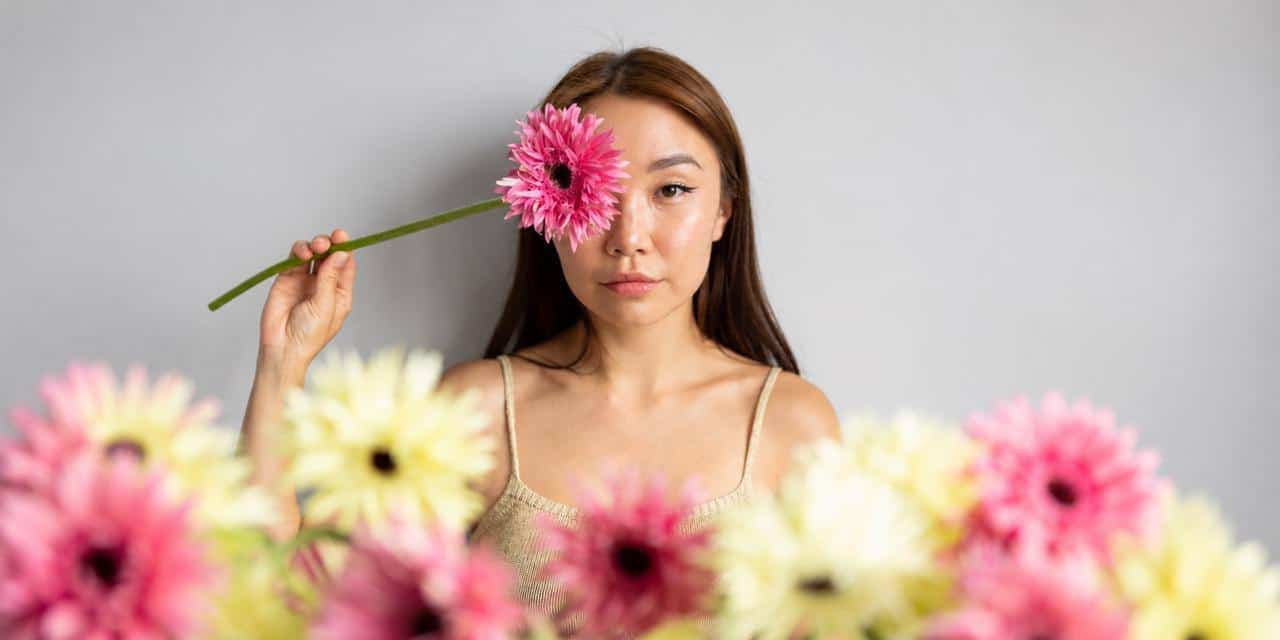
Flowers have always had a place in fashion. They appear in prints, embroidery, appliqué, and sculptural fabric details, translating the shapes and movement of nature into something that can be worn. For floral designer Aidana Beisenova, however, the flower itself is the material.
Rather than recreating a bloom in fabric, Beisenova works with fresh flowers, transforming them into wearable pieces that sit somewhere between floral design, jewelry, and fashion.
New York’s September shows put the garden on the runway and left the flowers in the scenery. One label built a circular indoor catwalk around an outdoor garden with fountains; another staged its show in a museum garden; a third filled a hall with an indoor garden, models dripping in green crystals — three of the images the Associated Press https://www.clickorlando.com/entertainment/2026/09/16/joyful-dressing-and-the-trends-that-took-over-new-york-fashion-week/ pulled from the week of September 9 to 15.
Beisenova took a different approach: rather than placing
Beisenova took a different approach: rather than placing flowers around the runway, she brought living botanical material directly onto the body.
“Fashion has become an important part of what I do because it lets me treat flowers as an artistic medium, not just decoration,” Beisenova says. “A flower already has its own color, texture, shape, and movement. In that way, it is much closer to fabric than people might think.”
That perspective came to life on the runway on September 12, when Beisenova was featured as a floral accessories designer at Asian New York Fashion Week https://www.asianfashionweek.org/ . Held at Lavan Midtown in New York City, the event featured two runway shows at 3 p.m. and 6 p.m. Beisenova contributed 10 original floral accessories, incorporated into four designers’ collections across both shows. Her creations brought fresh botanical materials directly into runway fashion, extending floral design beyond traditional arrangements and into wearable art.
Beisenova, who holds the Certified Floral Designer credential
Beisenova, who holds the Certified Floral Designer credential from the American Institute of Floral Designers and the Florida State Master Designer title from the Florida State Florists’ Association, created a collection of wearable floral pieces ranging from headpieces and corsages to cascading designs and sculptural floral purses.
But for Beisenova, choosing the flowers was not simply about selecting what looked beautiful. Each bloom had to contribute something to the fashion.
Flowers as Material
A white bridal headpiece was created with Dendrobium orchids, selected for their lightness and delicate movement. Their naturally airy structure allowed the flowers to frame the face without overpowering the bridal look.
For a bolder sculptural piece, Beisenova worked
For a bolder sculptural piece, Beisenova worked with red and white anthuriums. Their glossy surface, strong silhouette, and architectural shape created a completely different effect.
Supported by a silver aluminum-wire structure, the flowers became part of the form of the accessory itself rather than an embellishment placed on top of it.
Calla lilies offered another possibility.
Instead of using them as a traditional arrangement flower, Beisenova individually wired the lilies to create a cascading design. Their naturally curved stems and clean lines allowed her to control the direction of the composition bloom by bloom, creating movement that continued as the model walked.
That relationship between flower, garment, and body is central to her approach.
A floral accessory cannot exist independently
A floral accessory cannot exist independently from the person wearing it. It has to work with the proportions of the look, respond to movement, remain comfortable, and contribute to the overall image without competing with the clothing.
Beisenova approaches each piece with that balance in mind.
“I don’t want the flowers to look like something that was simply added to an outfit,” she says. “I want them to feel like they belong to the look.”
Building With Fresh Flowers
Working with living material introduces challenges that do not exist with conventional fashion accessories.
Fresh flowers change
Fresh flowers change. They react to temperature, movement, handling, and time. Their natural irregularities are also part of what makes them visually compelling.
For Beisenova, those limitations are not separate from the creative process; they influence the design from the beginning.
One principle that consistently shapes Beisenova’s work is her foam-free approach. Rather than relying on traditional floral foam, she develops her own mechanics using techniques such as hand-built wire structures and individually secured flowers. Floral foam can add weight and bulk and often requires a container or supporting base, while working without it gives Beisenova greater freedom to control the shape, placement, and movement of each bloom.
The technique makes it possible to approach flowers
The technique makes it possible to approach flowers almost as a fashion designer approaches fabric: building structure first, then considering silhouette, texture, color, and how the finished piece will behave on the body.
Durability matters, too. A flower chosen for a runway accessory has to do more than photograph beautifully. It needs enough structural strength to survive preparation backstage, styling, movement, and the runway itself.
That requirement naturally influences Beisenova’s flower choices. Orchids and anthuriums, for example, can offer both visual impact and structural resilience, while more delicate flowers may require different mechanics or be reserved for pieces intended for a shorter presentation.
The technical decisions remain largely invisible once the model steps onto the runway.
That is intentional.
The viewer should see the flower, the silhouette,
The viewer should see the flower, the silhouette, and the complete fashion image — not the engineering underneath it.
Beyond the Bouquet
Beisenova’s interest in wearable flowers is part of a larger idea she continues to explore: floral design does not have to remain confined to weddings, centerpieces, bouquets, and event décor.
“I want people to see that flowers are not only arrangements for weddings and events,” she says. “With flowers, you can create much more. Fashion is one of the places where I can explore that because flowers already give us incredible colors, textures, and forms.”
On the runway, that idea becomes particularly visible.
An orchid can become a headpiece
An orchid can become a headpiece. An anthurium can become a sculptural element. A calla lily can create the line of an accessory. A collection of fresh blooms can become something closer to jewelry than a traditional floral arrangement.
And because the material is alive, no two pieces can ever be completely identical.
That impermanence is part of their appeal.
Fashion usually works toward permanence: a garment can be photographed, archived, reproduced, and worn again. Fresh flowers introduce something different. Their beauty exists within a limited moment, making the finished runway look inherently temporary.
Her goal is not to make flowers imitate traditional accessories. It is to allow flowers to bring their own visual language into fashion — their natural shapes, unexpected textures, movement, and even their impermanence.
The result is a meeting point between two
The result is a meeting point between two disciplines that already share many of the same elements: color, proportion, texture, silhouette, and composition.
Beisenova plans to continue developing that intersection through runway and editorial work, experimenting with new floral structures and ways of incorporating botanical materials into fashion.
For her, the runway is not simply another place to display flowers.
It is a place to reconsider what floral design can become.