“Huna”: Egyptian Author Abdelrahman ElGendy on Prison, National Book Award & Being Denied U.S. Visa | Democracy Now!
“Huna”: Egyptian Author Abdelrahman ElGendy on Prison, National Book Award & Being Denied U.S. Visa

Watch Full ShowWatch Full Show

Listen
Listen
This is viewer supported news. Please do your part today.
Donate
Topics
Guests
- Abdelrahman ElGendyaward-winning Egyptian writer.
- Hossam Bahgatfounder of the Egyptian Initiative for Personal Rights.
Links
- “Huna: A Memoir of Revolution, Prison and Becoming”
- “I Am a 2026 National Book Award Finalist. The U.S. Denied My Visa”
- “Why I Had to Flee the United States”
This is viewer supported news. Please do your part today.
Donate
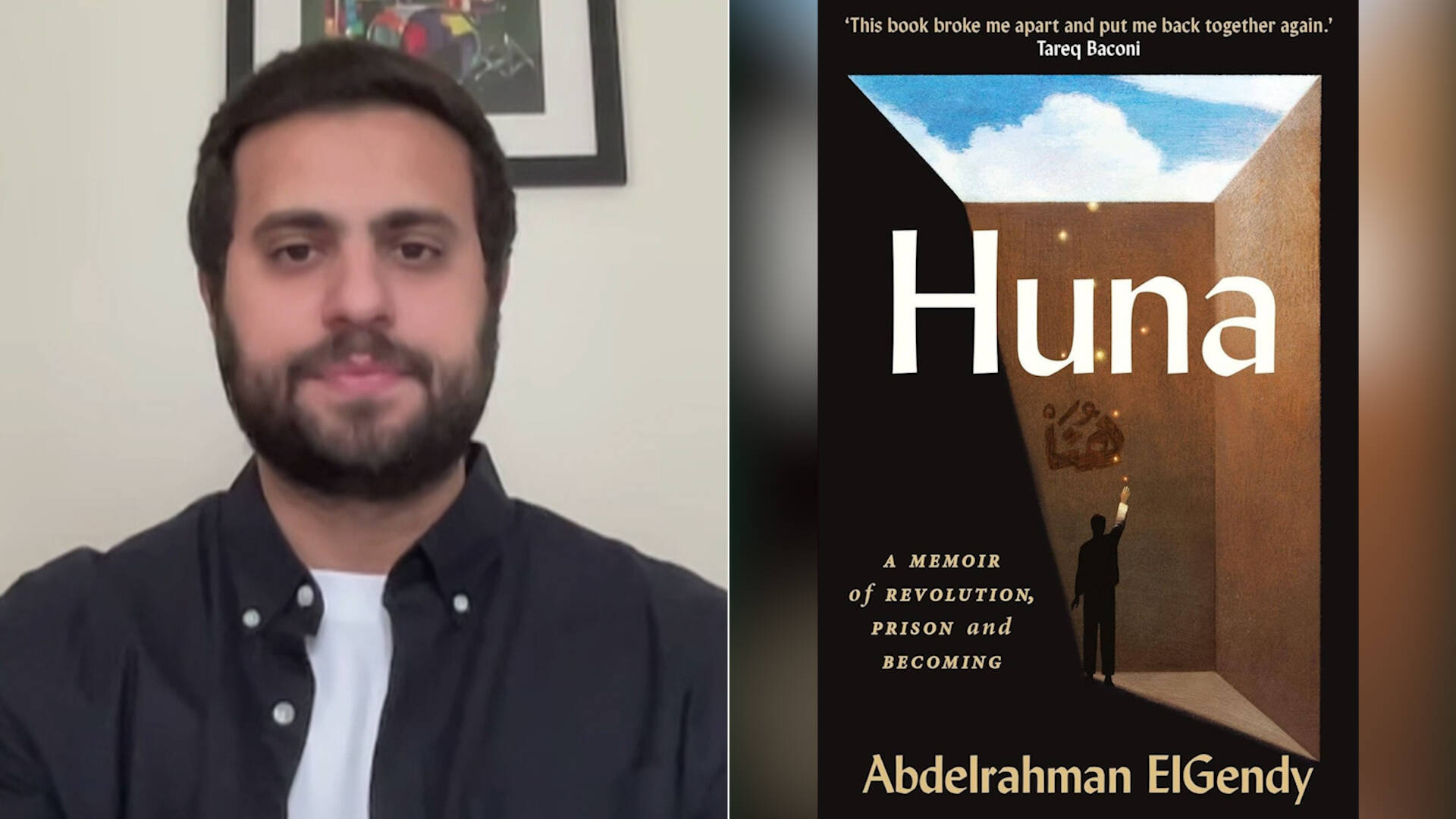
This year’s annual National Book Awards ceremony in New York City was marked by the notable absence of nonfiction winner Abdelrahman ElGendy, after the Trump administration denied the Egyptian author entry into the United States. ElGendy’s debut, Huna: A Memoir of Revolution, Prison, and Becoming, chronicles his arrest and over six years of imprisonment, alongside his father, following arrest at a protest against the military dictatorship of Egypt’s President Abdel Fattah el-Sisi. After his release from prison in Egypt, ElGendy obtained an MFA in the United States but was forced to flee once again — this time from the U.S. to Europe — for fear of being targeted by immigration authorities over his criticism of Israel’s war on Gaza and U.S.-Egypt relations.
“It was a gutting thing to not be able to attend the ceremony. But it was also unsurprising,” ElGendy tells Democracy Now! about being barred from receiving the National Book Award in person. “[I] have labored for so long my whole life to get to this point, only to again and again and again be forced to witness it all from afar and detached from the people I love.”
We speak to ElGendy about the weaponization of the visa process, in both the U.S. and Egypt, “as a form of transnational repression,” his arrest and imprisonment beginning at the age of just 17, and the Egyptian government’s ongoing repression of free speech, including its attempted closure of the independent news outlet Mada Masr, whose lawyers were in court today appealing its shutdown.
“Mada carries so much of the archive of our revolutionary history … so to erase it is to erase an archive,” says ElGendy, whose early writings were smuggled out of prison and first published in Mada Masr. “The current Egyptian military dictatorship [is] a frantic project of erasure of everything that has to do with the revolution, and it’s an insistence on erasing every trace that would allow people to remember that revolution has happened, that this rupture has happened before.”
More from this Interview
- Part 1: “Huna”: Egyptian Author Abdelrahman ElGendy on Prison, National Book Award & Being Denied U.S. Visa
- Part 2: Abdelrahman ElGendy on “Huna: A Memoir of Revolution, Prison, and Becoming” Part 2
Transcript
This is a rush transcript. Copy may not be in its final form.
AMYGOODMAN: This is Democracy Now!, The War and Peace Report. I’m Amy Goodman.
We are currently awaiting an Egyptian court decision on whether the closing of Mada Masr, the independent newspaper in Egypt, will stand. We’ll go to Cairo when we hear.
But right now we’re going to turn to what happened in the last few weeks here in this country, in New York, where we are. Novelists, essayists, poets and other writers from around the world took to the stage at the 77th annual National Book Awards ceremony in New York City last week. The winner of this year’s National Book Award for Nonfiction, Egyptian author Abdelrahman ElGendy, though, was notably absent from the event, after the Trump administration denied his U.S. visa application, blocking him from entering the United States.
ElGendy’s debut book is called Huna: A Memoir of Revolution, Prison, and Becoming, and chronicles his more than six years of imprisonment in Egypt following his arrest at the age of 17, alongside his father, during the crackdown on protests after the military coup led by Abdel Fattah el-Sisi in 2013. He and his father were in their car, and Abdelrahman was taking a picture.
This is the moment the prize for nonfiction was presented by panel chair Robert Warrior.
ROBERTWARRIOR: It’s my distinct honor to announce that this year’s National Book Award for Nonfiction goes to Abdelrahman ElGendy for Huna.
AMYGOODMAN: Abdelrahman ElGendy’s editor, Helen Thomaides, then took the stage and read a statement
HELENTHOMAIDES: If you’re listening to this, then a years-long dream of mine has come true, and I’m not there to live it with you. Years ago, in my prison cell in Egypt, I used to fantasize about writing a memoir. I would slip under a bright red duvet my mother had bribed the guards to let through, and imagine that everything happening to me would one day end up in a book, that the guard’s baton was battering not my ribs but those of the book’s protagonist, that the slap was landing on the protagonist’s face, not mine. I was the author, concerned only with how to render on the page the torture my body was enduring. The scribbles on a smuggled page became a potential essay, the essay a potential published article, the article a book. I’d imagine that book winning an award, and deliver fictional acceptance speeches under Mama’s duvet, fleetingly unincarcerated. Today, that dream should have come full circle, but like so many of the circles ruptured in my life, it will remain unfinished, broken by an oppressive regime with a fascist ideology whose concentration camps stand ready to swallow the bodies it deems undesirable.
AMYGOODMAN: That was Abdelrahman ElGendy’s editor Helen Thomaides reading Abdelrahman’s words after his memoir Huna won the National Book Award just last week. Ahead of the ceremony, Abdelrahman wrote a piece in The New Yorker magazine. It’s headlined “I Am a 2026 National Book Award Finalist. The U.S. Denied My Visa.”
Abdelrahman ElGendy wrote much of the book while in the United States, where he came two years after he was released from prison in Egypt. He studied at the University of Pittsburgh, where he obtained an MFA in creative nonfiction. Then, in April 2025, following the Trump administration’s widespread targeting of pro-Palestine voices, including international students and academics, Abdelrahman ElGendy decided to flee the U.S., fearing he’d be next, that he’d be detained and possibly deported back to Egypt over his criticism of Israel’s war on Gaza and U.S.-Egypt relations. At the time, he wrote in The Nation magazine, quote, “I was a political prisoner in Egypt. I didn’t want to become one again in America,” unquote.
For more, we’re joined now by Abdelrahman ElGendy from Europe, where he lives now.
Abdelrahman, I just want to congratulate you on this remarkable book, which I’ve just finished. And I had the joy, flying back from Turkey, the U.N. climate summit, of listening to your book, the audio book, which you read in your own words. The magnificence, the power, the pain of this book cannot be underestimated. I want to thank you so much for sharing your life with us, Abdelrahman ElGendy. Thank you for joining us.
ABDELRAHMANELGENDY: Thank you. Thank you so much, Amy. Thanks for having me and for these kind words. Thank you.
AMYGOODMAN: So, we are awaiting word right now about whether Egypt will be forced to reopen Mada Masr, a place where you actually, I think, published your first words. You wrote throughout your six years in prison. But talk about — well, first, start with the title, and talk about what it meant to win the National Book Award in the United States, the place you wanted to stay, to be in exile, to be protected, but could not reenter for the awards ceremony.
ABDELRAHMANELGENDY: Yeah. Thank you. I mean, of course, it was a gutting thing to not be able to, you know, attend the ceremony. But it was also unsurprising. You know, we all know how this U.S. administration is now trying to keep everyone who criticizes policies out, especially when it comes, you know, to our region, especially when it’s around Palestine. You know, and if you’re a citizen of another country that doesn’t, you know, need a visa, they don’t want you. They just detain you at the point of entry at the airport. But if you do, like in my case, they just deny you, you know, at the embassy.
And I just — yeah, they love repeating the idea that the visa is, you know, a privilege and not a right. This is kind of the mantra that they keep, you know, repeating to everyone. But, yeah, this, I think, is just intentional distraction from the most important point here, which is that the visa process is being weaponized, and has been now for a while, as a form of transnational repression, which we’re very familiar with in Egypt, as well, because the Egyptian state also uses this form of transnational repression, you know, denying us certain paperwork and stuff like that to punish you for political speech and to keep certain bodies that you deem undesirable outside. So, same for the U.S. So, the visa denial itself being weaponized in that way is the issue, not the fact that the, yes, consul office can deny or approve, etc. So, I think this should be, yeah, the headline, really.
But it was also, like, very sad, I think, in a way that is very specific to my personal journey, you know, as a — this is not new to me. As a kid, you know, I worked my whole life to earn a scholarship to study engineering at this great school that my family couldn’t afford at the time. And then I was arrested on the eve of my first day as a freshman. This is — I speak about this in the book — before I get to live this dream. And then, when I was released in 2020, it happened straight into COVID in 2020. And I started, like, when the lockdown was being lifted, and I started slowly rebuilding community. Because of my writing with Mada Masr, actually, because I continued writing with Mada post-prison, word kind of circulated. Relatives who were well connected told me that my name is being kind of floated again for rearrest. And eventually, I was forced to flee Egypt because of that writing with Mada Masr. And since then, you know, I’ve never been able to share a room with Egyptian readers of my work, except accidentally in exile, you know, when we’re all, like, kind of shunned away from Egypt together. So I’ve had to do it from a distance.
And now, you know, this book, which I imagined writing from prison, which I wrote, you know, throughout my time in the U.S., and then, just as I was about to graduate from my MFA in the U.S., which this book was the graduation, the thesis for — right? — you know, I was forced again to temporarily leave for safety concerns of ICE targeting, as you mentioned, because of my political writing and pro-Palestine activism on campus. And so, I had to graduate from my MFA remotely, as well, witness that moment, you know, be celebrated remotely by people in the room that I was unable to be in. And I wanted to bring my family over to the U.S. to have that graduation ceremony, that prison denied us in Egypt, and we were deprived of that again.
I couldn’t do a U.S. book tour. And now the book, you know, has made it all the way into that room of the National Book Award. And, you know, to have labored for so long my whole life to get to this point, only to again and again and again be forced to witness it all from afar and detached from the people I love who have witnessed this journey, it is gutting. But in a way, it is also just the story of my life. This is not new.
And still, I think I need to redirect all this back, you know, to Egyptian political prisoners, because as I said in my speech, a life that I’m living right now beyond prison, in which my dreams could even be crushed in this way, that was the dream back in prison. I dreamed of a day when I have these, like, unincarcerated people problems. But there are 60,000 political prisoners, you know, who don’t even have the luxury of such precarity, that at least opens into possibility, right? So, I think, yeah, I always want to redirect it to them. I am blessed, no matter what, like, everything that happened that was very sad and gutting and everything. But I always try to put that in relation to people back home behind bars in Egypt, my friends, Ayman and everyone else still behind bars. I’m still blessed to have these problems. Yeah.
AMYGOODMAN: Tell us why you named the book Huna: A Memoir of Revolution, Prison, and Becoming.
ABDELRAHMANELGENDY: Yeah, I mean Huna, huna is the Arabic word for “here.” And it was inspired by a popular Arab protest song, “Sawfa Nabqa Huna,” which means “We Will Remain Here.” And I first heard that song, you know, up close on my third night in detention. We were in this, like, military camp in the middle of the desert, very excruciating physical conditions, where 68 of us were crammed into a tiny room, piled on top of one another. There were some people that were shot and wounded, so it was very heavy. My father was with me at the time. He was dying.
And then, out of nowhere, the guards finally allowed in the homemade food our families had brought to the gate. So, our families would come every day; they’d be sent back. But that day, they just brought in the food. And then, for the first time since the arrest, we had a taste of home.
And then something very magical happened. We just began to sing. The mood got lighter, and we began to sing. And one of the songs was “Sawfa Nabqa Huna,” which goes, “We will remain here until the pain subsides. We will remain here. The melody will sweeten.” And, you know, we sang together, and I started feeling those chills on my arms. You could feel that everyone in the room was entering this sort of visceral moment together.
And I found myself thinking, fascinated, that I didn’t want to remain here. Like, who wants — you know, none of us wants to remain here. We couldn’t wait to escape this room fast enough. My father was dying. We were being tortured. People were shot. So, what was this huna? What was this “here” that we were so touched by, that we were all actively choosing to inhabit together? What were we entering?
And I think I would say my book — if I would kind of put it in one line, I’d say it is a six-year pursuit of this huna, like the question of what it means to inhabit a space that is designed to erase you in body, in language, in your very sense of personhood, and still find ways to be. So, I try to trace, you know, that sense of nonphysical hereness and witness, that repeatedly saves me from being wholly conquered by prison.
And you also mentioned the becoming part, which is important to me, because I was arrested — I think sometimes that gets lost, the fact that I was arrested at 17 years old. So, to me, this is not just prison and revolution. It is also becoming, because I say this is a coming-of-age story. And so many people come to this political awakening that I had, you know, in high school age. They start getting politically agitated or involved. And to me, it happened that I went into prison in those formative years. So, my whole history of activism was two months — right? — after the Rabaa massacre until October 6, and then I was arrested. So, incarceration, in a way, was this school in which I was thinking about the world and my positionality inside it.
So, I was just politically activated before I went into prison, and I went into prison with all those agitated questions that were so unsettled for me. I was so angry. I carried so much rage at the military dictatorship, the police state. And I felt like I had a moral compass. But it was mostly motivated not by, you know, theory or intellectual thought or engaging with political theory. It was just rage at seeing certain injustices and wanting to intervene and be part of removing them or restoring justice. So, to me, that was — you know, I see people massacred, a military dictatorship. I think, “These things are wrong, and I don’t want to be on this side. I want to be on the other side that is against them.”
But in prison, I get into a more, I think, sophisticated approach. In prison, I think you have — you know, you have nothing more than time, and you sit down, and you just question everything. And I think prison forces you to confront so many not only political questions, but also very existential questions, you know, about what it means to be here, to be human, to be in relation to other humans, to your own father, to your friends, your mom, and what kinds of obligations does that carry.
So, every day, I was encountering new things that agitated me even more, and that were forcing me, you know, to think. You’re beaten. You’re tortured. You’re being beaten by those batons every day. You see your father hit. Everything around you radicalizes you and makes you think, you know, “I cannot afford to look away from these things. I don’t have the luxury of looking away from these questions,” because the batons are beating me every single day. I just cannot not think about them and my relationship to them and to other people fighting them, and whether I think of them, again, as allies or even political enemies. So, momentarily in prison, I have to align with factions that, you know, I don’t align with politically. It forces me to think about these questions. Like, in my cell, I don’t agree with you politically. I’m very aggravated by you. But we step up outside the cell, and the same police officers are beating us. So, what does that mean in terms of, you know, allyship, mobilization, working together? So, yeah, all those questions at 17, you wouldn’t be thinking about, I think. But I couldn’t afford not to, because my survival depended on grappling with them in prison.
AMYGOODMAN: I mean, this is also a story of a father and son, a mother and son, a brother, a cousin. Talk about how you were first detained with your dad. And it’s a relationship that carries throughout the book. I mean, you go from being a son to being your dad’s protector, to having to separate from your father. My goodness, I mean, you were arrested at the age of 17.
ABDELRAHMANELGENDY: Yeah. One thing I always like to bring up about this is, one of my dear friends, when she read the manuscript of the book for the first time, before it was published, she told me, “Do you know what this book is?” And I told he, “What?” And she said, “This is a love letter to Baba.” And I found that very moving, because I do think this is one of — at least one of the things that this book is, because, you know, my father was apolitical. Like, he wasn’t even involved in politics. And I was a very hot-headed teenager. I really wanted to be on the streets. I was very — again, I was — I had this awakening, and I was attending protests very — you know, every single day, maybe three protests, you know, in the morning, in the afternoon and in the evening. And they tolerated — my parents tolerated that for a while.
But then, on October 6, that was a particularly dangerous day. This is the Armed Forces Day. And protesters wanted to break into Tahrir Square. And because of its symbolic value, you know, revolutionary value, the police would get very brutal when people attempt to even approach Tahrir Square. Up until today, it’s a very heavily securitized area. And so, what happens, the arrangement is my mother forced my father to basically come chaperone me, you know, to this protest, to look out for me and make sure that I don’t get harmed or arrested, which, you know, doesn’t work out as planned, obviously.
So, we go there. I start shooting a video. I’m, like, speaking enthusiastically. I leave the car. He yells at me to come back, so I go back inside. I shoot from the window. And then I don’t notice there are two plainclothes officers standing right next to the window, who kind of, from my commentary, kind of deduce that I’m aligned with what’s happening. So, they, you know, pull the door open. They wrench me out. They start beating me, take my phone. And then my father comes, and he starts trying to wrench me away, you know, from their arms. And then they end up arresting him, as well. So, my father gets arrested just because, you know, I made him be in that space, which, of course, we can always argue that it’s a structural issue, it’s a state’s issue. But guilt, you know, doesn’t — it doesn’t work like that. And so, my — the whole six year begins from that kind of inciting incident and that guilt. It’s a very guilt-ridden story, you know, toward my father.
And we’ve always, my father and I, struggled, I think, to express affection to one another. There’s also commentary about Arab masculinity in the book a lot, and specifically father-son relationships. So, we struggled to do that, and I think we carried so much and so many unsaid things inside both of us. And through prison, it was very difficult to communicate, because you’re used to seeing your father as this protective figure, right? And then, in prison, you suddenly realize he is helpless, he cannot protect you. And in a way, he does his best to protect me in all those small ways in prison, of course, but in the bigger scheme of things, he cannot get me my freedom, right? And I cannot get him his freedom. And, you know, the state loves to weaponize love, the Egyptian state, any fascist state, really. So, in prison, they used that against us. They hurt my father to get to me. They hurt me to get to him, and so on. So it was a very difficult situation.
But what I also try to explore in the book is the avenues that opened up once my father and I were not only father and son in prison. I suddenly started seeing him in all those other kind of roles. He was also a prisoner in relation to the state, a prison cellmate or, you know, a prison mate to other prisoners, which was both difficult, but I think also opened up different avenues of communication between us, because sometimes, I don’t know, we’d have a fight in the cell, and we’d fight together with — like, against people and be aligned with one another, and I think, “Oh, my father and I are co-conspirators now.” There’s that first scene in the book where we do this. And through the night, my father, for the first time ever, he rests his hand, you know, on my back and leaves it there through the night. And I remember that being one of the first instances in my life where he touches me in that way.
So, when he read the book after, you know, it was published — I gave him the Arabic. I wrote it in Arabic. It’s coming out in Arabic, and he read the Arabic version. And again, he doesn’t — he was so struck, I think, by the intensity of the love, because I couldn’t express it to him verbally. So, he just said, “You know, I understand so many things much better now,” and then went on to, like, fact-check the entire book, because that’s his — you know, his language of love. So, eventually, I think this is just the sweetest, I think, closure that could have happened to this harrowing experience that we shared together. And if he was the only reader, you know, of this book, if this was the only thing to come out of it, that would have been enough for me.
AMYGOODMAN: And, of course, he gets out before you and then tries to get you out, and ultimately does, based on the fact that you were arrested at 17.
ABDELRAHMANELGENDY: Yeah, and it is — I was wrongly tried — wrongfully tried as an adult instead of a minor. And this is — again, throughout the book, you come across the absurdity and arbitrariness, you know, of the Egyptian state. I was 17 at the time of arrest, two months shy of 18, right? So I had two months to turn 18. And then, the officer that arrested me breaks my ID, or both of our IDs, delivered us to the police station. And just so randomly, because of that, I get processed as an adult, and then I just keep getting processed as an adult throughout. In the prosecution, my lawyer ends up, you know, submitting appeal after appeal. None of them gets looked into, because we’re in Egypt. We get tried as this package deal, right? All of us together in a mass trial.
AMYGOODMAN: Abdelrahman, I want to continue this conversation after the show, but I want you to stay with us, because we’re going to go to Cairo right now.
ABDELRAHMANELGENDY: OK, yeah, yeah.
AMYGOODMAN: This story doesn’t end, and I want you to be a part of it. We’re going to Cairo, Egypt, where an appeal was just heard in the case against Lina Attalah, the editor-in-chief of Egypt’s leading independent news outlet Mada Masr, for operating an unlicensed website, they’re saying, though she’s been operating it for years. Late last month, she was fined $50,000 or to shut down Mada Masr, following an expedited trial where her lawyers were denied time to prepare a defense, call witnesses or submit documentation. Lina Attalah is also facing charges for publishing so-called false news, that could lead to her imprisonment. We’re going right now outside the court to Hossam Bahgat, founder and director of the Egyptian Initiative for Personal Rights, part of Mada Masr’s legal team, just outside the courthouse. And I want Abdelrahman to respond to what you report to us. Do we have a decision from the court whether Mada Masr can be reopened, Hossam?
HOSSAMBAHGAT: Thank you, Amy, for having me.
No, I mean, the defense team finished their oral pleadings and submitted the requests. The court has adjourned the session, and we should get a decision on this final appeal by the end of today. I mean, the good thing is that at least it looked more like a courtroom and more like a normal trial today compared to the absurdity that we saw in the first instance. Unfortunately, though, we don’t have any signs that there is an intent to look fairly at the situation, the position of Mada Masr. Today, the lawyers not only challenged the decision to convict Lina and shut down Mada Masr —
AMYGOODMAN: You’re breaking up.
HOSSAMBAHGAT: — and confiscate all its —
AMYGOODMAN: Hossam, you’re breaking up, but I want to tell people you can go to see our interview with Lina Attalah that I did with Anjali Kamat just as she was facing all of this, and also you can go to democracynow.org to see our visit to Mada Masr when we were in Egypt. I want to give Abdelrahman ElGendy the last word, though. You thank Lina Attalah and our former producer Sharif Abdel Kouddous for being able to find a way to get your words out of prison. Ultimately, you would smuggle them out. Is that right?
ABDELRAHMANELGENDY: Yes, absolutely. I began writing in that way, smuggling my words out in prison. And I think you just — you know, once you, as a political prisoner, get a taste of that magic of being able to smuggle your language out to the world, and then receive the world’s language back in response, you just cannot stop. And Mada were the first place to, you know, offer my words a home, is how I thank them. And they feature in the book, as well, because Mada, you know, they sent me wanting to publish, you know, some of the things that I smuggled out, and ever since I had this relationship with them, I published six more pieces with Mada Masr from prison. And that was important to me.
I think that the project of the current Egyptian military dictatorship is — it’s a frantic project of erasure of everything that has to do with the revolution, and it’s an insistence on erasing every trace that would allow people to remember that revolution has happened, that this rupture has happened before. It was possible, and therefore it is possible. And they don’t want it to be a thinkable or imaginable thing anymore.
And I think Mada Masr is a huge part of that. I cannot understand or speak about the campaign against Mada Masr, you know, divorced from the idea of this more bigger project of erasure of the Egyptian state, because Mada carries so much of the archive, you know, of our revolutionary history. It is the place that people like me, in prison and after prison, can go write in. It is the place where, you know, Alaa El-Fattah, who published “Graffiti for Two People” with Ahmed Douma. It is the place that speaks about prison letters and communication. And so, to erase it is to erase an archive. And also, it is to erase the more, I think, intimate and dangerous thing, is we go to Mada Masr to feel less alone, to remember, you know, that we were many, and therefore we are many still today. We have not been — you know, as Alaa says, we have not been fully defeated. And that, to me, is important. Maybe we’re not — maybe we are defeated in a way, but not wholly, not fully.
AMYGOODMAN: Abdelrahman ElGendy, I want to thank you for being with us and for this incredible memoir. It’s called Huna: A Memoir of Revolution, Prison, and Becoming. It has just won the 2026 National Book Award for Nonfiction, and we’ll link to your New Yorker and Nation pieces. That does it for our show. I’m Amy Goodman. This is Democracy Now!
The original content of this program is licensed under a Creative Commons Attribution-Noncommercial-No Derivative Works 3.0 United States License. Please attribute legal copies of this work to democracynow.org. Some of the work(s) that this program incorporates, however, may be separately licensed. For further information or additional permissions, contact us.
Up Next
“Dark Day for Journalism”: Egypt Shutters Independent News Site Mada Masr, Detains Editor
Most popular
- 1
“Little Hands, Big Change”: 8-Year-Old Kenyan Climate Champion Marren Akeyo Speaks Out at COP31 - 2
A New International Order? Xi, Trump & Putin Hold Historic Trilateral Summit in China - 3
Senate Passes Permitting Reform Bill with Support of 14 Democrats, Including Leader Chuck Schumer - 4
“Historic Judgment”: World Court Rules Burma Guilty of Genocide Against Rohingya
Non-commercial news needs your support
We rely on contributions from our viewers and listeners to do our work.
Please do your part today.
Make a donation