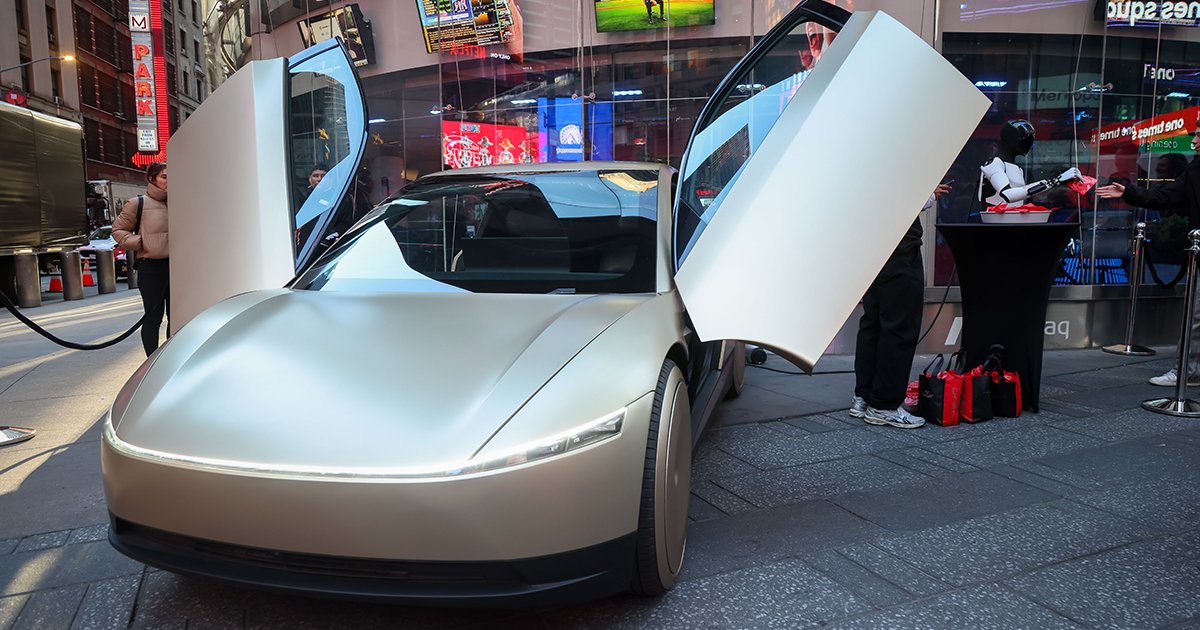
A Tesla CyberCab prototype in front of Nasdaq MarketSite in New York. (Michael Nagel/Bloomberg)
key takeaways:
- The U.S. Department of Transportation proposed removing brake pedal requirements for driverless vehicles entirely through an update to federal safety standards on June 25.
- This change could accelerate the deployment of purpose-built robotaxis from companies like Tesla, Waymo, and Zoox by removing the regulatory hurdles associated with manual control.
- NHTSA said it will maintain braking performance standards and is developing comprehensive rules for autonomous systems, with further regulatory updates expected.
The U.S. Department of Transportation is moving toward eliminating brake pedal requirements in driverless vehicles, a move that could clear the way for companies like Tesla Inc. and Waymo to put more robotaxis on American roads.
According to a notice made public June 25, DOT’s National Highway Traffic Safety Administration has proposed updates to federal motor vehicle safety standards that would remove the requirement for a manual brake pedal in vehicles specifically designed to operate without a human driver. This change would not apply to other types of automobiles, which would still have to have a brake pedal.
The new rule is part of the Trump administration’s ongoing effort to modernize standards for driverless cars, which could ease the way for purpose-built autonomous vehicles, including Tesla’s CyberCab, a two-seat electric car that lacks a steering wheel and foot pedals. The robotaxi market includes several big-name players, including Amazon.com Inc. Zoox and Alphabet Inc. Waymo is the largest operator of paid robotaxi rides in the US.
Current regulations create barriers for companies that want to bring to market autonomous vehicles designed without certain controls. Still, it’s unclear whether regulators plan to adjust rules related to steering wheels or other devices.
The requirements have been a stumbling block for auto makers in the past. These include General Motors Co., which halted work on its Origin AV in 2024 due to regulatory uncertainty over the lack of some manual controls in the vehicle.
NEW: NHTSA is updating federal safety standards to remove the manual brake pedal requirement specifically for vehicles operated by automated driving systems.
As fully autonomous vehicles (AVs) continue to evolve, NHTSA is reimagining the rules for cars that will never be driven… pic.twitter.com/UdCXfER0bP
– NHTSAgov (@NHTSAGov) 25 June 2026
Yet while DOT, through NHTSA, can set or remove specific rules that could ease approval for driverless vehicles, widespread adoption is still limited by technical factors, investment costs, and the readiness of individual travelers.
rethinking tool
NHTSA’s new proposal is part of a broader effort by the agency to remove unnecessary barriers that hinder autonomous vehicles. More changes are expected after this.
Tesla CEO Elon Musk, one of President Donald Trump’s biggest donors, has advocated for federal policy changes that would facilitate widespread commercial deployment of self-driving vehicles, including calling for a federal framework for driverless cars. The Autonomous Vehicle Industry Association, which represents companies including Waymo and Zoox, has similarly urged lawmakers to create a federal policy framework.
Last year, Musk lobbied lawmakers in Washington to help clear the way for autonomous vehicles, and pushed for amendments to a bill that would help establish a basic regulatory framework.
Tesla launched its long-awaited robotaxi network last year in Austin with a limited number of Model Y SUVs. It has since gradually expanded, adding service to Dallas and Houston with a total fleet of less than 100 vehicles in the state. The company also operates a non-autonomous rideshare network in the San Francisco Bay Area of California.
Waymo operates a fleet of thousands of robotaxis with customer rides in 11 cities and plans to expand to 20 cities by the end of the year.
The proposed rule on brake pedals would not affect other braking performance requirements such as stricter stopping distance standards, NHTSA said in a statement. The existing standard requirements for vehicles equipped with automated driving systems with manual driving controls will also not change.


Cox Fleet’s Kevin Clark discusses how fleets must rethink their maintenance strategies to remain efficient and flexible. Tune in by going above or RoadSigns.ttnews.com.
Historically, manufacturers have had to seek waivers from NHTSA to deploy autonomous vehicles that run contrary to federal standards, many of which were enacted decades ago before the advent of automated driving systems. NHTSA has updated many of those standards and said companies will not be required to seek waivers in the future once the modernization work is complete.
“While this update ensures that AVs can physically stop when given a command, NHTSA is separately developing safety performance requirements for AVs in real-world driving scenarios,” the agency said in its statement. “NHTSA will continue to use its broad defect enforcement authority to investigate unsafe ADS behavior and monitor recalls.”