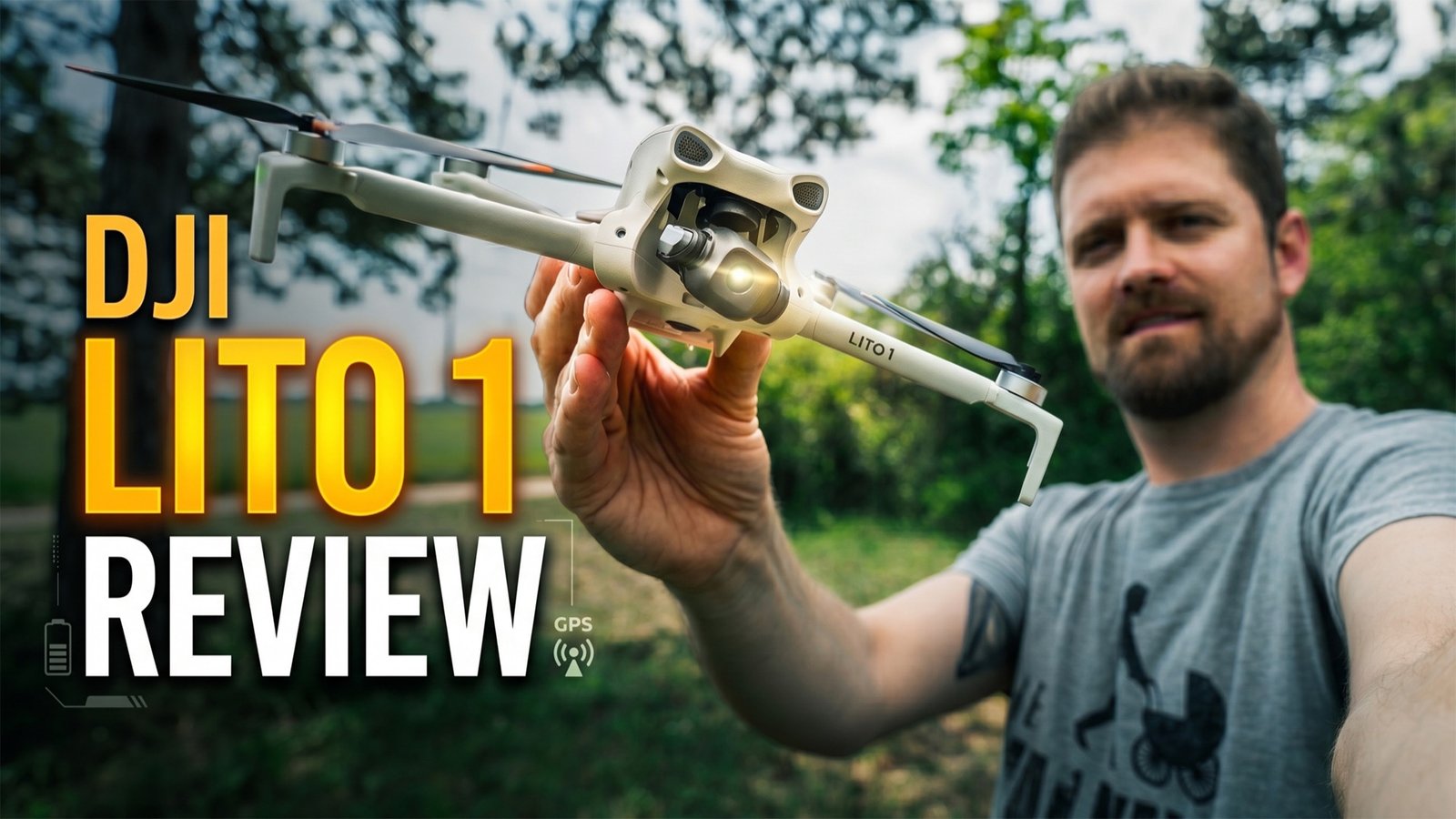
DJI’s new entry-level sub-250g drones, the Lito 1 and Lito The X1 adds front-facing LiDAR and D-Log M with its larger 1/1.3” sensor, while the more affordable Lito 1 sports a 1/2” sensor. In my review, I focused primarily on the Lito 1. So, if you’re interested, keep reading and/or watch the video with the shot footage to see for yourself!
Introduced in late April 2026, the Lito 1 and Lito X1 are DJI’s entry-level sub-250g drones for first-time aerial creators. As I understand it, the Lito series is replacing all existing mini drones in DJI’s “non-pro” lineup. The Mini Pro name will then be used for the top-of-the-line sub-250 gram drone.
Lito 1 vs Lito X1
The DJI Lito series consists of two models – the most affordable entry-level Lito 1 and the better equipped, but more expensive, Lito X1.
Here is a list of the main differences between the two drones:
- Camera Module: The Lito 1 features a small 1/2″ 48MP CMOS sensor paired with a 26.2mm (full-frame equivalent) f/1.8 lens with a focus range from 4m to infinity.
- The resolution and frame rates available in video mode are the same for both drones. The one exception is the inclusion of a FullHD 200fps mode on the Lito X1. The X1’s larger sensor is believed to have better dynamic range, and you can record video in the D-Log M profile as well as HDR. With the Lito 1, you can only record in the Normal profile, but it’s still 10-bit.
- Internal storage: The Lito 1 doesn’t have built-in storage, so you’ll have to insert a microSD card; Lito X1 has 42GB of inbuilt storage.
- Both drones feature omnidirectional vision systems with a bottom/up camera configuration, but the Lito X1 adds front-facing LiDAR.
While most reviewers so far have focused on the feature-enhanced Lito X1, I decided to challenge myself and chose the more affordable Lito 1 for my review.
DJI Lito 1 – entry level with omnidirectional vision
Finally, we reached the moment where DJI’s most affordable folding drone offers omnidirectional vision thanks to a full obstacle sensing system and can therefore be easily recommended to first-time pilots and drone beginners. Having a full obstacle sensing system significantly reduces the risk of the drone crashing during the first few sessions.

The new system only has two cameras, one facing downwards and one facing upwards, and I think this simple configuration helped DJI Reduce costs and keep drones so affordable.
The added front-facing LiDAR sensor on the X1 improves obstacle sensing in low light, but otherwise, it works well on both models.

According to DJI, the maximum flight time with both Lito models is 36 minutes, so, realistically, you get about 30 minutes. You can extend flight time with DJI’s larger, heavier battery, but keep in mind that the Lito will weigh more than 250 grams when using it, and you’ll have to follow strict rules.

With the O4 transmission system, the performance of the remote control is good and I did not experience any issues with the connection during my testing.
camera and lens
As I mentioned at the beginning, the Lito 1 uses a smaller 1/2″ CMOS sensor with a resolution of 48MP (or 12MP binned). The sensor size is similar to the smaller DJI Neo 2. The sensor is paired with a 26.2mm (full-frame equivalent) f/1.8 lens, which has a fixed focus. Like an action camera, you can’t change focus.
Additionally, the minimum focusing distance is 4m. This means that anything closer than this will be out of focus. For me, this was probably the most disappointing discovery while testing the drone. The X1 performs better in this regard, as it can focus on subjects even up to 1 meter away. There’s up to 4x digital zoom available, but, of course, you lose some image quality when using it.

Video mode – all the resolutions and framerates you need
The nice thing is that even though the Lito 1 doesn’t offer DJI’s D-Log M color profile, it still allows you to record in 10-bit 4:2:0 H.265 using the normal color profile. The colors coming out of the camera aren’t my favorite, but because of the 10-bit color depth, they can be adjusted quite effectively in post-production.
The Lito 1 can shoot in UHD 4K at frame rates between 24 and 60fps. From my testing, the bitrate in H.265 is around 85Mbps in 4K60 and around 65Mbps in 4K30.
For vertical shooting, the drone uses a 9:16 cropped middle portion of the image because unlike the Mini Pro series drones, the camera module cannot physically rotate to offer true vertical shooting. It is available in 2.7K resolution at up to 9:16 crop 60fps.

Another plus is that Lito 1 allows you to adjust sharpness and noise reduction. Like other DJI drones, I think it’s best to set both -2 For ultimate flexibility in post production. I also don’t like the oversharpened (smartphone-like) look when you leave the two together 0.

slow motion video
Slow-motion video is available at up to 100fps and up to 4K resolution. Saves drone footage as 25fps video clips are slowed down by 25%. The bitrate of the resulting video is around 30Mbps, so basically, the bitrate of 4K 100fps footage is around 120Mbps.
It would be nice to see 120fps in 4K, but I’m still grateful that even the most affordable drone models get at least 100fps in 4K. Quality is also definitely useful.


Still – DNG Raw up to 48MP
The Lito 1 supports still image capture in compressed JPEG, DNG RAW, or both, at 12MP (4000 x 3000px) or 48MP (8000 x 6000px). From my testing, 48MP DNG still image size is around 60-70MB, 12MP DNG photo size is around 18MB. For JPEGS, it’s 20-30MB for 48MP and around 9MB for 12MP.


I would say that still image quality is not bad when there is enough light. In challenging lighting conditions, you will soon reach the limitations of the smaller sensor with increased noise.
If you’re interested in pixel-peeping the still images I shot in full resolution, Here you can download them.
conclusion
In my opinion, the DJI Lito 1 and Lito X1 are perfect as affordable entry-level drones. Previously, the two most affordable sub-250g drone models, the DJI Mini 4K and the DJI Mini 3, did not offer any sort of interference and were therefore difficult to recommend for beginners who were just starting to fly drones.
Although the image quality of the DJI Lito 1 is not excellent, it is not that bad either. The small 1/2″ sensor can produce relatively good-looking images when lighting conditions are favorable. For me, perhaps the biggest – and most unexpected – limitation was the fixed-focus lens with a 4-meter minimum focus distance.

Honestly, if you’re in the market for your first drone and plan to use it primarily for capturing images, I’d definitely recommend spending a little extra (currently the difference is only €70) and getting the Lito X1, which has a better camera module, built-in storage, and additional LiDAR sensor. If the price gap becomes large enough in the future, Lito 1 could also be a viable option.
Finally, it looks like both Lito drones are not currently officially available in the United States. However, this may change in the future.
Do you have experience flying any DJI drones? What do you think of the new entry-level Lito drone? Let us know in the comments section below the article.