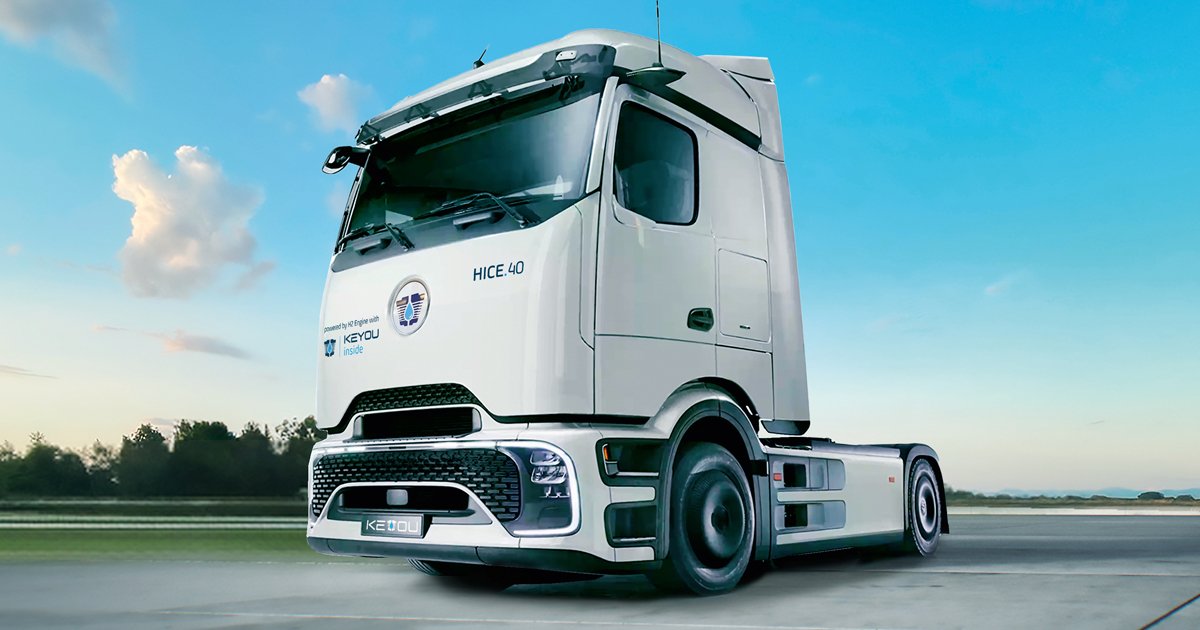
The Qiu HICE.40 is expected to achieve a range of up to 650 kilometers or more than 400 miles. (Daimler trucks)
key takeaways:
- Daimler Trucks partnered with Kiyu to introduce hydrogen-fueled internal combustion engine tractors in Europe as early as 2027.
- The partnership adds hydrogen combustion to Daimler Trucks’ 2027 powertrain lineup, along with diesel, battery-electric, hydrogen fuel cell and natural gas options.
- Qiu will first convert Mercedes-Benz Actros L 1848 tractors, while Daimler Trucks plans to have 100 NextGenH2 fuel cell trucks by 2026.
Daimler Trucks is teaming up with Kiyu to begin offering tractors with hydrogen-fueled internal combustion engines as early as 2027, focusing on European markets.
The partnership adds a fifth variable to the engine options that the world’s largest truck maker will offer in 2027. The other four options are diesel, battery-electric, hydrogen fuel cell electric, and internal combustion engines powered by natural gas.
The move by the parent company of Freightliner and Western Star also opens up competition with Volvo Group’s Cespira hydrogen ICE powertrain joint venture.
Daimler Trucks’ existing vehicle and engine variants will provide the basis for the partnership. KU will be responsible for the hydrogen conversion, with the vehicles and engines optimized by the Munich-based company’s service providers.
Mercedes-Benz Actros L 1848 tractor units and engines manufactured in Mannheim, Germany, with the existing 12.8-litre engine platform, will be the first trucks to be converted by KU and its service partners.
The resulting tractor, the KU HICE.40, is expected to achieve a range of up to 650 kilometers or more than 400 miles.
In the longer term, the port fuel-injection system with 350-bar compressed hydrogen is expected to be adapted to additional Daimler truck models.
Daimler Trucks said it had been exploring hydrogen combustion for several years and, rather than building its own systems, opted for a partnership model.
“The road freight transport sector requires different drive solutions for different applications,” said Andreas Gorbach, Daimler Trucks board member responsible for truck technology. “Hydrogen can be used to power both fuel cells and internal combustion engines. By working with KU, we are partnering with a specialized company to bring hydrogen combustion technology to market quickly and efficiently.”
Daimler Trucks said it believes trucks with hydrogen ICE powertrains are stronger and have lower system complexity than fuel cells, making them particularly suitable for applications with high payload requirements.

Eaton’s Jason DiNardo and Leah Bogle address common misconceptions about automated manual transmissions and examine what today’s drivetrain service environment requires. Tune in by going above or RoadSigns.ttnews.com.
In comparison, the truck maker sees fuel cell technology as an advantage in demanding long-term operation, noting that ranges of more than 1,000 kilometers are possible with minimal and fast refueling.
German logistics group Dachser will be the first customer to put a production model of the Mercedes-Benz NextGenH2 hydrogen fuel cell electric tractor on the road in December.
Dachser Group is ranked 35th in Transport Topics Top 50 list of the largest global freight companies.
The NextGenH2 has a range of over 1,000 kilometers when both liquid hydrogen tanks are refueled. A liquid hydrogen refueling technology developed by Daimler Trucks and its partner Linde, known as SLH2, allows trucks to be fully refueled within 10–15 minutes.
Linde (North America) is ranked 29th on the TT Top 100 list of the largest private carriers in North America.
A total of 100 NextGenH2 trucks will be built at Mercedes-Benz’s flagship Werth plant until the end of 2026 as part of the first small series production for the model.
Daimler Trucks took the wraps off the NextGenH2 in January, the second generation of its GenH2 hydrogen fuel cell tractor. Series production of fuel cell trucks is targeted for the early 2030s.
The German company said it supports the development of hydrogen refueling stations capable of dispensing both gaseous and liquid hydrogen, allowing all common hydrogen forms to be offered at a single station, as is the case with gasoline and diesel stations.
Keyou HICE.40 will use gaseous hydrogen, and NextGenH2 will use liquid hydrogen.
Meanwhile, in North America, Freightliner is introducing its flagship Cascadia tractor with a natural gas-powered Cummins X15N engine.
Cummins is also expected to offer an internal combustion engine fueled by hydrogen as part of its high-efficiency, low-emission, multiple fuel program. The engine maker is set to introduce non-diesel options of the X10 engine.
Freightliner and Western Star will introduce six Cummins engines, including the X10, in 2027.