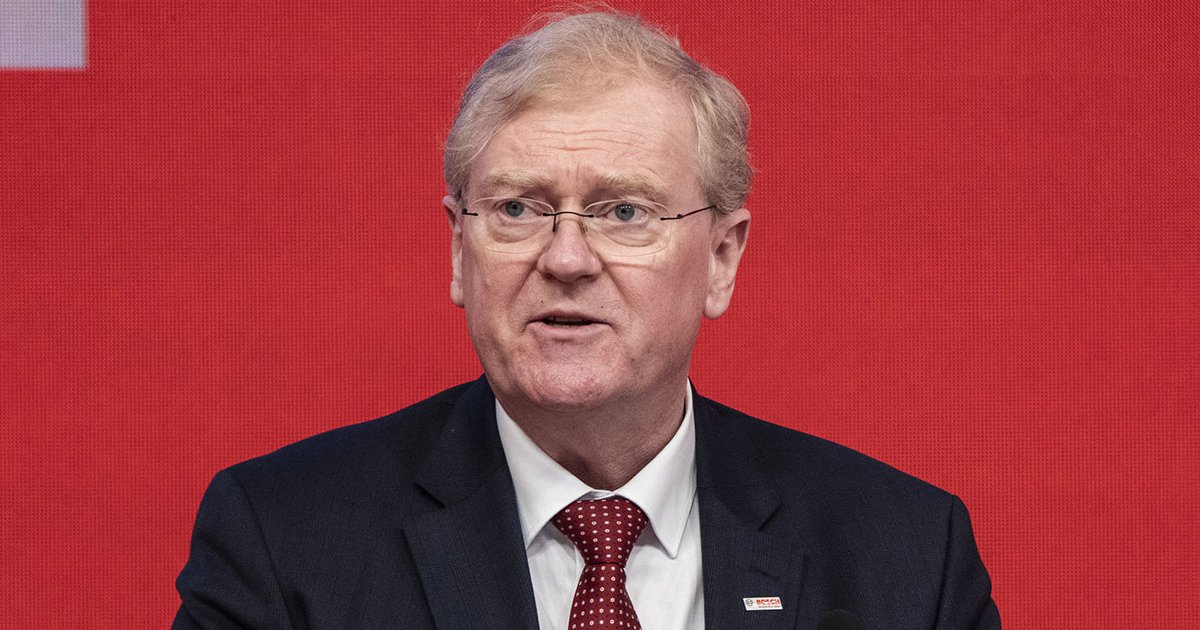
Departure of Stefan Hartung, CEO of Robert Bosch. (Qilai Shen/Bloomberg)
key takeaways:
- Robert Bosch CEO Stefan Hartung will step down on July 1 and will be replaced by Deputy CEO Christian Fischer.
- Bosch said Hartung requested to leave as the supplier faces EV demand uncertainty, China competition, tariffs and planned cuts of 18,500 jobs.
- Chief financial officer Markus Forschner and mobility head Markus Hein will become co-deputy CEOs as Fischer takes over the leadership of Bosch.
Robert Bosch GmbH CEO Stefan Hartung is stepping down after cutting thousands of jobs and taking steps to make the world’s largest automotive supplier more competitive.
Bosch said on June 26, the 60-year-old requested to leave to pursue “new social commitments and entrepreneurial work.” Deputy CEO Christian Fischer, 58, will replace him on July 1.
After rising through its ranks, Hartung is to lead the closely held maker of drivetrain components, power components and air conditioning units from 2022. Chief financial officer Markus Forschner and head of the mobility unit Markus Hein will become the new co-deputy CEOs. Bosch said Hartung’s departure followed thorough consultation with the company.
Bosch, which employs more than 400,000 people and had revenue of 91 billion euros ($104 billion) last year, has been hit hard by the automotive industry’s downturn. Global demand for electric vehicles has been uneven, prompting Bosch’s automaker customers to scale back some of their EV ambitions. Nimble new competitors in China are also outperforming large parts of the existing industry on costs.
Bosch, which is leading the response under tough circumstances, has detailed plans to eliminate a total of 18,500 positions. The cuts, including 13,000 cuts announced in September affecting its mobility unit, served as a wake-up call to the industry’s struggles. Its peers, Aumovio SE and ZF Friedrichshafen AG, are also reducing staff.
Since then the challenges have increased further. US tariffs, declining demand in China and the Middle East conflict are impacting margins, prompting renewed efforts to reduce costs.
Fischer, who has a PhD in economics, becomes deputy CEO of Bosch in 2022. He has been responsible for the group’s strategic growth initiatives and portfolio management as well as the consumer goods business. He started his career as a business trainee with Bosch, then worked as a consultant for Roland Berger in Berlin and Stuttgart.
Hartung, a former McKinsey manager, has other interests. Earlier this year, he joined Henkel AG’s shareholder committee, a body that advises the German company’s top management. In October, Bosch extended his CEO contract for another five years.
Earlier on June 26, Manager magazine reported plans by Volkswagen AG to double job cuts to 100,000 and press for renewed pressure to close four plants in Germany. BMW AG, which had previously been more hawkish, last week sharply cut profit expectations for the year.