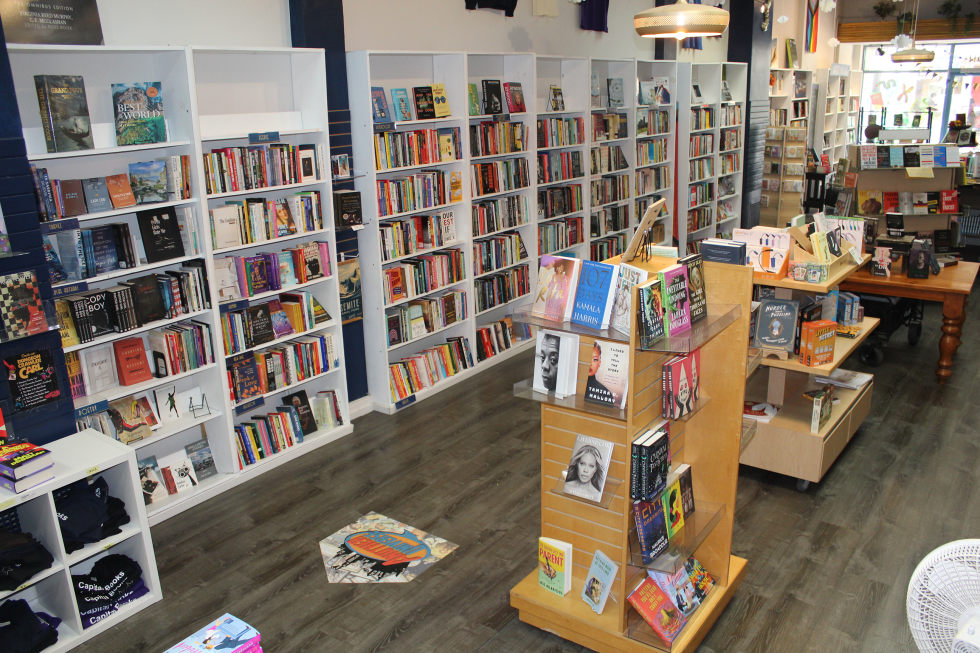
Approximately 12,000 different
titles are for sale on the main floor ofCapital Booksin downtown Sacramento. Of those, bookstore
co-owner Ross Rojek said the number explicitly written by
generative artificial intelligence: “Zero, but I don’t know.”
Large Language Models like
ChatGPT and Claude are increasingly used to churn out
machine-written novels. Some have embraced the technology, while
those in the publishing industry, like Rojek, avoid it like the
plague. He refuses to stock any generative AI titles, believing
they won’t sell. “People want to buy books by people,” he says.
AI book covers and artwork are easy for Rojek to spot, but he
increasingly doubts what is or isn’t machine-written text.
“It’s not going to get any
better,” Rojek says. “It’s going to get harder and harder to
detect, and I don’t know that there’s a solution to it other than
human curation and customer decision.”
Publishers and authors in the
Capital Region have pushed back against the recent proliferation
of AI books, refusing to touch the technology or work with those
who do.
‘I just don’t think that
machines can feel’
Julia Park Tracey, of
Grass Valley, is the executive editor atSibylline Pressand handles acquisitions. She screens all
submissions sent to the publisher, which exclusively works with
women authors over age 50, and rejects manuscripts suspected of
AI text, believing them low quality and dishonest.
“I just don’t think that machines
can feel,” Park Tracey says. “They can fake it, but we want
authenticity. We want vulnerability, and how can a machine be
vulnerable?”
Sibylline Press hasn’t received
many manuscripts suspected of AI text, but a recent incident
proved to be a grey area. An aspiring author admitted during the
signing process that she used AI to rewrite and copyedit her
book. The company asked her to rewrite it herself. If someone has
a story to tell but lacks experience, Park Tracey encourages them
to hire a ghostwriter.
“If you don’t have the skills to
write a book, work with a human,” Park Tracey says. “But feeding
it into AI, it just sets off red lights all down the production
path because I don’t want to waste my time reading a book that’s
not authentic.”
Sibylline Press publisher Vicki
DeArmon, of San Diego, said that using AI-generated text in a
book “is a mark against quality, but it’s also a mark against
promotability.” Publicizing who wrote it, how and why are key to
marketing. These traits are absent in a machine-written novel,
making it a tough sell. “It’s not like any book rises to the top
without a parallel construction of who the author is,” she
says.
DeArmon thinks generative AI
could write a passable plot-heavy novel. For the more complex
books Sibylline Press specializes in, like memoirs, an author’s
tone, voice and uniqueness are vital for marketability, and AI
text is too generic to meet audience expectations the publisher
has cultivated.
“I’m not sure that there isn’t a
market for it, but it doesn’t necessarily have the sophistication
that we require,” DeArmon says. “But, you know, maybe those
readers don’t require that sophistication.”
‘They’re getting away
with it’
To develop LLMs, some tech
companies have pirated books for use as training data without
permission or compensation of authors, which has soured a lot in
the publishing industry on the technology. “Many of us are
already burned, mad, exhausted and feel ripped off by generative
AI because we’ve had our hard work that we worked on for years
stolen for training purposes,” Park Tracey says.
This has resulted in several
class action lawsuits. Facebook owner Meta was sued for using
pirated books from the file-sharing website Library Genesis as
training data for LLaMA 3. Two of those books were authored
byPark Tracey. The
plaintiffs in Kadrey v. Meta Platforms, Inc.alleged copyright infringement, but in June
2025, a judge ruled it fair use. “Those of us whose work was used don’t
call it fair,” Park Tracey says.
The authors lost their
training-related copyright claim.However, a similar lawsuit, Bartz v.
Anthropic, resulted in a $1.5 billion settlement. Anthropic used
7 million pirated books as training data for Claude. While the
judge also found this fair use, they also ruled that downloading
and keeping the pirated books was not, which led the tech company
to agree to pay around $3,000 for half a million qualifying
books.
Four of those titles
were authored byKim Culbertson,a recently retired high school teacher from
Nevada City. As to the amount awarded, she thinks it’s too low.
“I don’t feel that’s fair,” she says. The settlement money is
split between the book’s author and publisher, so she’ll only net
around $6,000 in total. Regardless of the amount, she sees the
ruling as a win for writers.
“The fact that the judge cited on
behalf of authors and on authorship and creativity and
intellectual property, I mean, that’s a good sign,” Culbertson
says. “That was validating to hear, ‘yes, they stole this from
you.’ Did they make billions of dollars anyway? Yes.”
Elk Grove authorMark Steenslandhad one book qualify for the settlement and
will split the award with his publisher. While any money is
better than no money, if Anthropic had offered him that deal, “I
would have said no.” Steensland feels like a lump sum is a means
to buy off writers, and offering residuals, a percentage of any
money made off their work, would have been more equitable.
“If you’re going to be having
this kind of profit, then I should be sharing in that also, since
this is my work that is allowing you to do this,” Steensland
says. “So just in principle the arrangement is unfair, and it’s
kind of like they’re getting away with it.”
Michele Drier, a retired journalist turned author from
Sacramento, had three books qualify, all self-published, meaning
she’ll keep the full settlement. As for the dollar amount, she
said, “it’s a reasonably fair amount,” with the caveat being she
isn’t an expert on intellectual property and trusts the deal the
lawyers reached was just.
As for her book being used as
training data without permission: “I’m really upset about it,”
Drier says. Pirating her work, “I don’t like that, but it’s
somewhat understandable because at least you stole it because you
want to read my book.” But using her work for generative AI
training data, in her view, is inexcusable. “Because then you’re
making money off of it.”
‘It’s really
dishonest’
Some aspiring authors have used
generative AI to create machine-written books and fraudulently
passed them off as original work. Others have used the tech to
copyedit their writing, permissible to some, but unappealing to
Culbertson. She enjoys spending time tinkering around with a
sentence until it’s just right. “Efficiency is never going to be
my drug of choice. I don’t think being faster is what makes
something better,” she says.
For Culbertson, writing involves
making creative choices that she believes reflect a person’s
thought process and personality. She worries that using
generative AI to rewrite text will cause authors to lose their
individuality.
“Writing is about messing around
with language and sound, and there’s a rhythm in it, and it’s
beautiful,” Culbertson says. “And I am afraid that too much
AI-generated text is going to all start sounding the same. It’s
like a homogenization of language in a way that I’m not
interested in.”
Steensland said the prevalence of
low-quality generative AI books damages public perception of the
art form. He refuses to use the technology, believing it utilizes
stolen work and wastes electricity and water. He also points to
other flaws, such as how chatbots have created misinformation due
to “hallucinations” and worsened some people’s mental health to
the point of suicide.
“We can clearly see the dangers
and drawbacks of the technology as a whole, and that makes us
responsible for it,” Steensland says, “and I’m not going to
participate in that in any way if I can.
“I smoked cigarettes for years,
and I thought it tasted great and it smelled great, and I looked
cool as hell when I was smoking. Cigarettes killed my dad, and I
wasn’t acknowledging objective reality. That’s something we need
to do.”
Drier also won’t use generative
AI for writing. “It’s really dishonest to put out
machine-generated material that has no heart or soul to it,” she
says.She thinks generative
AI could be used to create passable “formulaic fiction,” a story
that follows popular tropes and patterns, but worries these
low-effort AI books oversaturate the market and “absolutely
undercut legitimate authors.”
In 2023, Amazon’s self-publishing
platform, Kindle Direct Publishing, announced a policy change to
deter AI books from flooding the marketplace. Authors were
allowed only three title uploads a day, or 21 a week. Two years
later, that limit was reduced to 10 titles a week, and reduced
further in September to two a week.
Recently Drier’s sales on the
platform have declined. She doesn’t know why but speculates the
abundance of AI books makes it harder for potential customers to
come across her work. She hopes the recent policy change will
help, but at the end of the day, it will be up to readers to
decide whether or not AI books have a place in the market.
“I wish that there were some way
that readers could be discerning enough that they would stop
buying those books,” Drier says. “That’s the only thing I can
think of that’s going to stop this.”
Never miss a story: Get Comstock’s weekly newsletter delivered to your
inbox.
Will generative AI replace journalists? Many of those in the
business think so, if preventative measures are not taken.
Others say it’s a tool for brainstorming and increased
productivity.
Tuleburg Press, founded in 2013, is a Stockton nonprofit
publishing company with a focus on developing creative literary
community programs, showcasing local writers and building an
appreciation of the book arts.
No agent? No problem. In the age of self-promotion, tech
savvy authors are cutting out the middleman.
Local arts leaders say Sacramento has no shortage of talent or
audiences, but shrinking grants, rising costs and limited
corporate support are making it harder to build a sustainable
creative economy.