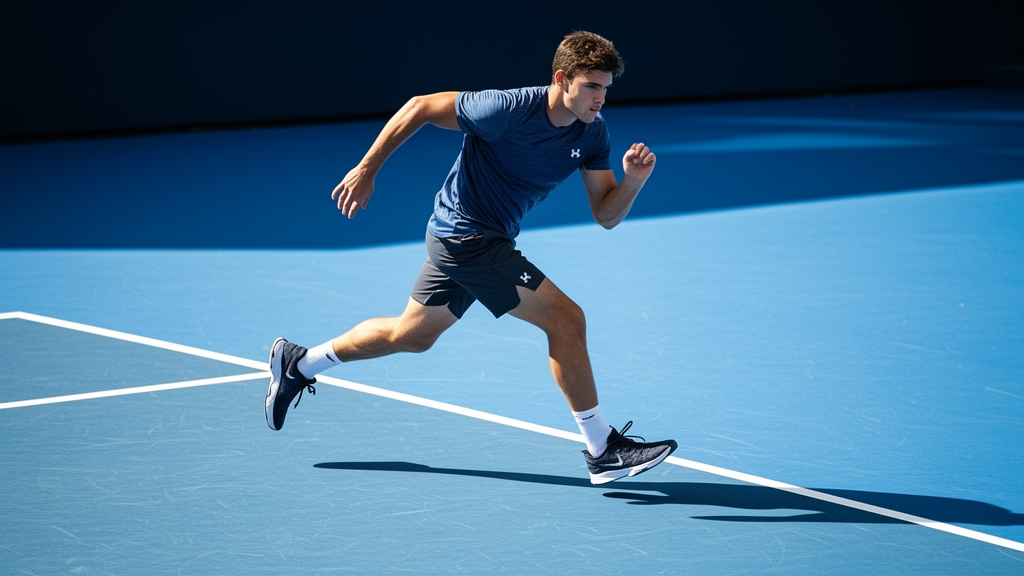
An eight-week randomized controlled trial has demonstrated that court-based sprint interval training delivers superior improvements in aerobic power, ventilatory threshold, and on-court technical accuracy compared with traditional continuous endurance running in competitive collegiate tennis players. Conducted by exercise scientists at Capital University of Physical Education and Sports in Beijing, China, the single-blind investigation evaluated forty-eight male players to resolve how distinct conditioning strategies influence the physiological and functional demands of competitive tennis. While both training modalities produced measurable cardiovascular gains over the intervention period, athletes completing court-specific shuttle sprints achieved statistically greater enhancements in maximal oxygen uptake and second ventilatory threshold than those assigned to steady-state treadmill running, alongside exploratory improvements in groundstroke precision, reactive strength, linear acceleration, and change-of-direction speed.
The physical demands of competitive tennis present a persistent programming challenge for coaches who must carefully balance conditioning volume against technical court practice, tactical instruction, and athlete recovery within finite weekly training schedules. The sport requires athletes to repeatedly produce high-intensity multidirectional accelerations, sudden braking actions, and explosive stroke executions interspersed with brief recovery intervals throughout extended matches. Although continuous endurance training has long served as a traditional method for building foundational cardiorespiratory capacity, uninterrupted steady-state running does not replicate the intermittent, high-velocity movement patterns inherent to competitive match play. Consequently, researchers designed the court-based sprint interval protocol to investigate whether a time-efficient conditioning stimulus incorporating tennis-specific movement geometries could simultaneously stimulate central oxidative capacity and support sport-specific neuromuscular and technical performance without requiring extensive additional running mileage.
The study cohort comprised forty-eight male collegiate tennis players recruited from Capital University of Physical Education and Sports, all classified as Tier 3 highly trained or national-level athletes according to established participant classification criteria. Eligible participants were between eighteen and twenty-three years of age, possessed at least five years of systematic tennis training experience, and had competed in Chinese Collegiate Tennis Competition Group A tournaments during the preceding twelve months. Athletes were excluded if they presented recent musculoskeletal injuries, significant interruptions to systematic training, or cardiovascular and metabolic disorders. The participants exhibited homogeneous baseline characteristics, with an overall mean age of approximately twenty-one years, mean body mass index near twenty-three kilograms per square meter, and an average training background exceeding six years. Following comprehensive familiarization sessions, participants were randomly allocated in an equal one-to-one ratio to either the sprint interval group or the continuous endurance group.
Throughout the eight-week intervention, both experimental cohorts maintained
Throughout the eight-week intervention, both experimental cohorts maintained identical technical tennis training schedules, participating in regular university tennis classes twice weekly for forty-five minutes per session, yielding ninety minutes of standardized on-court practice each week. In addition to this baseline volume, participants completed three supervised conditioning sessions per week according to their randomized allocation, with the sprint group training on Mondays, Wednesdays, and Fridays, while the continuous group completed sessions on Tuesdays, Thursdays, and Saturdays. The sprint interval protocol required athletes to execute court-based 110-meter shuttle sprints across marked cones set at intervals of 0, 5, 10, 15, 20, and 25 meters, following a structured 0-20-5-25-5-10-5-15-0 meter route that demanded repeated maximal accelerations, decelerations, and directional changes. Players completed three sets of three maximal repetitions, with twenty seconds of passive recovery between repetitions and five minutes of rest between sets, totaling nine shuttle runs and 990 meters of sprinting per session.
In contrast, the active comparator group performed continuous endurance running on motorized treadmills at an individualized speed corresponding to sixty-five percent of each participant’s baseline maximal oxygen uptake. To achieve progressive aerobic overload, continuous exercise volume advanced systematically across the eight-week intervention, starting at thirty minutes per session during weeks one and two, expanding to forty-five minutes per session in weeks three and four, and reaching sixty minutes per session throughout weeks five to eight. All conditioning sessions across both groups incorporated identical twenty-minute standardized dynamic warm-up routines—consisting of low-intensity jogging, dynamic quadriceps stretching, butt-kicks, high-knees, lateral lunges, and mobility drills—as well as structured post-exercise cool-downs comprising five minutes of walking and fifteen minutes of static stretching overseen by the same dedicated supervisory coaching team.
Cardiopulmonary fitness was evaluated using graded treadmill exercise testing coupled with breath-by-breath open-circuit spirometry to measure maximal oxygen consumption, maximal minute ventilation, and the second ventilatory threshold where respiratory compensation occurs. Following within-family Holm adjustment to account for multiple statistical testing, group-by-time interaction effects remained statistically significant for both primary aerobic indices. Maximal oxygen uptake in the sprint interval group increased from 50.41 to 53.24 milliliters per kilogram per minute, reflecting an average gain of 2.83 units, whereas the continuous endurance cohort increased from 49.83 to 51.58 milliliters per kilogram per minute, an improvement of 1.75 units. The estimated between-group difference in longitudinal change was 1.073 milliliters per kilogram per minute in favor of sprint training. Similarly, the second ventilatory threshold advanced by 214.71 milliliters per minute following sprint intervals compared with 106.76 milliliters per minute after continuous running, yielding an estimated between-group difference in change of 107.95 milliliters per minute.
The physiological adaptations did not reflect a uniform
However, the physiological adaptations did not reflect a uniform upward shift across every cardiopulmonary metric examined by the research team. Furthermore, secondary ventilatory indices did not demonstrate differential adaptation between the conditioning protocols; the interaction for the ventilatory equivalent slope for carbon dioxide output was statistically significant prior to multiplicity control but did not withstand Holm adjustment, and the ratio of second ventilatory threshold to maximal oxygen uptake showed limited evidence of divergent change. These precise findings indicate that the primary aerobic advantage conferred by the shuttle sprint protocol centered specifically on expanding peak aerobic power and delaying the onset of respiratory compensation during intense exercise rather than altering generalized ventilatory efficiency.
Standardized tennis groundstroke performance was assessed on an indoor hard court using a programmable ball machine that fed balls at a fixed velocity of forty-five kilometers per hour with moderate topspin at six-second intervals. Players executed forty valid groundstrokes—comprising twenty forehands and twenty backhands across alternating ten-ball blocks—directed toward a designated target zone measuring 1.5 by 1.5 meters positioned near the opposite baseline and sideline. Two independent assessors blinded to group assignments scored high-definition video recordings of every trial. Overall stroke accuracy in the sprint interval cohort rose from 64.01 percent to 68.23 percent, an improvement of 4.22 percentage points, whereas the continuous group improved from 63.33 percent to 64.84 percent, an increase of only 1.51 percentage points. This differential change remained statistically significant after multiplicity adjustment, generating the largest interaction effect size observed in the trial. Concurrently, unforced errors dropped by 4.01 percentage points in the sprint group compared with a 1.30 percentage point reduction in the continuous running cohort.
Neuromuscular assessments conducted on a calibrated three-component force platform revealed a distinct, outcome-specific adaptation pattern across lower-limb explosive metrics. Drop-jump reactive strength index—calculated as jump height divided by ground contact time—exhibited a statistically significant exploratory group-by-time interaction following Holm adjustment, increasing from 1.60 to 1.69 meters per second in the sprint cohort while shifting only from 1.58 to 1.61 meters per second among continuous runners, representing an estimated difference in change of 0.062 meters per second. In contrast, countermovement jump height improved equivalently in both groups over time, displaying no differential interaction between training programs, while squat jump height and the eccentric utilization ratio exhibited negligible divergence. Researchers noted that the maximal stretch-shortening cycle demands and rapid deceleration-reacceleration cycles of shuttle sprinting specifically stimulated fast ground-contact force transmission, whereas general vertical impulse production developed similarly across both active athletic routines.
Field-based physical performance tests echoed this selective performance
Field-based physical performance tests echoed this selective performance transfer, as demonstrated by photocell timing gate assessments during twenty-meter linear sprints and the 5-0-5 change-of-direction test. Sprint interval conditioning produced a greater reduction in twenty-meter sprint time, dropping from 3.25 to 3.18 seconds compared with a minor change from 3.27 to 3.24 seconds following continuous treadmill training, yielding a statistically significant adjusted interaction. Similarly, 5-0-5 completion times, which evaluate the execution of a five-meter approach, a 180-degree turn, and a five-meter return sprint, improved by 0.11 seconds in the sprint group versus 0.04 seconds in the continuous group, confirming superior adaptation in directional agility. Conversely, standing long jump distances improved slightly over time across the entire sample but revealed no differential interaction between groups, corroborating that bilateral horizontal jumping power was not uniquely enhanced by the sprint running intervention.
Serial capillary blood lactate concentrations were measured at rest, immediately after exhaustive treadmill testing, and throughout fifteen minutes of seated passive recovery using an enzymatic analyzer. Although unadjusted statistical models initially suggested that sprint training promoted greater decreases in blood lactate concentration at fifteen minutes of recovery and a larger relative percentage drop from peak concentrations, neither interaction retained statistical significance following Holm correction within the lactate outcome family, with both adjusted values settling at 0.054. The authors emphasized that post-exercise capillary concentration reflects a shifting dynamic balance between systemic lactate appearance and peripheral disposal rather than providing a direct quantitative measurement of metabolic clearance flux. Because blood samples were collected following treadmill running rather than during tennis drills, the observed trends cannot confirm that altered lactate kinetics causally mediated the superior stroke consistency recorded during on-court testing.
Intervention fidelity and training load monitoring underscored the marked difference in time efficiency between the two conditioning strategies despite comparable internal training loads. Data gathered through Polar chest-worn heart rate sensors confirmed outstanding participant adherence, exceeding ninety-five percent attendance across twenty-four scheduled sessions in both cohorts with protocol completion rates surpassing ninety-six percent. Remarkably, the actual main conditioning duration averaged 16.29 minutes per session for the sprint interval group compared with 48.52 minutes per session for the continuous endurance group. Despite continuous runners accumulating roughly three times the active exercise duration, both groups sustained nearly identical session training impulse scores using the Edwards heart-rate zone weighting method, averaging 61.39 and 61.88 arbitrary units, respectively. Within the sprint group, players maintained high running intensity throughout the intervention, averaging 30.23 seconds per 110-meter repetition at a mean velocity of 3.65 meters per second with an average sprint decrement of just 2.40 percent.
The study authors highlighted several methodological boundaries
The study authors highlighted several methodological boundaries that must contextualize the practical application of their findings. The participant cohort was restricted to young, highly trained male collegiate athletes, meaning that physiological and technical responses cannot be directly extrapolated to female players, developing junior competitors, recreational tennis enthusiasts, or touring professionals who operate under divergent physical and tournament stresses. Additionally, the eight-week intervention timeline captured early physiological adaptations but cannot determine whether cardiorespiratory advantages persist or plateau across an entire competitive season. Because the experimental design deliberately contrasted two multifaceted exercise programs differing in intensity, movement topology, and duration, the observed group differences reflect the holistic programs as prescribed and cannot isolate the independent contribution of exercise volume from movement mode. Furthermore, stroke mechanics were tested under predictable ball-machine conditions on a separate day without late-match mental pressure or tactical opponent responses. Consequently, while court-based shuttle sprint intervals represent an exceptionally potent and time-efficient conditioning strategy for collegiate tennis players, coaches should integrate them judiciously alongside structured strength development and comprehensive match-play preparation.
Subject of Research: Cardiorespiratory, technical, and neuromuscular adaptations to court-based sprint interval training versus continuous endurance running in collegiate tennis players
Article Title: Effects of 8-week sprint interval training on cardiorespiratory fitness, blood lactate responses, stroke performance, and neuromuscular function in collegiate male tennis players
Article References: Li, Y., & Shi, B
Article References: Li, Y., & Shi, B. (2026). Effects of 8-week sprint interval training on cardiorespiratory fitness, blood lactate responses, stroke performance, and neuromuscular function in collegiate male tennis players. Frontiers in Physiology, 17, Article 1956423. https://doi.org/10.3389/fphys.2026.1956423
DOI:10.3389/fphys.2026.1956423
Keywords: sprint interval training, continuous endurance training, tennis conditioning, VO2max, second ventilatory threshold, stroke accuracy, unforced errors, reactive strength index, change of direction, 5-0-5 test, blood lactate recovery, collegiate tennis, shuttle sprints, training impulse, exercise physiology, neuromuscular performance, high-intensity interval training
News. Court-Based Sprint Intervals Outperform Continuous Running in Collegiate Tennis Conditioning. Scienmag