

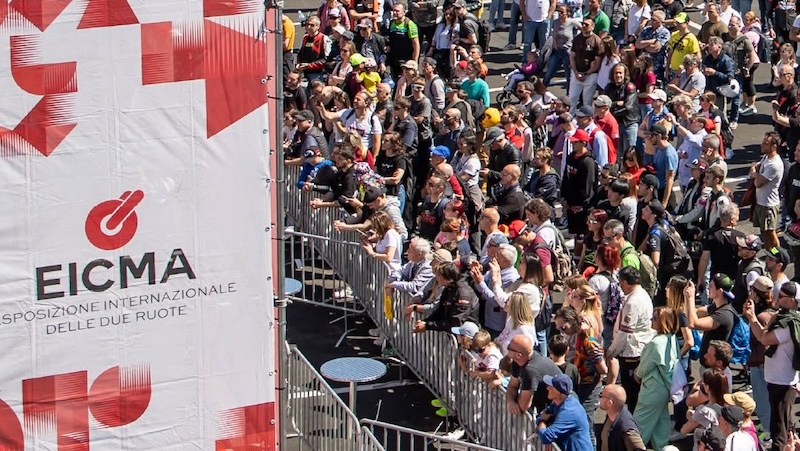
Every year, the world’s largest motorcycle companies (and plenty of the world’s smallest motorcycle companies, too) converge on Milan, Italy for Europe’s premier motorcycle showcase. That means that all of the newest electric motorcycle announcements happen in one place, and we get a chance to check out the coolest developments and most interesting new gear.
Below is a list of the best things I saw while walking around the show this year, presented in no particular order.
LiveWire shows off Honcho S4 in several variants, plus new DUST Moto dirt e-bikes
LiveWire came to EICMA with perhaps its most diverse electric two-wheeler lineup yet, showing just how far the company has expanded beyond the premium electric motorcycles that originally defined the Harley-Davidson spin-off.
The new S4 Honcho family was a major focus, including the street-oriented Honcho Street, off-road Honcho Trail, and newly unveiled Honcho Skate, a stripped-down addition to the modular platform. The booth also included LiveWire’s larger S2 electric motorcycles, creating a pretty broad spectrum from lightweight urban machines up through full-size highway-capable electric motorcycles.

The other big piece of the booth was DUST Moto, which LiveWire acquired earlier this year. The production-intent DUST Hightail was displayed alongside the newly revealed DUST Spur, giving LiveWire an immediate presence in the increasingly popular lightweight electric dirt bike category.
Add in STACYC’s electric balance bikes for young riders, and the entire booth almost looked like an electric two-wheeler progression chart: start a kid on a STACYC, move up through lightweight DUST and Honcho machines, and eventually graduate to a full-size LiveWire.

GRIT motorcycles shows off three models
GR1T Motorcycles is a relatively young European electric motorcycle startup that caught my eye at EICMA with its G1 platform, a lightweight electric motorcycle designed and engineered in Italy. The basic recipe is pretty compelling: 130 km/h (81 mph) top speed, 11 kW of continuous power and 26.6 kW (36 hp) peak, all while weighing just 130 kg (287 lb).
Perhaps most importantly for urban riders, its roughly 6 kWh battery is actually split into two removable 3 kWh packs, meaning apartment dwellers can pull the batteries out and charge them inside. They’re big, but removing them is doable.
GR1T’s bikes therefore pack in around 50% more battery capacity than most electric motorcycles in this size and weight class, meaning roughly 50% more range, as well.


There are also some interesting and clever design choices, like the underslung rear suspension and the triple-camera system that includes front and rear dashcams plus a cockpit-facing camera for recording the rider.
The clever part of the overall design scheme is that GR1T isn’t developing a separate platform for every motorcycle. The same basic G1 chassis, motor, batteries, belt drive, and electronics underpin four versions: the G1S Street, G1X Scrambler, G1XR Raider, and utility-oriented G1M Mission.
Prices are set to start at €8,495 including VAT, putting these squarely in that emerging category of reasonably affordable, lightweight electric motorcycles that have enough speed for real-world commuting without chasing superbike performance.

There’s an important caveat, though: these aren’t production motorcycles yet. GR1T says it is currently fundraising, with factory development and pre-orders set to follow after funding closes and first deliveries now targeted for the first half of 2028.
So the bikes aren’t quite ready for primetime yet, but it’s definitely a company to watch.
Real Motors Project Ares
Real Motors brought one of the more visually striking electric motorcycles to EICMA with Project: ARES, a futuristic electric café racer that the American startup describes as an “Electric Analog” machine – basically an attempt to preserve the raw, mechanical connection of motorcycling while ditching unnecessary screens and gadgetry.
And there’s plenty of performance underneath the sci-fi bodywork: Real Motors lists a 75 kW (100 hp) motor, a 15 kWh battery, a 120 mph (192 km/h) top speed, and an estimated weight of 485 lb (220 kg).


The analog analogy is spot on, with the display probably the simplest and most straightforward I’ve ever seen on an electric motorcycle. There’s also no app, no subscription, and no digital handcuffs. The bike is very much the electric equivalent of a simple ICE bike that just rides, albeit with a much nicer ride.
Unlike many of the futuristic concepts scattered around EICMA, ARES is actually headed toward limited production.
Real Motors plans to build just 250 examples in its first LOT 01 production run, with pricing starting at $20,000 and North American deliveries targeted for early 2027. European deliveries are expected after homologation is completed.
The company has also brought former LiveWire CTO Vance Strader onto the project as it makes the difficult transition from a very cool prototype into an actual production motorcycle.
I actually had the chance to do a spin on the bike, and so I’ll be reporting back on the experience. But you can tell from my smile below that the ride was quite an experience!


Seatylock has the most angle-grinder proof U-Lock for motorcycles
Seatylock has been my go-to e-bike lock company for several years now, and I use their locks for my several e-bikes and my wife’s e-bike too.
Now Seatylock has returned with some even more impressive locks. The company showed off its new Ultra D28 lock, which is both angle grinder-proof and wide enough to lock the wheel of a motorcycle. It solves the problem of how do you make a lock strong enough for a motorcycle but also small and light enough that you can actually carry it with you, unlike a massive chain lock that usually stays where you park your motorcycle overnight.
In the image below, you can see the shackle next to an exposed section demonstrating the diamond coating that essentially destroys angle grinder discs – even diamond coated discs.
The company also has a slightly smaller version of the same lock designed for bicycles.
Both will absolutely destroy even the toughest angle grinder discs. Sure, eventually someone could cut through them, but it may take a dozen discs and by that point the thief has moved on to an easier target.
Flying Flea
At EICMA 2026, Royal Enfield continued expanding its electric motorcycle ambitions with its Flying Flea sub-brand, showcasing the scrambler-style motorcycle alongside its growing lineup of lightweight, retro-inspired electric motorcycles.
There were several interesting colorways and customized designs on display, showcasing the Flying Flea’s stylish design.
The new models blend Royal Enfield’s classic design heritage with modern electric technology, targeting urban riders and those looking for a fun, approachable electric motorcycle rather than a high-performance machine.
With distinctive styling, compact proportions, and an emphasis on accessible riding, the Flying Flea lineup represents Royal Enfield’s effort to carve out a place in the emerging market for smaller electric motorcycles while maintaining the character that has made its gasoline-powered bikes so popular.
Yamaha NMAX E
Yamaha showed off its new NMAX E electric scooter, bringing battery-powered performance to one of the brand’s most recognizable urban scooter families.
Designed as an electric alternative to the popular gasoline-powered NMAX, the new model combines familiar sporty styling with a quiet, low-maintenance electric drivetrain aimed at everyday city commuting.

The NMAX E uses Yamaha’s new compact eAxle powertrain, shared with the larger-wheeled XENTER E, and delivers up to 7.5 kW (10 hp) of peak power, putting it in the 125cc-equivalent class.
With its practical step-through design, automatic operation, and approachable performance, the NMAX E represents another step in Yamaha’s push to electrify its urban mobility lineup, particularly in European markets where scooters are already a popular alternative to cars.
Segway safety scooters
Segway showed off a new visionfor safer electric scooters, including its futuristic X Cruiser concept that takes rider protection to a whole new level.
Rather than relying solely on traditional motorcycle safety equipment, the X Cruiser explores automotive-inspired features such as integrated seats with seatbelts, partial enclosures, and even a fully roofed version designed to offer additional protection from the elements.
The concept includes several configurations, ranging from a more conventional open scooter to a partially enclosed design and a fully covered model that looks like a cross between a motorcycle and a tiny electric car. While these designs are still concepts rather than production-ready scooters, they demonstrate how Segway is rethinking two-wheeled transportation by exploring ways to make electric scooters safer, more comfortable, and potentially more appealing to riders who might otherwise be hesitant to trade four wheels for two.
Eli Zero gets even faster – and more racecar-like!
Eli Electric Vehicles took to EICMA 2026 to display its compact Eli Zero electric quadricycle, a tiny two-seat urban EV designed to offer much of the convenience of a car without the size, weight, or expense of a conventional automobile.
With its enclosed cabin, side-by-side seating, and ultra-compact footprint, the Eli Zero offers a practical alternative to larger vehicles for short city trips, combining the weather protection and comfort of a car with the maneuverability and efficiency of a much smaller vehicle.


The company revealed a more powerful L7e-class version of the Eli Zero that it had previously teased, expanding the vehicle’s capabilities beyond its existing L6e configuration. The new Race Edition also pushes the envelope farther with custom interior and a few extra accents to the body.
With growing interest in smaller, more efficient urban transportation, Eli’s presence at EICMA definitely underlined how the show is increasingly embracing electric mobility solutions that go beyond traditional motorcycles and scooters.
NIU e-scooters get MY27 updates
NIU showed off its latest lineup of electric scooters, continuing the brand’s push to make battery-powered two-wheelers a practical alternative to gasoline-powered urban transportation. Known for its sleek designs, connected technology, and approachable electric scooters, NIU highlighted models aimed at a range of riders, from everyday city commuters to those looking for more powerful machines capable of keeping up with faster urban traffic.
The company showed off several new models for the 2027 model year, with scooters that combine modern styling with features such as smartphone connectivity, smart security systems, and efficient electric drivetrains, all while maintaining the simplicity and low operating costs that make electric scooters so appealing.
While I didn’t see anything groundbreaking at the brand’s booth this year, the incremental updates look to push new tech features further throughout the brand’s many models, helping more of NIU’s offerings enter that premium level that the company has been known for.
Honda EV Outlier is extra futuristic
For something a bit wilder, Honda shared its futuristic EV Outlier Concept, an electric motorcycle that explores what two-wheeled design could look like when engineers are freed from the constraints of traditional gasoline-powered motorcycles.
With its long, low-slung profile, radically different riding position, and futuristic bodywork, the EV Outlier looks more like something out of a science fiction movie than a conventional motorcycle. The concept features electric motors integrated into both wheels, giving it two-wheel drive while opening up new possibilities for packaging and weight distribution.

Rather than simply replacing a combustion engine with a battery and motor, Honda used the EV Outlier to rethink the entire motorcycle layout, demonstrating how electrification could lead to entirely new types of riding experiences.
While the bike remains a design concept with no announced production plans, it offers an intriguing glimpse into Honda’s vision for the future of electric motorcycles.
Vespa Elettrica is getting removable batteries
Vespa showed off its next-generation electric scooter lineup at EICMA, including electric versions of the Primavera, Sprint S, and Primavera Tech. While they don’t look radically different, there’s a lot more happening underneath the familiar steel bodywork.
A new Italian-made, rare-earth-free electric motor improves efficiency and performance, while the 45 km/h Primavera and Sprint S now feature removable batteries.
The faster 67 km/h Primavera Tech gets up to 90 km of WMTC range – a 12.5% improvement – along with an updated vehicle management system and more efficient charger.
Stay up to date with the latest content by subscribing to Electrek on Google News.
You’re reading Electrek— experts who break news about Tesla, electric vehicles, and green energy, day after day. Be sure to check out our homepage for all the latest news, and follow Electrek on X, Facebook, and LinkedIn to stay in the loop. Don’t know where to start? Check out our YouTube channel for the latest reviews.





1 Comment