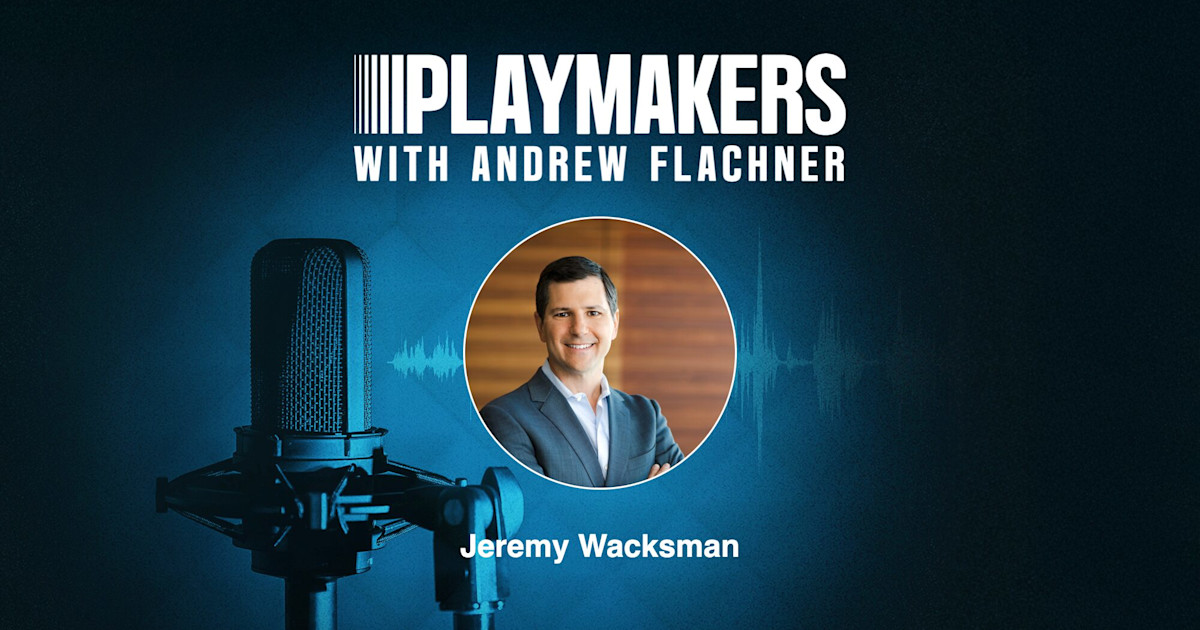
The views, thoughts and opinions expressed in the Playmakers podcast belong solely to the podcast creators and guests.
On this episode of the Playmakers podcast, Zillow CEO Jeremy Wacksman reflected on the challenges of the current housing market, what Zillow learned from a product that didn’t last and what he believes the future holds amid the industrywide debate over pre-market and private listings.
Zillow has emerged as one of the strongest industry advocates for market transparency, and when asked about a hypothetical future in which large swaths of listings are hidden from public view, the nearly 18-year Zillow veteran didn’t seem worried.
I don’t think that’s going to happen
“I don’t think that’s going to happen. You have to really hoodwink a seller to make it happen, and you have to disadvantage a buyer, and then you also disadvantage the agents,” Wacksman said. “It’s just not what buyers and sellers are going to tolerate.”
A persistently ‘challenged’ market: Wacksman said it seems likely that “we’re going to be in a challenged housing market for the foreseeable future” as the industry hovers around “historic lows” in turnover rates and transaction volume. Even so, about 4 million homes are being sold annually, “so the market’s not frozen.”
The buyers and sellers involved in those transactions still “need agents, they need loans, they need transaction software, they need great service.” The “silver lining” of the current market? Because those clients are transacting despite the tough market conditions, “they are much more educated” and have “much more intent,”
Creating a ‘more delightful’ consumer experience: Zillow’s ultimate
Creating a ‘more delightful’ consumer experience: Zillow’s ultimate mission for its “super app” is to make buying and selling a home less difficult, less stressful and more efficient for consumers, Wacksman said.
“Everyone is working really hard and really inefficiently,” he said. “If we can build a system where the buyer never has to leave the app, and they can be always updated, and they can do all their things in a more efficient way — and the agent they’re working with and the loan officer they’re working with can use their software to meet that buyer where they are — that can be an easier, faster, more delightful experience.”
Learning from failure: Though Zillow’s brief experiment with iBuying ended five years ago, the venture has been in the news recently due to the company’s $212.5 million settlement in a class-action lawsuit brought by investors shortly after the program shuttered.
When asked what Zillow had learned from Zillow
When asked what Zillow had learned from Zillow Offers, Wacksman said iBuying initially “seemed like a great way to solve a lot of customer problems all at once,” but the company “learned quickly that the business doesn’t work as we thought it did.”
That experiment, however, is what led Zillow into transaction software, the mortgage business and the development of its super app. “Even the swings that don’t work out, you take them because you can learn from them,” Wacksman said. “It’s important to pull from your failures as much as you pull from your successes.”
‘We stand for transparency’: Consumers should “of course” be “empowered with information,” Wacksman said of the industry’s debate over market transparency.
Everything works better when they
“Everything works better when they are. That’s part of why we stand for transparency: A more educated, more informed end consumer ends up being a better consumer for professionals, but also it actually helps agents do their job better, because they don’t have to spend time demystifying or being an information arbiter,” he said.
“The consumer always gets what they want at the end, and if companies try and pull tricks or pull the wool over someone’s eyes, a consumer is going to see through that and eventually get to what they want,” he added. “That’s part of why, to us, it’s such an obvious stance to take.”