In categories such as nutrition, food and FMCG, exclusivity periods of one to three months are increasingly being discussed
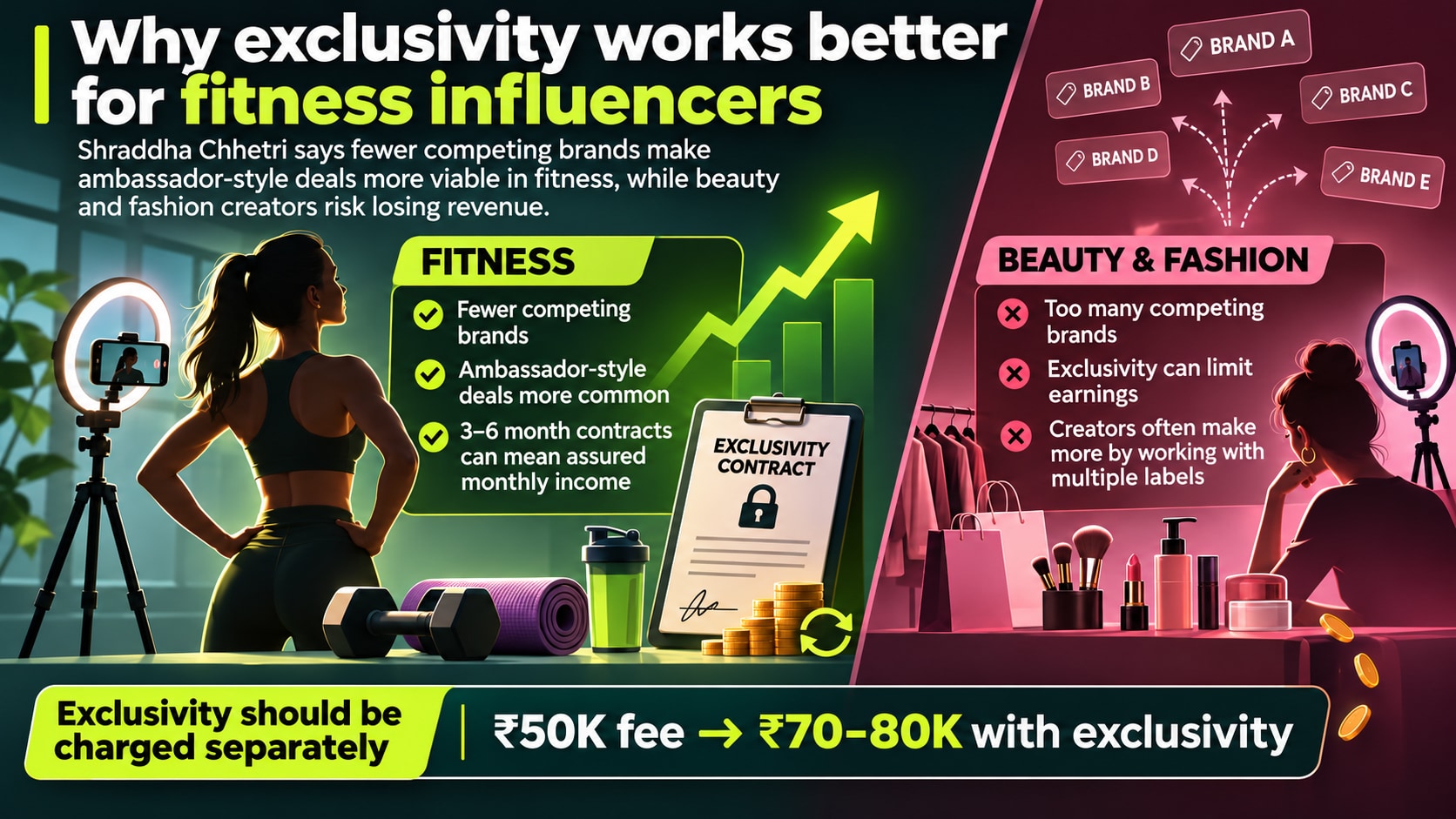
Fitness influencers are better positioned to enter exclusive brand partnerships than their counterparts in beauty and fashion, where a crowded advertiser market makes single-brand commitments financially restrictive, according to influencer Shraddha Chhetri.
Chhetri said fitness brands are more likely to expect creators to act as long-term brand ambassadors, given the relatively limited number of competing advertisers in the category. In contrast, beauty and fashion influencers often collaborate with multiple brands, making exclusivity a potentially expensive proposition.
Because of competition, exclusivity is being asked
“Because of competition, exclusivity is being asked of creators. But in beauty and fashion, where there are so many brands, it isn’t really happening. You see this more in fitness, where brands expect creators to become brand ambassadors because there are fewer brands,” Chhetri said.
She argued that exclusivity can be a commercially attractive arrangement in categories with fewer competing brands, particularly when contracts run for three or six months and offer creators guaranteed monthly payments.
Trending Topics
Jio IPORohit PatelKuldeep SehrawatMS DhoniPM Modi
“In this industry, there’s no guarantee that you will get paid every month. But with exclusive contracts, there is a monthly payment, and from the audience’s perspective, loyalty also remains intact,” she said.
Chhetri cautioned that such arrangements could substantially reduce
However, Chhetri cautioned that such arrangements could substantially reduce earning opportunities for influencers operating in beauty and fashion, where working with several competing brands is often central to their business models.
Fitness creators gain income stability, beauty influencers face opportunity costs
According to Chhetri, the economics of exclusivity depend heavily on the number of potential advertisers within a category.
Fitness creators may benefit from a predictable income stream by signing longer-term partnerships with individual brands. These agreements can also strengthen audience associations between a creator and the products they recommend.
Beauty and fashion influencers, however, operate in categories
Beauty and fashion influencers, however, operate in categories where brands frequently compete for creator partnerships. Restricting collaborations to a single advertiser could mean sacrificing several potential campaigns.
Chhetri said brands must therefore compensate creators for the business they potentially lose by accepting exclusivity clauses.
“If you’re charging ₹50,000 a month for two reels and the brand is also asking for exclusivity, then charge them ₹70,000 or ₹80,000 for exclusivity,” she said.
Her example represents a 40–60% premium over
Her example represents a 40–60% premium over the original monthly fee, although the actual additional compensation would depend on the creator and agreement.
She also suggested that exclusivity is better suited to macro-influencers than micro-creators.
For micro-influencers, brands are often more interested in obtaining content for their own promotional use than establishing exclusive relationships, she said.
Brands still expect old-school ambassador loyalty
Kalyan Kumar, Co-Founder and CEO, KlugKlug, said exclusivity negotiations have been part of influencer marketing for nearly a decade, particularly when brands engage major creators.
He questioned whether traditional expectations of brand loyalty
However, he questioned whether traditional expectations of brand loyalty make sense in categories where consumers routinely use competing products.
According to Kumar, many brand managers continue to approach influencer collaborations with an old-school celebrity ambassador mindset, expecting creators to remain associated with a single brand.
He argued that such expectations do not reflect how audiences consume products in everyday categories such as beauty, fashion and lifestyle.
Unlike infrequent, high-value purchases such as automobiles, consumers
Unlike infrequent, high-value purchases such as automobiles, consumers regularly switch between skincare, makeup and fashion brands. Expecting influencers to promote only one brand can therefore appear disconnected from actual consumer behaviour.
Kumar said brands seeking exclusive associations need to make a significantly larger financial commitment rather than expecting loyalty through one-off collaborations.
He suggested that brands could guarantee creators around 10–12 campaigns annually within a specific category to make exclusivity commercially worthwhile.
Without such commitments, creators are likely to favour
Without such commitments, creators are likely to favour working with multiple competing advertisers to maintain both their income opportunities and authenticity.
Exclusivity clauses move from informal requests to commercial negotiations
Lakshmi Balasubramanian, Founder, Greenroom, said exclusivity was previously more of an unspoken expectation than a formally negotiated condition.
“There was a time when exclusivity wasn’t really a defined part of influencer marketing conversations. Brands would collaborate with a creator, only to see them post content for a competing brand shortly after,” Balasubramanian said.
Such situations often resulted in agencies having
Such situations often resulted in agencies having to explain that creators were free to collaborate with competitors unless contractual restrictions had been agreed upon.
Agencies would sometimes informally request influencers to space out competing brand promotions to avoid conflicts.
As the influencer marketing industry matured, however, exclusivity increasingly became part of formal commercial negotiations.
Balasubramanian said brands now approach exclusivity differently depending
Balasubramanian said brands now approach exclusivity differently depending on the product category and campaign objectives.
While some advertisers demand broad restrictions on competing collaborations, others seek exclusivity only for individual campaigns.
Short restrictions lasting one or two weeks may occasionally be accommodated, but longer commitments typically involve additional financial compensation.
In categories such as nutrition, food and FMCG,
In categories such as nutrition, food and FMCG, exclusivity periods of one to three months are increasingly being discussed, she said.
Can exclusivity become a sustainable revenue model for creators?
The contrasting approaches across fitness, beauty and fashion highlight how influencer exclusivity is increasingly shaped by category economics rather than a uniform expectation of brand loyalty.
For fitness influencers, exclusive agreements can provide recurring income and reinforce a creator’s association with a particular brand. For beauty and fashion creators, maintaining relationships with multiple advertisers may remain the more lucrative option.
Industry executives suggest brands looking for sustained influencer loyalty will need to offer guaranteed campaign volumes, clearly defined exclusivity periods and compensation for competing opportunities that creators must forgo.
Tags
First Published on November 2, 2026, 08:55:13 IST