Boom trucks are getting bigger on strength of core markets.
If you’ve been a faithful reader of Crane and Transport Briefing in 2026, by now you’ve probably noted a pattern in our Product Focus features. Ask a rough terrain crane manufacturer how business is going this year, and the answer comes back to some version of steady; customers are thinking harder before they buy, and when they do, they’re buying bigger. Ask a telescopic crawler manufacturer the same question, and the answer is nearly identical.
Boom trucks, it turns out, are not different from the macro trends across crane and transport OEMs.
“The boom truck market remains steady year over year,” said Jacob Dunning, product manager for National Crane at Manitowoc.
Over at Tadano Manitex, Ray Ramirez, the company’s product specialist, put it almost the same way. He said, “The boom truck market is fairly steady compared to last year, but customers are being more selective.”
Meanwhile, another manufacturer called the current environment a boom (no pun intended). But look closer, and it appears an emphasis on a hyper-productive sector explains the perspective.
Ultimately, what the industry is describing is a market where tariffs, financing costs and general economic caution have changed how and when customers buy without changing whether they buy at all. That’s worth sitting with, because it’s the same shape of story this publication has now heard across the last three separate equipment category features. So, despite some headwinds, sales remain strong, and there’s optimism of even better days ahead.
And while it’s tempting to say boom trucks are simply following wherever general demand goes, there is a more nuanced read. For a sector that has a broad range of applications from utility to construction to forestry and others, there’s more to be gleaned from this year’s machine updates and case uses.
For boom trucks specifically, it appears steady replacement demand and a slow drift toward bigger capacities at the top of every manufacturer’s range will keep things comfortable and lead to very little drama in the short-term.
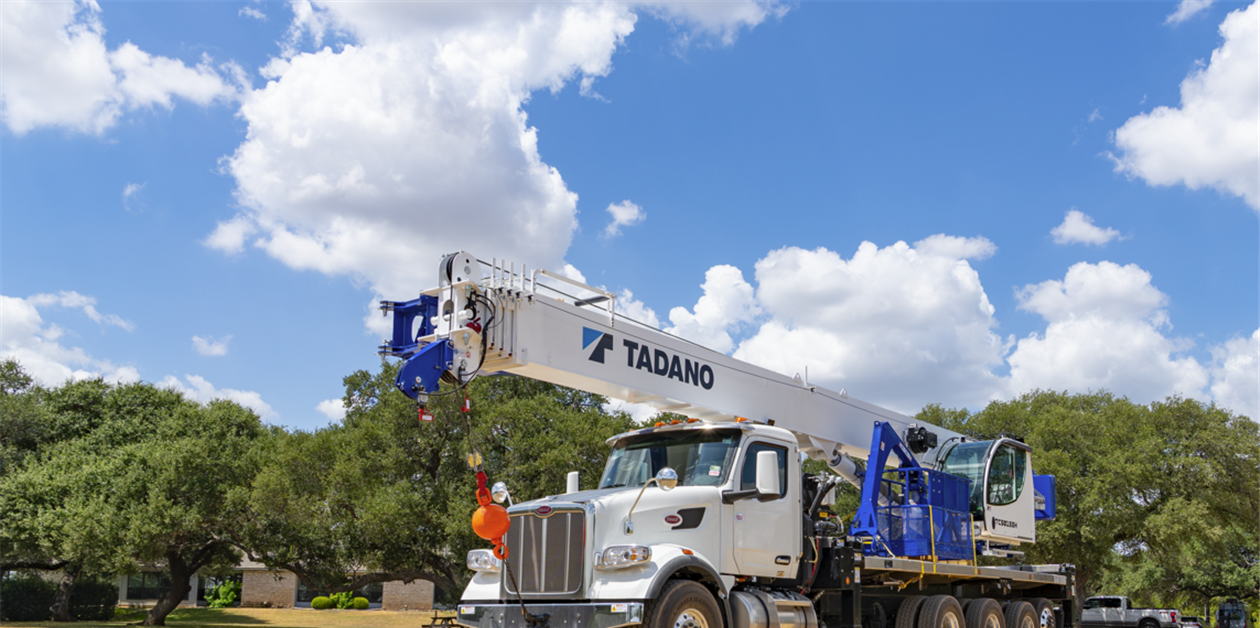
Tadano Manitex
Ramirez’s read on the market leans on the same selectivity Dunning described, just from a different angle.
“Higher equipment costs, tariffs and financing uncertainty are making customers look harder at ROI before buying,” he said. “The biggest shift I’m seeing is less about overall demand and more about where the demand is, and what configurations customers actually need.”
Transmission and distribution work remain Manitex’s strongest markets, with emerging demand tied specifically to data center and power infrastructure projects, work that Ramirez said is pulling customers toward “higher-capacity, longer-boom machines.”
Within the Manitex range, the 40- to 60-ton class is where demand concentrates most, with the 40-ton class standing out as particularly strong; longer boom options are where Ramirez expects future development to focus.
“We’re seeing some push toward higher capacities, but demand is still fairly distributed,” Ramirez said. “Longer boom options and more capability in that 40-to-60-ton range are areas I’d look at for future development based on what customers are asking for.”
Asked what it would take to move the market toward higher sales, Ramirez pointed to the same pressures already shaping buying behavior.
“Lower financing costs, more predictable material and tariff costs and continued strength in infrastructure and utility spending would help drive a real uptick,” he said. “Once customers have more confidence in the cost of ownership and their ability to keep equipment utilized, I think we’ll see stronger demand.”
Tadano Manitex’s boom truck range now runs from under 23 tons up to 50-plus tons, covering everything from light utility and municipal work to heavy construction and industrial lifting.
National Crane
National’s demand, Dunning said, is up even against a market he describes as generally flat. Though he noted that’s as much about the Manitowoc brand’s outsized market share.
“Customers turn to National Crane, as it is the premier product in the market,” he said. “There’s a strong demand for boom trucks in the market due to an increase in infrastructure projects and telecommunication upgrades. Utility customers are utilizing boom trucks for maintenance and installation of new power transmission systems and communication towers.”
Behind that confidence is a fairly specific read on where the growth actually sits. Standup models in the 30-ton class remain strong, Dunning said, while swing-cab demand skews toward 40 tons and larger and increasingly larger still.
That trend is what led National to develop the NTC80, an 80-ton model that pushes past the top of the company’s previously stated range.
“Customers are increasingly looking for greater reach and capacity as their markets evolve,” Dunning said.
Infrastructure spending, telecomms upgrades and a growing forestry and tree-service market are the main drivers Dunning pointed to, alongside a familiar refrain: aging fleets and strong rental utilization are what’s expected to keep sales moving.
“Continued investment in the utility, construction and oil and gas markets is an important driver of growth in the boom truck market,” he said.
National’s boom truck range now spans 10 to 80 tons, covering residential and commercial construction, utilities, forestry and oil and gas work.
Altec
Not every manufacturer described the same steady, selective market.
“I would characterize the boom truck market as extremely positive with lots of growth and demand,” said Ryan McGiboney, Altec’s cranes market manager. “We are in a historic boom in the market.”
The difference may come down to where Altec’s business concentrates. The company’s boom trucks serve a wide swath of the electric utility transmission market. McGiboney pointed to a narrower, more acute set of market drivers in that segment: data center development and storm-hardening work.
“The concentration of data center development in a few areas – Texas, Virginia and the Southeast – is the largest driver of regional demand,” he said, adding storm work is “exclusively happening in coastal, hurricane-prone areas.”
Rising line voltages on existing infrastructure are also pushing structures taller and heavier than traditional digger derricks can service, McGiboney said. It’s work, he added, that increasingly falls to boom trucks.
“The current crop of 60-plus ton cranes are being received well by customers that want a long boom for the reach,” McGiboney said, “as well as a useful crane chart for more traditional crane work with the same piece of equipment.”
Demand within Altec’s range concentrates in the 45- to 65-ton class, slightly higher than the ranges other manufacturers described. McGiboney said the company’s larger cranes are increasingly bought for a dual purpose: long reach for transmission work, which is paired with a genuinely useful crane chart for more traditional lifting on the same job.
Altec’s boom trucks are dual-rated – ANSI A92.2 compliant as an aerial device, and ASME B30.5 compliant as a crane – and McGiboney pointed to the company’s AC65E as the only boom truck on the market with a hydraulic articulating jib and two boom telescope modes.
Load King
Load King’s most visible product news this year wasn’t a boom truck at all.
At The Work Truck Show 2026, the company showcased the Voyager AMX+, a lightweight aluminum service truck built around a 12,000-pound capacity crane with a 30-foot reach, alongside the Outback 28SC-30, a tracked, battery-electric unit built for utility work in tight or off-road easements.
Both are smaller-scale service and utility equipment, not telescopic boom crane trucks, but the timing may say something about where the company’s product development energy is currently concentrated. It’s possible boom trucks are simply due a future cycle of attention.
As recently as the end of last year, A Load King’s representative estimated the entire North American boom truck market at roughly 1,000 units; a ceiling not expected to move much, even while predicting double-digit growth for the company.
The spokesperson described a market segmented into three clear tiers: a 10- to 30-ton range built around simplicity and cost-effectiveness, a 30- to 45-ton range where customers step up into their first riding seat, and a 50-ton-and-up “crossover” class described as “a real truck crane on a commercial chassis.”
Load King’s range now spans 10 to 80 tons across 14 models, from the 10-ton MU16 up through the 80-ton Stinger 80-160.
Elliott
In late 2025, Elliott Equipment Company was acquired by Stellar Industries, and the combined companies presented at CONEXPO-CON/AGG 2026 with an Elliott 1881TM boom truck as a featured machine.
Prior to the acquisition, Elliott described a steady market overall, with real pockets of strength in utility transmission work, public-sector maintenance and engineered jobs requiring longer booms or specialty tooling.
Demand within Elliott’s range generally splits cleanly by application: 40- to 50-ton capacities for transmission work and heavier construction picks, and 18- to 36-ton machines for public works, sign and lighting work, and general construction where a non-CDL rating or a compact footprint matters.
Elliott’s lineup covers that range across three families: 10- to 18-ton models with boom lengths from 39 to 125 feet; 26- to 36-ton models running 51 to 142 feet; and 40- to 50-ton models spanning 95 to 142 feet.
Elliott’s newest model, the 40105, launched with a best-in-class 40-ton capacity at 10-foot radius, a 160-foot maximum tip height and features DynaSmooth hydraulics, Bluetooth remote diagnostics and a high-visibility tilting cab.
It’s aimed squarely at the same customer priorities we’re seeing across the industry: reach, customization and total cost of ownership over the life of the machine.
As for the future, what Stellar’s acquisition means for the long-term of Elliott boom trucks will be worth watching in 2027.
Product Roundup
Tadano Manitex TC50155HL
Capacity: 50 tons | Maximum boom length: 155 feet | Jib length: 39 feet | Maximum tip height: 163 feet | Outrigger type: Out-and-down
National Crane NTC60XL
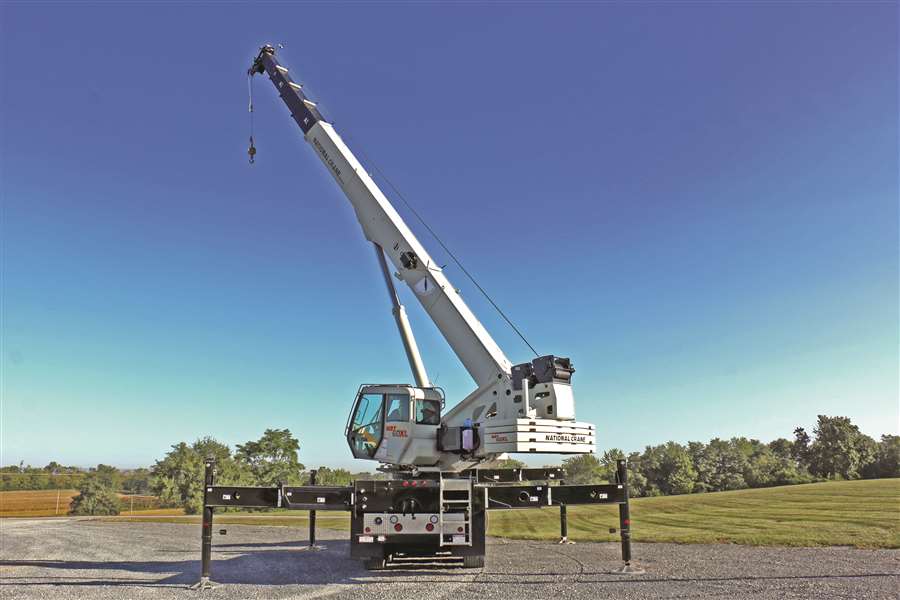
Capacity: 60 tons | Maximum boom length: 151 feet | Jib length: 36 feet (fixed) | Maximum hook height: 202 feet | Outrigger type: Four-position, out-and-down
Altec AC65E-155S
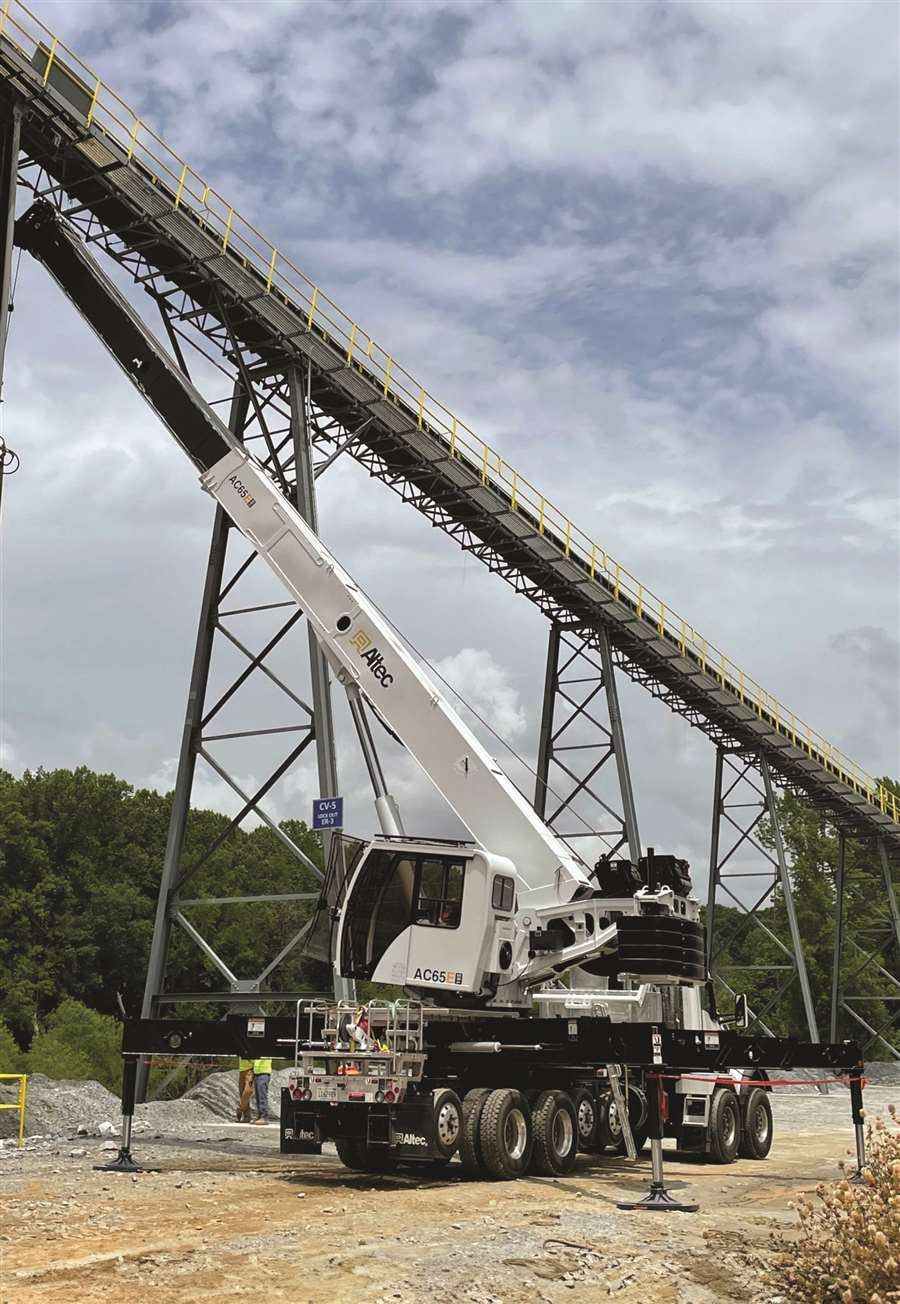
Capacity: 65 tons | Maximum boom length: 155-foot main boom | Jib length: 32 feet (retracted), 50 feet (extended) | Maximum hook height: 215 feet max sheave height (with jib), 211 feet max hook height (with jib) | Outrigger type: Swing-out-and-down with four distinct outrigger spans and Smart Zone Rating functionality
Load King 40-142RS
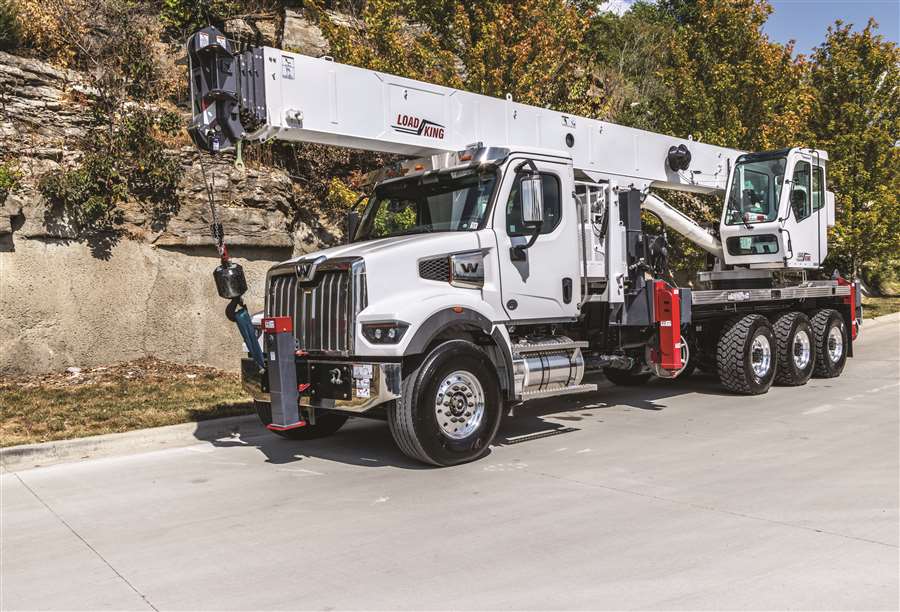
Capacity: 40 tons | Maximum boom length: 142 feet | Jib length: 55 feet | Maximum hook height: 207-foot tip height | Hook height: 204 feet | Outrigger type: Out-and-down
Elliott 40142
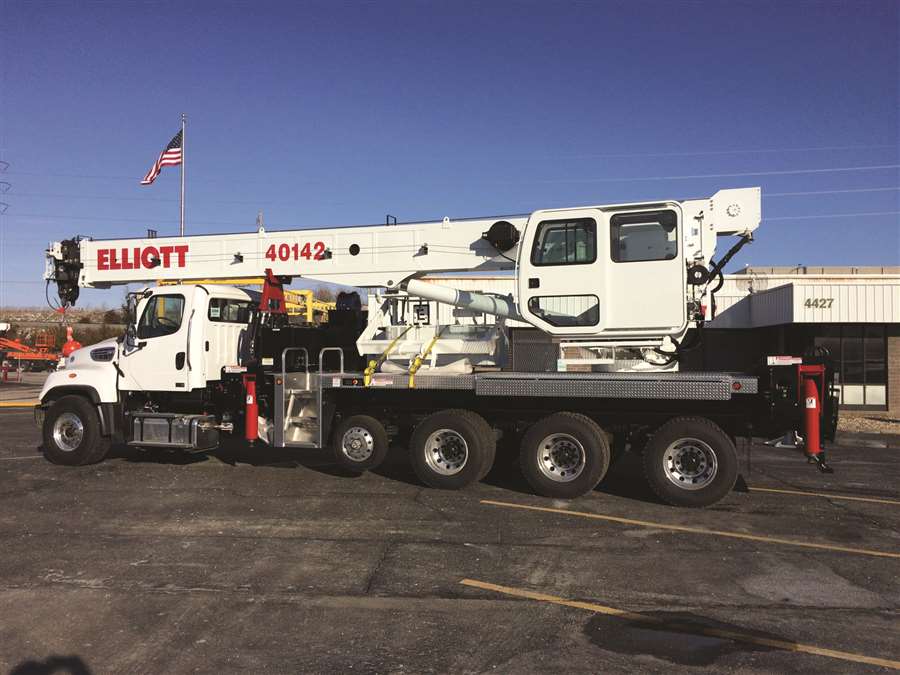
Capacity: 40 tons | Maximum boom length: 142 feet | Jib length: 57 feet | Maximum hook height: 209 feet | Outrigger type: Out-and-down