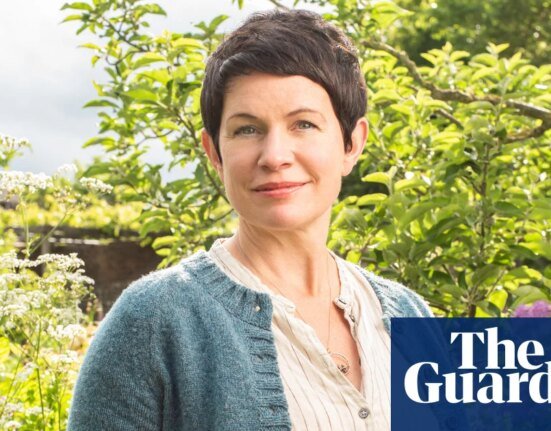
Sarah V. Barnes is both a historian and a horsewoman. Her first novel, “She Who Rides Horses: A Saga of the Ancient Steppe,” received the 2022 Best Indie Book Award for Historical Fiction, among other prizes. “A Clan Chief’s Daughter,” finalist for the 2026 Nautilus Prize for Historical Fiction and the 2026 Colorado Book Award for Historical Fiction, represents the second installment in the “She Who Rides Horses” series. Barnes lives in Boulder, Colorado.
SunLit: “A Clan Chief’s Daughter” was a finalist for the Colorado Book Award in Historical Fiction. What’s the story about?
Sarah V. Barnes: “A Clan Chief’s Daughter” is the second in the “She Who Rides Horses” series, set 6,000 years ago on the Eurasian steppe. The books recount the story of Naya, a 14 year-old girl who is the first person among her people to ride a horse. In book one, Naya and a magnificent chestnut red filly are brought together through a mystical encounter. Naya dreams of befriending the young horse and eventually riding her. By the end of book one, she has accomplished this remarkable feat, but at the beginning of book two, when Naya returns home after a winter spent among the wild horses out on the steppe, she discovers that her father’s enemies want to exploit the red filly and her band in order to undermine his leadership as chief of the clan.
Each week, The Colorado Sun and Colorado Humanities & Center For The Book feature an excerpt from a Colorado book and an interview with the author. Explore the SunLit archives at coloradosun.com/sunlit.
Naya is plagued by nightmares of what could happen to the animals she has tamed if they fall into the hands of men seeking power and control. She concludes that only by renouncing her sacred gifts and her heart’s desire can she protect the red filly and the other horses, as well as remain loyal to her father. Her sacrifice nearly costs her everything.
SunLit: What inspired you to develop Naya’s character?
Barnes: The short answer is the horses. The longer answer begins with the confession that I did not intend to become a novelist. My first job after college was as a management consultant. After a couple of years I returned to school, earned a PhD in history and spent two decades as a university professor. Eventually I left academia and having reconnected with my childhood passion for horses, began riding, training and competing.
After working for several years as a riding instructor, I discovered the work of Linda Kohanov, author of “The Tao of Equus” and a pioneer in the world of equine-facilitated learning. I decided to attend a four day writing-focused workshop at her Arizona ranch, not because I considered myself a writer but rather because I was intrigued by Linda’s explorations into how spending time with horses can foster intuition and creativity.
“A Clan Chief’s Daughter”
- Prospector:Search the combined catalogs of 23 Colorado libraries
- Libby:E-books and audio books
- NewPages Guide:List of Colorado independent bookstores
- Bookshop.org:Searchable database of bookstores nationwide

SunLit present new excerpts from some of the best Colorado authors that not only spin engaging narratives but also illuminate who we are as a community. Read more.
Toward the end of the third day of the workshop, after leading us through several experiential activities with her horses designed to awaken our nonverbal sentient communication abilities, Linda invited the workshop participants to finish the afternoon by finding a quiet spot to hang out and just write whatever came to us.
Pulling up a chair at one of the picnic tables where we’d eaten lunch earlier in the day, I started to write. The words flowed. A girl, dressed in animal hides, uncommon blue eyes scanning a distant horizon. A filly, her unusual chestnut coat as red as the girl’s own hair, lit like a flame by the rays of the setting sun. The boundless grasslands of prehistoric Eurasia. The first person ever to ride a horse…
Then COVID hit, offering an opportunity for me to shift my priorities. Book one, “A Tale of the Ancient Steppe,” came out in 2022. Book two, “A Clan Chief’s Daughter,” appeared in June 2026. Book Three, as yet untitled, is in the works. I’m still discovering where the story wants to go. It’s made the experience of writing quite liberating and fun. At the same time, I also feel a tremendous sense of responsibility.
The story is a gift and I feel obligated to tell it to the best of my ability. As a former history professor, I’m quite certain that Naya and the red filly have something important to teach us, both about the consequences of the past, and the possibilities for the future.
SunLit: Has the character of Naya developed in the way you thought she would, or have you found her occasionally surprising you along the way?
Barnes: Naya and the red filly, along with the other characters, are constantly surprising me. After the experience of writing that first chapter, I continue to feel as though the story exists in another dimension and is being channeled through me – something like Elizabeth Gilbert describes in “Big Magic.”
I’ll add a seemingly small detail, only to find out three chapters later why it’s important. Every time I sit down to write, I wonder what’s going to happen, and if I ever get stuck, it’s usually because I’ve started trying to force something, rather than letting Naya and the red filly lead the way.
SunLit: Tell us about the broader sweep of history that you’ve built these stories around. Why was the domestication of the horse such an important development and why did it appeal to you as a backdrop for historical fiction?
Barnes: The domestication of the horse arguably did as much to change the course of human civilization as any of the other historical developments often cited. The pastoralists of the Pontic-Caspian steppe who were responsible for taming and later breeding the lineage that became the progenitors of all of today’s domestic horses developed a highly mobile nomadic lifestyle which allowed them to exploit the steppe grasslands and amass great wealth in the form of enormous herds of cattle, sheep, goats, and especially horses.
Because livestock could be stolen, in order to protect their wealth, these herders had to become warriors. At the same time as the size of their herds increased, climate change resulted in more arid conditions, leading to competition for prime grazing land. Such circumstances provided the basis for the emergence of patriarchy. Clans formed based around male relationships – fathers and sons, nephews and uncles, brothers and cousins – those who could be counted on to remain loyal to a successful leader or chieftain.
Not coincidently, these same patriarchal herder-warriors were likely the first to develop a cosmology based upon a transcendent masculine creator-deity, as well as the tendency to think in terms of hierarchical polarities – us/them, divine/mortal, masculine/feminine, etc. This dualism, along with the challenges of surviving in an increasingly hostile environment, may have encouraged a proclivity to view humans as separate from and opposed to the natural world. Eventually, through trade networks, migration, warfare and conquest, the horse cultures of the steppe spread their worldview and resulting social structures, along with their language, throughout the Indo-European world.
Although the above outline is based on the latest academic research, scholars can never say for certain what happened in the past. There is always a gap between what actually happened and what we can know about what happened, based on the surviving evidence. This is where historical fiction has a part to play in illuminating what we can learn from the past.
Imagining a story about the taming and domestication of horses, with all the ensuing civilization-shaping consequences, can not only enable us to understand how we got to where we are today, but suggest what other options might have once been available to us and might still be possible in the future. Throughout 6,000 years of shared history, horses have stuck with us, despite our willingness to exploit their generous natures. Perhaps they have something to teach us, or remind us, about what could have been – a different path that we chose not to follow but one that is still open to us, if we allow ourselves, this time, to follow their lead.
SunLit: Your love for horses and familiarity with their behavioral characteristics is evident in the narrative. How did your own experiences inform the book?
Barnes: About the same time that I found my way back to my childhood passion for horses, a transformation was occurring in the way many trainers and recreational horse owners thought about horses’ nature and capacities. While the most successful riders had always practiced compassion in their interactions with horses, an increasing number of horsemen, and especially horsewomen (who make up the vast majority of participants in modern equine pursuits) now seek to place relationship at the center of their horsemanship.
Modern science recognizes horses, along with many other species, as sentient beings, with nervous systems similar to ours. Among those with an understanding of how such systems function, the ability to foster a sense of safety and connection is now recognized as a fundamental skill in working with both horses and humans. The more I’ve learned in this area over the last couple of decades, the more I’ve worked to embody the knowledge in my own practices with horses – and people. This in turn informs my storytelling.
In the words of the novel, Naya must learn to “see with the eyes of her heart and create ties without the use of a rope.” These are skills I work on every time I visit the barn and carry with me into the rest of life – and art.
SunLit: How did you research this topic? And how did you balance historical information with the creativity behind your narrative?
Barnes: Initially, I just wrote, letting the story flow without doing any research at all. When I did stop to investigate, I was gratified (and somewhat astonished) at the accuracy of much of what had come through. Eventually I did shift into full research mode – reading monographs, mining footnotes and tracking down obscure research articles. Although ancient prehistory was not my field of expertise, I immersed myself in the secondary sources on ancient steppe cultures and horse domestication.
This involved straying into history-adjacent fields including archeology, anthropology, paleo-linguistics and studies of ancient DNA, as well as comparative mythology and Jungian psychology. Unlike when I was conducting my PhD research, back in the age of the card catalog, almost all of what I needed was available online. Unfortunately I have not been able to travel to the steppe locations where the story takes place – these areas of southern Russia and Ukraine are literally a war zone.
These days, I alternate between writing and keeping up with emerging research, as well as contemporary discussions around topics like patriarchy, the climate crisis and the implications of AI for the survival of humanity. All of it is relevant to Naya’s story, and vice versa.
SunLit: What drew you to write historical fiction?
Barnes: As a historian, I was always constrained in my storytelling by what the evidence that survived allowed me to say about the past. As a writer of creative fiction, even though I strive to be as historically accurate as possible, when the evidence isn’t available, I have permission to use my imagination.
SunLit: Tell us a little about your creative process. What does your typical writing day look like?
Barnes: I usually try to visit the barn in the morning. Spending time with my horse keeps me grounded in the essence of the story. Ideally I write in the afternoons, although lately, helping to care for my new granddaughter is providing a welcome distraction. Coincidentally, she’s a blue-eyed red-head, like Naya.
SunLit: Tell us about your next project. Is there another chapter of the “She Who Rides Horses” saga in the works, or are you going in another direction?
Barnes: I’m currently working on what was meant to be the third and final book in a trilogy, but now it’s looking like “She Who Rides Horses” may want to be a five-book series. We’ll see.
A few more quick items
Currently on your nightstand for recreational reading: Anne Patchett, “These Precious Days”
First book you remember really making an impression on you as a kid: “The Hobbit” and the “Lord of the Rings” trilogy. Like so many of us, I was mesmerized by the world Tolkien created.
Best writing advice you’ve ever received: Work with the best editor you can find. They will give you all the advice you need, and more.
Favorite fictional literary character: Black Beauty. Anna Sewall was a genius — writing in the 19th century, giving a horse a voice and agency in order to combat animal cruelty.
Literary guilty pleasure (title or genre): “Outlander”
Digital, print or audio – favorite medium to consume literature: Depends — audio if the book has a good narrator, preferably the author; print if I’m curled up in my favorite chair with a cup of tea; digital if I’m traveling.
One book you’ve read multiple times: “The Little Prince,” by Antoine de St. Exupéry. Two lines in particular stand out: “It is only with the heart that one can see rightly; what is essential is invisible to the eye. And Men have forgotten this truth… but you must never forget it. You become responsible, forever, for what you have tamed…”
Other than writing utensils, one thing you must have within reach when you write: A water bottle. Sometimes (often) I lose track of time and it’s easy to get very dehydrated here in Colorado. I also like to play Indigenous music – it helps transport me to a different time and place.
Best antidote for writer’s block: Taking a shower, going for a walk, going to the barn – anything that encourages my creative mind to wander.
Most valuable beta reader: A good friend who gets the story but will also point out flaws that might bother the typical reader. I’m blessed with a couple of willing victims.