
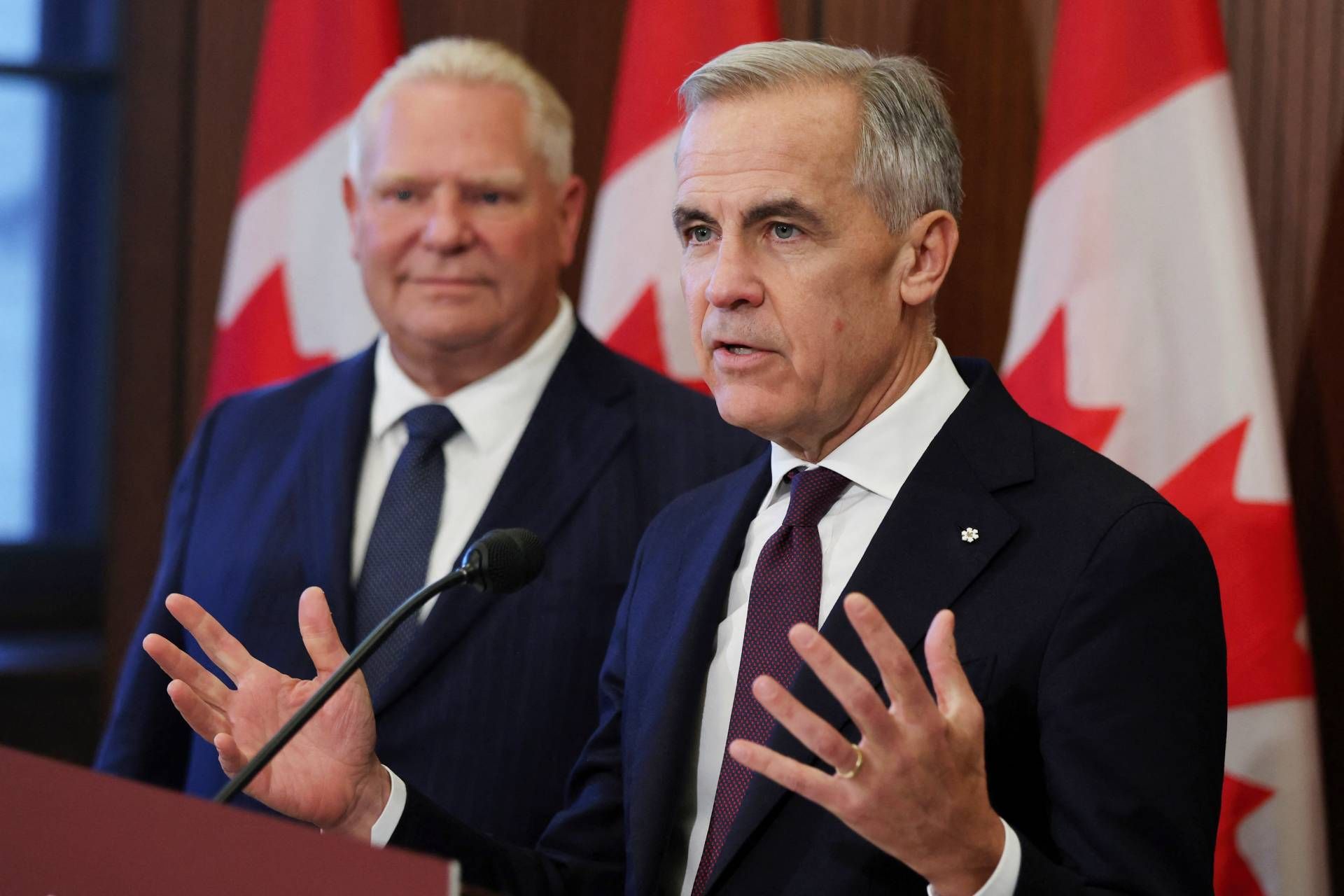
“Politics,” Groucho Marx once said, “is the art of looking for trouble, finding it everywhere, diagnosing it incorrectly, and applying the wrong remedy.” Mark Carney has obviously taken the great sage’s advice to heart. On Wednesday, he — and Premier Doug Ford — promised to jointly form a $2.5-billion investment fund to “fortify Ontario’s auto industry.” Simultaneously, the Prime Minister put pause on the recently imposed greenhouse-gas standards that had the automotive industry — or, at least, part of it — in such a tizzy.
Article content
Article content
The reaction to the new program was immediate and positive. The president of the Automotive Parts Manufacturers’ Association, Flavio Volpe, called the plan “needed support for the connected and electrified products customers are demanding” while the Canadian Vehicle Manufacturers’ Association’s Brian Kingston says the plan offers some “relief,” and that pausing the emissions-regulations ramp-up will give automakers “some flexibility as they deal with a much more significant threat, which is, of course, U.S. tariffs.”
But is it really? Is this “investment” really what the industry needs? Here are the important questions that need to be asked of the combined federal and provincial initiative.
How will this help Canadian autoworkers?
Article content
Article content
Article content
The first question that anyone — not just the auto industry — needs to ask themselves when the government suddenly gets generous is “How will any of this help Canadian workers?”
The clause that caught my attention in the press release attached to the $2.5-billion announcement said monies will be devoted to “capital projects” to enable manufacturers to invest upgraded production lines “to build the connected and electric vehicles of the future.” In a word, what the provincial and federal government will be “investing” in is automobile assembly factories, either the building thereof, or, more probably, the refurbishing of existing ones. Whichever is the case, the cars that these investments are intended to promote will be battery-powered.
- Motor Mouth: The political calculations that could kill Canada’s auto industry
- Motor Mouth: How Carney can use U.S. fuel-economy standards to bargain with Trump
- Story continues below
The first question that came to my mind as soon as I read the official press release is “Who exactly will be taking advantage of said governmental largess?” Or, elucidated another way, “Who the Hell is going to buy all the EVs that $2.5 billion can build?”
Though there have been brief upswings in adoption, EV sales in Canada are barely growing. Honda cancelled its plans for its huge battery and EV-manufacturing facility in Alliston; General Motors’ BrightDrop experiment turned into a debacle; and Stellantis’ much-ballyhooed NextStar Energy battery plant is now producing storage batteries for the grid. No amount of money — even $2.5 billion — is bringing those projects back.
Yes, Quebec remains a hotbed of EV activity — though its subsidization program ends next year, and, if history is any guide, sales in La Belle Province will probably drop like a stone — but there’s no one clamouring for more EV capacity to serve Canadian consumers.
Nor is there demand for more EVs south of the border. Never mind the tariffs that would be imposed on anything, electric or otherwise, shipped from our shores. EV sales are wilting in the United States, even with California setting up its own subsidization program. And the thought that Canada could export EVs to Europe is almost laughable.
Indeed, it’s kind of hard to believe that anyone — even a government that seems to have no understanding of how automobile are produced — could think there’s a reason for Canadian automakers to build more EVs, especially since, like every other vehicle built in Canada, most would have to be exported. If one were a cynic — Qui? Moi? — one might think Carney’s announcement was nothing more than Trudeau-era virtue signalling, the announcement of those billions more important than seeing they get put to good use. And you don’t have to be much of a conspiracy theorist to think this is just the Liberals making big promises they know no one will ever take them up on.
Who really benefits?
The decision to “stay” emissions standards is likewise odd. Nonetheless, thanks to the “new action plan” to protect workers from tariffs and “strengthen Ontario industries,” Canada’s light-duty vehicle greenhouse-gas regulations will be frozen at 2026 levels (172 grams per mile) through the end of 2029, emulating, in spirit if not quite in absolute numbers and timing, Trump’s recent Safer Affordable Fuel Efficient (SAFE) Vehicle Rule that rolls back fleet-wide fuel economy averages to 32.3 U.S. miles per gallon (7.28 L/100 km), and holds it pretty steady until 2031.
That said, at least the Americans are consistent in their policy goals — they are simultaneously rolling back governmental support for electric vehicles — while less than 200 words after promising to invest that $2.5 billion in EV manufacturing, the Prime Minister promised to roll back the very reason why automakers should produce them.
Who exactly will be taking advantage of said governmental largess? Or, elucidated another way, Who the Hell is going to buy all the EVs that $2.5 billion can build?
More troubling is who benefits from this softening of tailpipe-emissions standards. It’s certainly not Toyota, Canada’s largest automaker — and presumably the primary focus of the Carney government’s retention efforts — which is well on its way to electrifying or hybridizing its entire fleet. Ditto Honda (the second-largest automaker in the land, and hopefully also a priority), which manufactures fuel-sipping Civics and CR-Vs here, many of which are also hybrids.
Indeed, the only benefactors to this sudden about-face would seem to be Detroit’s Big Three — General Motors, Ford, and Stellantis — who would have been at pains to make their profit-spewing pickups meet the former, more stringent standards.So, the question I’d ask — the one I think we should all be asking — is why are we singling out the very automakers who have continually reduced their manufacturing footprint in Canada for reward?
So, I’d like to ask you directly. Mark, have we in fact extracted some kind of quid pro quo for this accendance to the Detroit Three’s gas-guzzling ways? Has Ford signed some sort of unshakable agreement that really will see it produce Super Duty pickups in Oakville, even though Trump has slapped a 50% duty on heavy-duty trucks? Have we elicited a promise from GM that it will really shift heavy-duty-truck production to Oshawa, despite the looming January 1 deadline for Trump’s latest — and perhaps most devastating — round of tariffs? And mercy me, have I missed an announcement by Stellantis that it is re-opening the Brampton plant after all?
Why — and this is not a rhetorical question, Mr. Carney — are we once again rewarding those who have been our least reliable partners in auto manufacturing?
Author’s Note: Speaking of governmental stupidity and car production, did you read the news about Tesla’s importation of cheap, Chinese-built Model 3s being shut down because the government thought it would exceed the quota they envisage for 2027? Supposedly, this is because Global Affairs is monitoring import applications “for the purpose of providing equitable access to the quota to eligible applicants.”
I think that statement is going to come back to haunt the Liberals — and most especially Minister of Industry Melanie Joly. That’s becauseAutomotive Newsis reporting that, come 2027, Stellantis is going to start importing two Jeep models built by its Chinese partner Dongfeng. And it appears that there’s absolutely nothing — despite the Minister’s promise of harsh retribution for the company’s closing of its Brampton Assembly plant — the government can do to prevent Stellantis from importing vehicles that Brampton might have produced because access must be, again, equitable.
I’m betting Ms. Joly is now ruing her decision to reject Leapmotor’s offer to build complete knock-down (CKD) cars in Brampton’s still-idled plant, especially since it looks like Mexico just eliminated the tariff on CKD vehicles assembled there. Like I said, could the Liberals possibly screw this up worse?


2 Comments