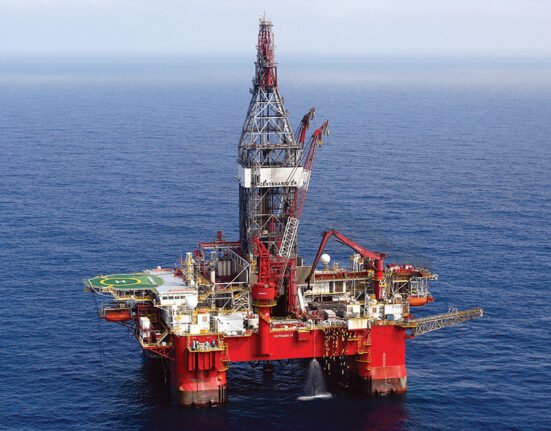
Commercial ship in the Strait of Hormuz near Bandar Abbas, Iran. (Amirhossein Khorgui/ISNA via AP)
| Update:
key takeaways:
- Oil prices rose more than 7% after US President Donald Trump said on July 8 that the interim deal with Iran was “dead” although he would allow negotiations to continue.
- Crude oil prices recently fell above $100 a barrel to levels seen before the war with Iran broke out in late February.
- Turbulence in oil markets increases uncertainty over inflation and other economic trends.
New York – Oil prices are rising and stock markets are falling around the world on July 8 after President Donald Trump cast doubt on a temporary ceasefire in the war with Iran.
The S&P 500 fell 0.5% after Trump said the deal to stop fighting was “dead,” although he said he would allow negotiations to continue. As of 10 a.m. Eastern time, the Dow Jones Industrial Average was down 550 points, or 1%, and the Nasdaq Composite was 0.2% lower.
Action was stronger in the oil market, where the price of a barrel of Brent crude rose 7.2% to $79.48. This is still well below its pre-war peak, when the price of the most actively traded contract reached around $120. But this surge is troubling as oil prices have fallen back to where they were before the war.
The concern is that if the war continues, the Strait of Hormuz will be blocked and oil tankers will be kept bottled up in the Persian Gulf instead of supplying crude to customers around the world. That could worsen inflation, which economists expected would drive down oil prices and in turn force the Federal Reserve and other central banks to raise interest rates.
Higher rates may curb inflation, but they also slow the economy and hurt the prices of all types of investments.
BREAKING: President Trump announced that the US-Iran ceasefire agreement is effectively “over” after a new violent round of military attacks overnight.
Speaking from the NATO summit in Ankara, Türkiye, Trump criticized the Iranian leadership and said they have no interest in continuing… pic.twitter.com/8kHDmriTrO
– Fox News (@FoxNews) 8 July 2026
Stock markets in Europe fell and oil prices climbed shortly after Trump said “For me, I think it’s over” about the status of the ceasefire. He said US representatives could continue talks, but he cast doubt on the outcome. “They can talk, but I think they’re wasting their time,” he said.
Trump later said that the United States was preparing for another night of strikes against Iran.
On Wall Street, companies with larger fuel bills were the biggest losers. American Airlines lost 3.4% and Norwegian Cruise Line Holdings lost 2.4%.
Shares of companies in the housing industry were also particularly weak. They were hurt by concerns that rising Treasury yields in the bond market would cause mortgage rates to rise and the industry to cool.
Builders FirstSource, which sells counters, windows and other building materials, fell 5.2% for one of the sharpest losses in the S&P 500. Homebuilders PulteGroup fell 3.8%, and DR Horton fell 3.6%.
Helping to offset those losses was a rally for some impressive stocks in the artificial intelligence industry. They have been under pressure in recent weeks due to concerns that their prices have risen too high and cannot generate enough productivity and profits to make all the investments in AI chips and data centers worthwhile.
Their fluctuations weigh heavily on Wall Street as AI stocks have grown into some of the largest stocks in the US market, which gives their movements a greater impact on the S&P 500 than other stocks.
For example, Nvidia rose a modest 0.3%, but it was still the third-strongest force driving upside on the S&P 500 due to its status as the biggest stock on Wall Street.
The biggest push came from Broadcom, which rose 4%. Apple announced a multi-year commitment with Broadcom to design and produce custom components for its products. Apple said the value of the agreement could exceed $30 billion.
In the bond market, Treasury yields rose along with the price of oil. The yield on 10-year Treasuries rose to 4.58% from 4.55% at the end of July 7, up from just 3.97% before the war with Iran began.
In overseas stock markets, European markets extended losses after Trump’s comments and Germany’s DAX fell 1.6%.
In Asia, South Korea’s Kospi fell 5.3% and continued its sharp swing amid concerns and enthusiasm about AI stocks dominating its market.
Hong Kong’s Hang Seng Index was an outsider and rose 3%.

Cox Fleet’s Kevin Clark discusses how fleets must rethink their maintenance strategies to remain efficient and flexible. Tune in by going above or RoadSigns.ttnews.com.
Hong Kong-traded shares of Chinese AI startup Zipu, also known as Z.ai and traded as Knowledge Atlas Technology, rose 13.4%.
A six-month lock-up period for “cornerstone” investors following the start of trading in Hong Kong in January ends this week. China National Radio reported late on July 7 that about 70% of Zipu’s cornerstone investors were committed to staying despite previous concerns that the end of the lock-up period could trigger a sell-off.
Zipu’s share price has risen more than 1,300% since its launch.
AP Business Writers Matt Ott, Chan Ho-Him and Ellen Kurtenbach contributed to this report.