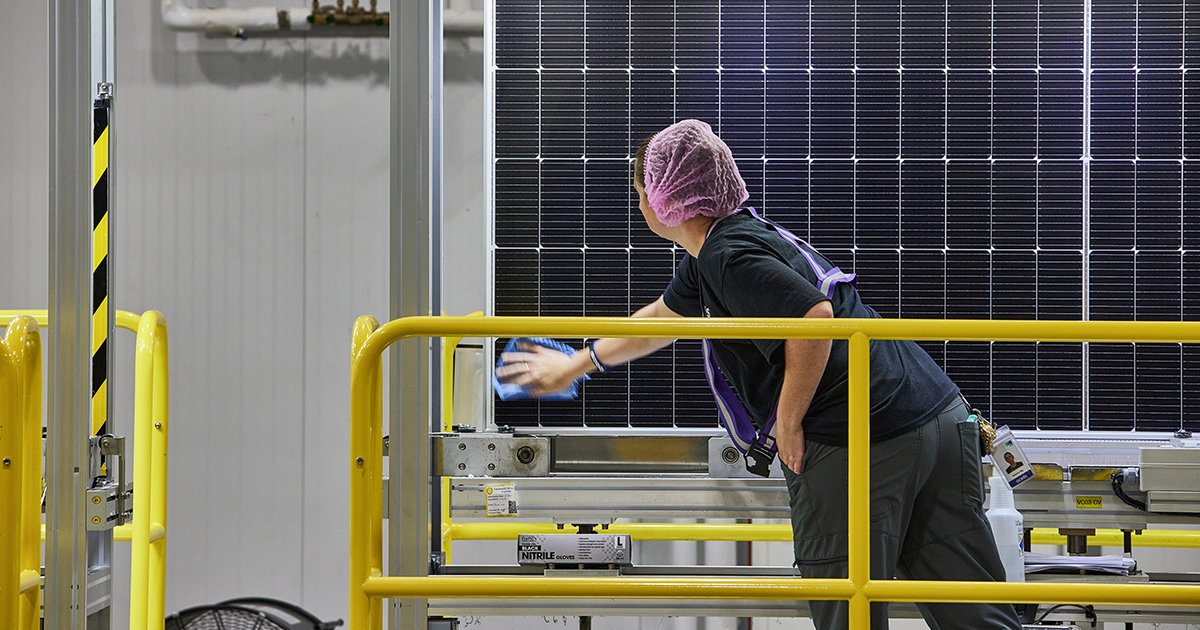
A technician checks a finished solar panel during quality control at a manufacturing plant in White, Ghaziabad. (Matt Odom/Bloomberg)
key takeaways:
- US manufacturing output stalled in May after four months of gains, while factory output remained flat from April, according to Federal Reserve data.
- The slowdown shows that supply chain disruptions and rising costs from the Iran war are weighing on activity, even as total industrial output rose 0.1%.
- Durable goods and defense-related production continue to support manufacturing, but economists will keep an eye on whether cost pressures will further reduce output in the coming months.
U.S. manufacturing output stalled in May after four months of gains, suggesting the Iran war may be starting to weigh on activity as supply chain disruptions and rising costs continue.
Federal Reserve data June 15 showed factory output was little changed last month after rising 0.7% in April. The average estimate in a Bloomberg survey of economists called for a 0.3% advance.
Total industrial production, which also includes output from utilities and mining, rose 0.1%.
The report is somewhat inconsistent with signals from recent surveys, which have indicated a pick-up in activity amid wartime customer storage, rising defense-related orders and ongoing data center buildouts.
The June 15 data could be a sign that rising costs are starting to ease as a separate report last week showed prices received by producers rose at the fastest pace since 2022 in May compared with a year earlier.
Manufacturing excluding motor vehicles and parts also remained flat in May, according to the Fed report. Mining output, which also includes energy extraction, rose 1.3%. Utilities output fell.
May #industrialproduction:Total +0.1%, mfg. +0.0%, Utilities -0.4%, Mining +1.3%; #capacity utilization 76.2% https://t.co/nYuGKYaV9g #feddata
– Federal Reserve (@federalreserve) 15 June 2026
The data showed a divide between manufacturing of durable goods, which continued to grow, and manufacturing of non-durable goods, which declined. The decline reflects a decline in the production of petroleum and coal products, plastics and rubber, and textiles.
Output increased in categories exposed to data-center buildouts, including computer and electronic products, electrical equipment, manufactured metals, machinery and primary metals. Those industries have helped support factory activity, even as shortages of inputs like memory chips and plastic resins are straining supply chains.
Defense and space equipment production reached its highest level since December 2019 for the sixth consecutive month. Economists see efforts to recoup weapons used in the war, as well as increased exports as part of recent trade deals, as potential drivers of growth this year.