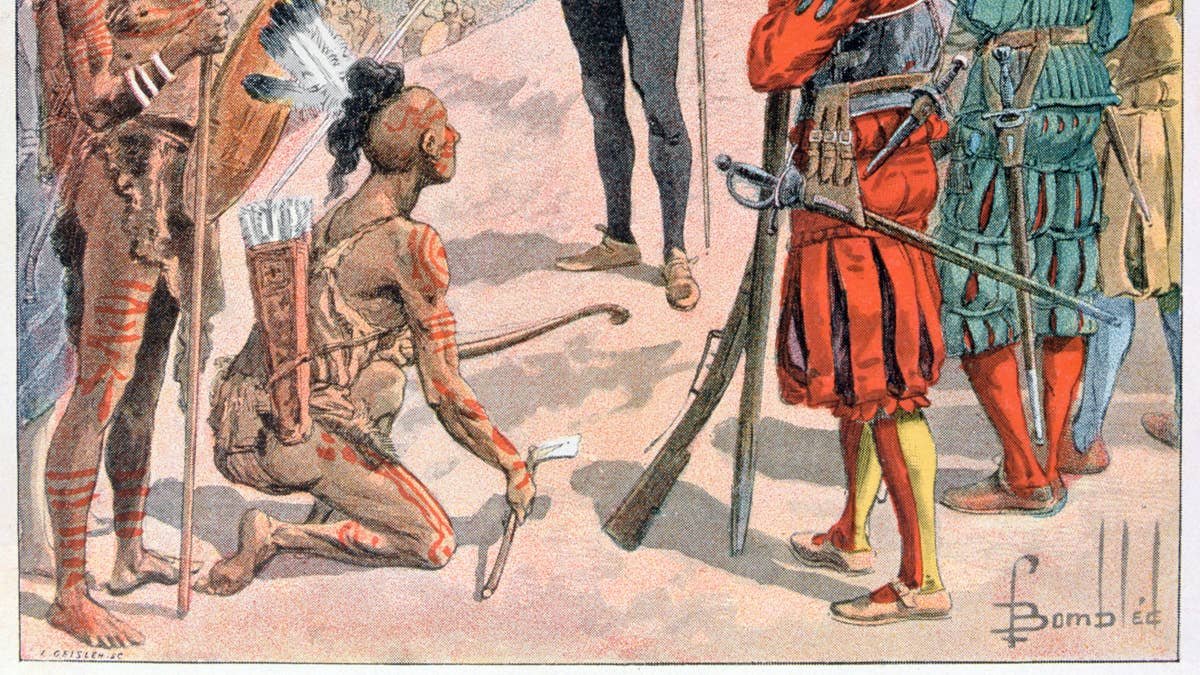
On July 24, 1534, French explorer Jacques Cartier committed a symbolic act that would echo through centuries of North American history. Standing on the shore of Gaspé Bay, in present-day Quebec, he raised a large wooden cross bearing the French royal coat of arms and claimed the surrounding lands in the name of King Francis I of France.
For those sailing with Cartier, it was a declaration of royal authority. To the natives already living there, it was an unfamiliar gesture from visitors coming from across the Atlantic. The land was home to the St. Lawrence Iroquoians, whose way of life, trade networks, and traditions existed long before the arrival of Europeans.
Cartier’s campaign was part of France’s effort to join Spain, Portugal and England in the race for influence beyond Europe. Newfoundland’s rich fishing grounds had already attracted European sailors to the region, while stories of untapped riches encouraged monarchs to sponsor ambitious voyages into unfamiliar waters.
The cross that gave a powerful message
The cross Cartier reportedly created was approximately 30 feet tall and had an inscription declaring, “Long live the King of France.” It was more than a religious symbol. It represented a political claim, indicating that France intended to stake out its place in North America despite having little understanding of the region’s vast geography or its established indigenous societies.
Historical accounts tell how Donnacona, an indigenous leader, questioned Cartier’s decision to raise the cross without consultation. Although Cartier attempted to calm concerns through gestures and conversation, the encounter reflected deep misunderstandings that would shape relations between European and indigenous communities for generations.
Before departing, Cartier also persuaded Donnacona to allow his two sons, Domagaya and Tignogni, to accompany the French to Europe. His knowledge of the St. Lawrence River would prove valuable during later expeditions, although the circumstances surrounding his departure remain a subject of historical debate.
A claim that opened the door to New France
Cartier returned to North America on subsequent voyages, moving further inland and exploring the St. Lawrence River. His reports convinced French leaders that the region held strategic potential, even though the dream of finding vast riches was never realized.
While permanent French settlement did not occur until decades after the founding of Quebec City by Samuel de Champlain in 1608, Cartier’s ceremony in the Gaspé marked one of the earliest formal claims that laid the foundation for New France.
Nearly five centuries later, that giant cross remains one of the defining images of European exploration of Canada. It symbolized ambition, imperial rivalry, cultural encounter and the opening chapter of a story that changed the continent forever.