Source: e-centre 2.0 – Netherlands | Electric cars are already doing this. For example, Renault (5) or Kia (EV9) are capable of delivering energy to the home or the grid. After extensive testing in laboratory and pilot environments, this technology is now available for homes as well. Now the conversation is slowly turning towards two-wheelers, and for electric motorcycle riders, it’s worth paying attention to the implications of this.
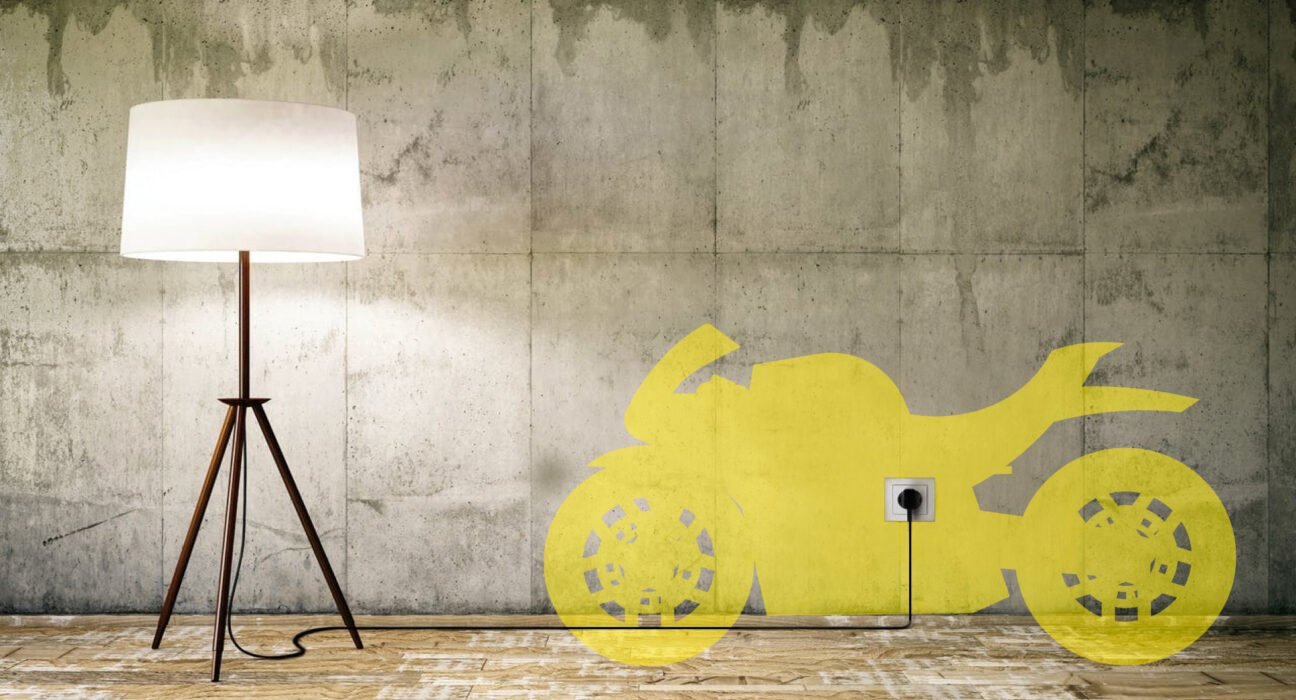
Bi-directional charging, or V2X (vehicle-to-everything), is the ability of an electric vehicle to not only receive energy from the grid but also send it back. This could mean powering your home during an outage (V2H), sending power back to the grid during peak demand (V2G), or running appliances directly from a bike battery (V2L). The technology exists. Infrastructure is gaining momentum. The question for the electric motorcycle world is when will it become real for us?
The Battery Size Problem, and Why It’s Not a Dealbreaker
Here’s the honest picture: Electric motorcycles have smaller batteries than cars. A Zero SR/F has a capacity of 17.3 kWh. A Stark Class MX sits at 6 kWh. On paper, this looks like a non-starter for powering a home.
Meanwhile there are lots of commercials for (large and expensive) home batteries. But if you really want to benefit economically and practically from home batteries (and solar panels), it is best to choose a battery that can at least cover your evening/night consumption. This is around 5 kWh on average. When you look at it this way, an electric car battery is even more practical as a home energy storage system. Any excess capacity can alternatively be used for energy trading or other purposes during the day.
For V2G applications that feed the grid, small batteries also contribute when aggregated across thousands of connected vehicles. In Europe, and especially the Netherlands, batteries could potentially help balance overloaded power grids.
The more interesting angle is fleet and urban deployment. In theory, a delivery company running ten electric mopeds could have a small but programmable distributed energy asset lying idle overnight. This is where aggregators and smart energy management platforms start to implement the economics.
Technical barriers are real
Bi-directional charging isn’t just a software toggle. It requires a compatible on-board charger that can handle power flow in both directions, a bi-directional wallbox or charging station, and a communication protocol between the vehicle, charger, and grid. Most current electric motorcycles come with uni-directional on-board chargers. Redesigning them increases cost and complexity on platforms where weight and compactness are already engineering constraints.
Battery longevity is another legitimate concern. Wear increases with each charge and discharge cycle. Repeated deep cycling to support V2G programs can accelerate degradation if battery management systems are not carefully calibrated for this. The good news is that the research found no significant deterioration in managed conditions. The operative word is managed.
Standardization is also still in progress. CCS (Combined Charging System) is the dominant connector in Europe, and bi-directional CCS support is expanding but not yet universal. CHAdeMO, the legacy standard that enabled the first generation of V2G vehicles, is being phased out. And AC V2G (via Mainex, as found on all Zero motorcycles) is also already available.
Motorcycle makers aren’t there yet, but the direction is clear
None of the major electric motorcycle brands currently offer factory-supported bi-directional charging. That’s a gap. But it shows exactly where the car industry stood three or four years ago. ElaadNL published an interesting research report on bidirectional charging
Most electric vehicle owners already have solar panels. By charging smartly when the sun shines, you can get the most out of your electric car’s battery earlier. This way, you drive at a much lower cost. For electric motorcycle brands, the opportunity exists – especially for manufacturers targeting urban commuters, fleet operators, or home energy-conscious riders who already have solar panels and want to close the loop. A bike that charges from your rooftop and rides back to your house is a different product than a bike that just requires a socket.


Where does the e-centre charge come from?
Understanding how an electric two-wheeler sits within a broader energy system – buildings, grids, solar arrays, storage setups – is not straightforward. Technical decisions made at the charging infrastructure level determine what is possible later. A standard charger installed today is not automatically upgradeable to bi-directional tomorrow.
This is the kind of systems-level thinking that the e-Centre Charge, led by Flip Oude Wernink and operating out of the Automotive Campus in Helmand, brings to the fore. The division covers charging infrastructure planning, smart charging, energy storage and the integration of electric two-wheelers within broader energy systems – bridging the gap between the bike and everything around it.
Bi-directional charging is not a major feature for electric motorcycles today. But the groundwork that is being laid – in standards, in hardware, in energy market structures – will determine which brands and which riders are positioned to take advantage of it when it arrives. Now knowing what questions to ask is half the job.
The e-Centre Charge is a division of the e-Centre 2.0, located at the Automotive Campus, Helmond, Netherlands. For charging infrastructure advice and smart energy integration for electric two-wheelers >
e-Centre 2.0 is powered by The Pack >