Analyzing the swing with data and examining body movement too… a new approach to golf lessons starting at the directly operated Seongnam Pangyo branch of GDR Academy
The combination of swing technique, physical function, and data-driven training: new possibilities for golf lessons
Debuting in November 2026 at GDR Academy’s Seongnam Pangyo directly operated branch
[CEO Journal = Director Jongwon Choi] Golf is a curious sport. Even after repeating the same motion thousands of times, yesterday’s swing is different today, and there are plenty of times when you think you’ve perfectly understood what the lesson pro taught you, only for your body not to move as you expect once you stand over the ball.
To build a better swing, golfers correct the path of the backswing, check the clubface at impact, and repeatedly practice weight transfer and torso rotation. If they still don’t get satisfying results, they seek out new lessons or even change clubs.
But it may be worth looking at the golf swing from a slightly different angle.
Are knowing the principles of a good swing and being able to perform that movement consistently the same thing?
A golf swing is not simply a skill of moving the arms and the club. It is a complex movement that starts from the interaction between the ground and the feet and connects, within a very brief moment, the movements of each part of the body: the rotation of the lower body and torso, then the shoulders, arms, and wrists.
So even with sufficient technical understanding, different results can appear depending on the ability to control body movement and the way force is transmitted.
“Golf Performance,” which has drawn attention in golf training recently, starts from exactly this perspective.
In addition to how a swing should be built, it examines what abilities the body performing that swing has.
“GDR PERFORMANCE,” which Golfzon’s GDR Academy plans to unveil at its Seongnam Pangyo directly operated branch this November, is also a new attempt to bring this approach into golf lessons.
Ahead of the official opening, CEO Journal plans to experience the program firsthand and then record, step by step, how body movement and the golf swing change during actual training. Going beyond a simple trial impression, we aim to look at the process and results of that change in a follow-up series of articles, based on swing video, measurement data, and expert analysis.
In the era of analyzing swings, it is now time to look at the cause
The change in golf lessons is as interesting as the way people enjoy golf itself.
In the past, it was common for a lesson pro to observe a swing directly and explain its problems based on experience. Golfers had to watch the pro’s movements and imitate them, or learn a correct swing by their own feel.
But advances in video analysis technology and launch monitors have greatly changed this practice environment.
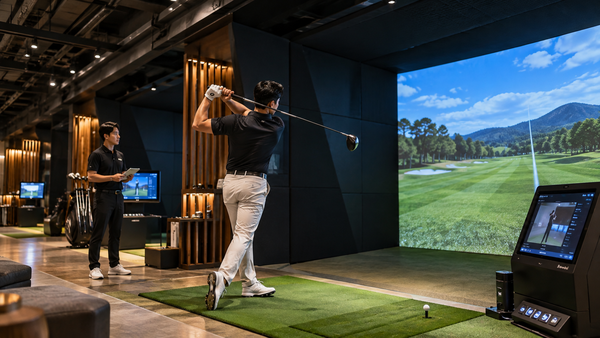
In particular, GDR (Golfzon Driving Range), which Golfzon introduced in 2014, is a simulator for golf practice and has contributed to widening a practice environment in which amateur golfers can check their shots as data.
Checking figures such as clubhead speed, ball speed, launch angle, and carry distance at a driving range is now nothing special.
Golf practice that relied on feel has become practice done alongside data.
Yet even though so much information can now be checked, golfers’ concerns remain much the same.
You can tell that the clubhead is not moving along the intended path, but why such movement repeats has to be examined separately.
The same goes for when body rotation in the backswing seems insufficient. You need to distinguish whether the movement was simply learned wrongly, whether there is a limit in the body’s range of motion, or whether several factors are acting together.
That is why, as measurement technology advances, the role of the experts who interpret the data becomes more important.
If swing analysis shows the movement and results appearing now, physical function assessment makes it possible to look at another factor that can influence that movement.
Understanding these two kinds of information together is an important task of new golf training.
How does golf physical training differ from ordinary strength training?
When people hear “physical training for golf,” they tend to think first of flexibility or strengthening core muscles.
The explanations are also familiar: you need to be able to rotate your body a lot to make a big backswing, and you need good strength to send the ball far.
But from the perspective of sports science, the physical abilities golf requires are a bit more complex.
A systematic review and meta-analysis published in 2024 in the international journal Sports Medicine synthesized 20 studies to analyze the relationship between golfers’ physical characteristics and clubhead speed.
The results showed that upper- and lower-body strength and the ability to produce explosive force had a significant association with clubhead speed. In particular, force-production characteristics seen in jumping movements and explosive upper-body strength showed noteworthy associations.
That does not mean flexibility and balance are unimportant in golf. A correlation with clubhead speed does not explain every characteristic of swing accuracy or body movement.
Rather, this study makes us think that physical training for golf must be more than simply increasing flexibility or strengthening muscles.
Mobility, stability, strength, power, and movement coordination of the body each carry out a different function and act in combination in the golf swing.
What matters here is understanding concretely which physical abilities one’s own swing needs.
For example, a golfer with sufficient strength doesn’t necessarily transmit that force efficiently to the club. Conversely, there are golfers who, though relatively lacking in strength, produce a stable swing using appropriate movement and timing.
Golf performance training can be described as an approach that takes into account each person’s different physical condition and swing characteristics together.
The American College of Sports Medicine (ACSM)’s 2026 global fitness trends also named data-driven training and functional fitness training among the major items.
This shows that interest continues across the fitness industry in assessing individual movement and physical ability and designing programs according to exercise goals.
Golf, too, can connect to this trend in that understanding and developing the physical abilities needed to actually perform the swing matters more than simply increasing the amount of exercise.
GDR PERFORMANCE: where swing analysis meets physical training
GDR PERFORMANCE, newly unveiled by Golfzon’s GDR Academy, is a golf-specific program that examines swing technique and physical training together.
According to the guide GDR Academy released in September 2026, the program consists of four main elements.
They are individual swing analysis, personalized physical training, swing training, and periodic data feedback.
First, swing analysis is the starting point for understanding a golfer’s current state.
Each golfer has different swing paths and impact characteristics, and even the same golfer can get different results depending on the club or practice conditions. So the process of understanding which parts of your swing need improvement is important.
The second element is personalized physical training.
Physical training for golf needs to be designed by considering the current physical state and training goal, rather than having all participants repeat the same exercises.
For example, a golfer whose main challenge is rotational mobility and a golfer who needs to produce force instantly may need different approaches.
The third is swing training.
For the physical abilities being improved in physical training to connect with the actual golf swing, technical practice must take place alongside.
That’s because becoming more flexible or stronger does not automatically change existing swing habits.
The last is periodic data feedback.
It is the process of checking what changes appeared after training and reflecting those results in the direction of the next training.
When using swing data, too, it matters to look at the changes and consistency that appear across repeated measurements, rather than a single best record.
These four elements describe the basic direction of GDR PERFORMANCE.
It is a process of analyzing the swing, training the physical abilities each person needs, applying them back to the swing, and confirming the results with data.
A notable part of how the program actually operates is that it has been structured so that ordinary amateur golfers can also experience the golf performance training that professional athletes are familiar with.
Branch Manager Jeong Da-sol, who oversees GDR PERFORMANCE, explained that the program was conceived around group training of about four people, in order to lower the burden of participation for ordinary golfers and increase the fun of exercise.
In particular, the teaching pro who instructs golf technique and the professional trainer in charge of physical function each take their own area of expertise while aiming to share the information needed in a member’s training process and to cooperate.
However, how this way of operating translates into actual swing improvement and better performance is something that must be confirmed through the upcoming training process and measurement data.
Even for the same swing problem, the answers can differ
One problem that often comes up in golf is the slice.
For a right-handed golfer, it is a shot shape in which the ball curves to the right of the target line.
In this case, golfers try to adjust the clubface direction or correct the swing path.
But just because the result is the same doesn’t mean every golfer creates that shot shape from the same cause.
For some golfers, learning to control the clubface may come first, and for others it may help to look at the movement and timing of the whole swing.
If necessary, the characteristics of body movement could be checked as well.
What deserves consideration here is that physical assessment does not replace golf lessons.
Technical problems must be solved with technical training, and where improving physical ability is needed, appropriate training should be added.
It isn’t appropriate to look for the cause of every swing problem in the body, but repeatedly correcting the same movement without considering physical condition at all can also have its limits.
A good lesson ultimately connects to finding the training an individual needs.
Even golfers with the same years of experience can differ in their regular exercise habits, strength, mobility, and body control. So the process of building a repeatable movement suited to each person’s conditions matters more than copying a single uniform ideal swing.
From this perspective, GDR PERFORMANCE can be one example showing how golf practice and physical training can be connected.
In particular, how specialized physical training and golf technique instruction are combined is an important part of understanding this program.
Golfers should be able to hear an explanation of what problems they have, why a particular exercise is needed, and how that exercise can connect to the actual golf swing.
This carries a different meaning for golf lessons than simply adding one more exercise program.
A new approach to golf lessons starting in Seongnam Pangyo
The place where GDR PERFORMANCE will debut this November is GDR Academy’s directly operated Seongnam Pangyo branch.
In an official announcement in September 2026, Golfzon introduced GDR PERFORMANCE as a program for golfers interested in longer distance, swing refinement, and stable play.
The golf industry has long developed around equipment and measurement technology.
The materials of clubs and shafts have diversified, and the equipment that analyzes a golfer’s swing has also become more precise. Many movements that used to be explained by feel can now be checked through video and figures.
But the advance of equipment hasn’t resolved all the concerns of people learning golf.
Between precisely understanding your swing through data and actually improving it, a process called training is still needed.
GDR PERFORMANCE draws interest as an attempt to connect swing analysis, physical training, technical instruction, and data feedback into a single process.
Of course, the real results of a new program have to be confirmed through actual operation and users’ experiences. Simply offering a training program alongside cannot guarantee improved performance.
Even so, it is meaningful in that it prompts us to look at the way we learn golf somewhat more broadly.
It is a question worth considering at least once for anyone who has enjoyed golf for a long time.
We have done a lot of practice to build a better swing. But how well have we understood our own physical abilities that make that swing possible?
Perhaps the advance of golf lessons can find new possibilities not only in more precise swing analysis technology but also in the process of connecting that data to each golfer’s physical condition.
Before changing the swing, understanding the body that produces it.
The direction of new golf training that GDR PERFORMANCE proposes can be examined from exactly this point.
CEO Journal intends to experience and confirm for itself how that possibility is realized at an actual training site.
From the body state and swing at the start of training, through the process of staged training and interim changes, to the final assessment: based on swing video, measurement data, and expert analysis, we will look in turn, through follow-up series articles, at the results and limits that emerge in that process.
What changes will three months of training bring to a golfer’s body and swing? We hope to find the answer in the records to come.
키워드
최종원 기자
eliot.choijw@gmail.com다른 기사 보기
저작권자 © CEO저널 무단전재 및 재배포 금지