


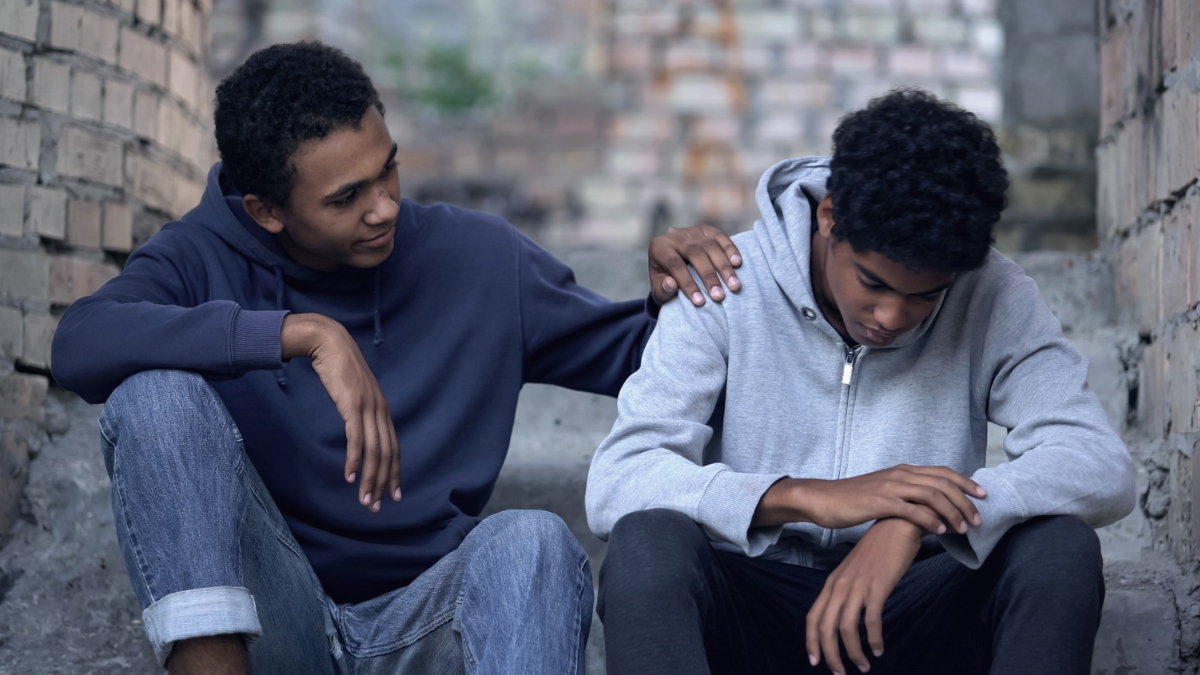
Crisis Text Line’s latest research reveals a troubling imbalance: Boys and men make up fewer than 1 in 5 of the people who reach out for support. The disparity has nothing to do with the scale of their struggle — men die by suicide at significantly higher rates than women in the United States. What it reflects instead is a persistent reluctance to ask for help in the first place. That gap, between genuine need and willingness to speak up, is the starting point for our new report.
Between 2022 and 2024, we supported tens of thousands of conversations with boys and men. Each one represents a moment where someone broke the pattern and reached out anyway. What they told us paints a clear picture, and it’s one we need to sit with, not just read past.
Anxiety and stress lead — showing up in 39% of these conversations, and over 40% among adult men. Loneliness builds with age: Relationship struggles dominate early on, but isolation becomes the bigger weight over time. And here’s the statistic that stops us every time we say it out loud: nearly 1 in 3 boys under 14 told us they were having thoughts of suicide. One in six had engaged in self-harm. These are kids who haven’t even started high school.
There’s something hopeful in our research, too
But there’s something hopeful in our research, too. When we asked what actually helps, boys and men told us: connection and movement. Social support and physical activity came up again and again as the coping strategies that made a real difference.
That tells us something important: This isn’t just a service problem. You can build the most accessible mental health system in the world, and it still won’t reach someone who’s been taught his whole life to not say he’s struggling. Addressing this crisis means building spaces where boys and men can show up as they are — spaces that work the way they actually experience and express distress, not the way we wish they did.
Humans need humans. That’s true for every texter we support, and it’s especially true for the boys and men who are least likely to ask. Our job now is to lower that barrier — earlier, before a hard moment becomes a crisis — through stronger community ties, more inclusive spaces, and support that meets them where they already are.
Because of the people who stand behind this
Because of the people who stand behind this work, Crisis Text Line can keep showing up for the people least likely to ask for it.Read the full report, Exploring Mental Health Trends Among Boys and Men to see the full data insights and what it’s telling us.
If you know someone who is struggling and needs support, simply text HELLO or HOLA to 741741 to reach a live, trained volunteer Crisis Counselor 24/7. Reaching out isn’t a weakness. It’s a strength.


