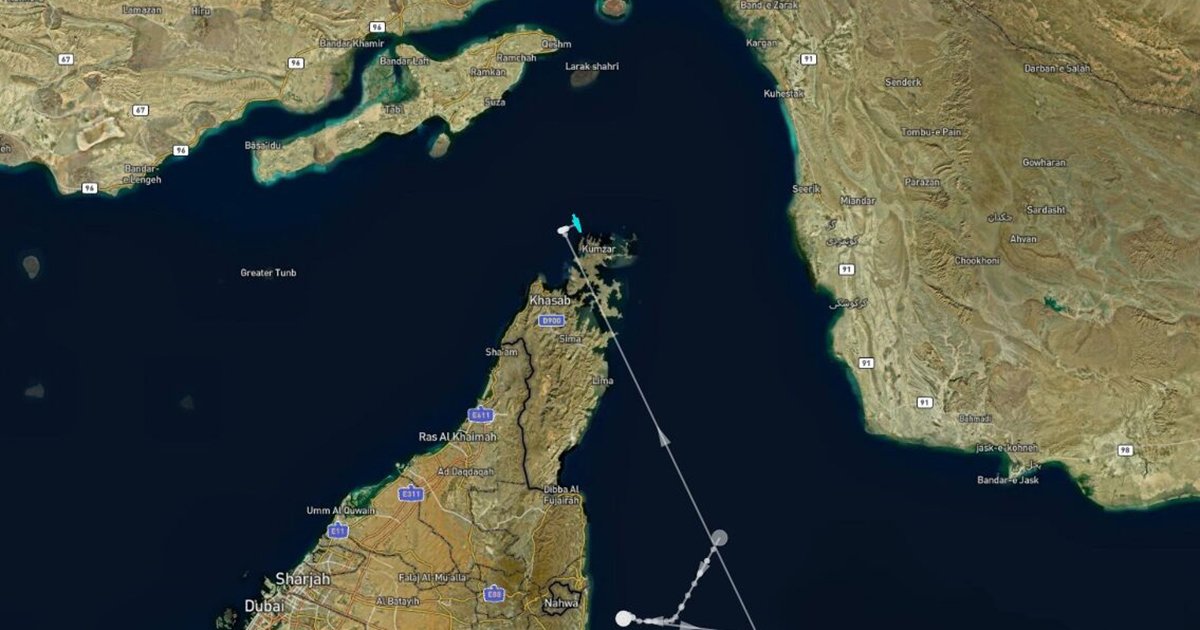
Kawomelis reappeared in the Strait of Hormuz along the Omani coast early on 20 July, indicating it was at anchor. (Bloomberg)
key takeaways:
- Visible tanker traffic in the Strait of Hormuz came to a near halt after two ships operated by Dynacom were attacked due to Iranian attacks and escalating US attacks.
- The disruption raised concerns about global oil and liquefied natural gas supplies as ships increasingly traveled with transponders turned off and initially sent energy prices soaring.
- Risk consultant Marisk said the attacks show that merchant ships remain exposed to military action, while the full extent of shipping disruption may take weeks or months to emerge.
Iranian attacks on tankers and escalating US attacks appear to have brought traffic to a standstill in the Strait of Hormuz, as two ships controlled by one of the industry’s most adventurous shipowners were attacked.
An oil supertanker named Achelous and a smaller fuel tanker both crashed into the waterway, according to Dynacom Tanker Management Ltd., the ship’s manager. Public reporting by freighters of their navigation through the waterway has almost ceased as owners and crews will do anything they can to avoid attack.
Attacks on ships controlled by Dynacom – which has built a reputation for finding passage through the strait during crises, even when others could not or would not – will roil the industry and underline how dangerous the crossing has become following a recent increase in violence on both sides.
On 19 July, the Islamic Revolutionary Guard Corps issued a statement that four ships turned off their transponders and attempted to cross Hormuz through an “unsafe route” after ignoring warnings. Iranian media, citing the IRGC, reported that two “met with accidents and were stopped en route.”
The flare-up of violence in the Middle East has raised concerns about disruptions to vital energy flows, including liquefied natural gas, from the Persian Gulf to global customers. Oil and European gas prices jumped on July 20 after the weekend strikes before paring gains.
The targeting of the ships is likely to raise new concerns over the safety of ships passing through Hormuz and touching the Omani coast. Iran has approved a route to the north that passes close to its coastline.
Dynacom’s brand new LR1 catches fire in Omani waters.
New business as usual.
A Dynacom products tanker was attacked and set on fire in a twin attack off the coast of Oman on Monday during an apparent attempt to transit the Strait of Hormuz.
The attack occurred eight nautical miles (15 km)… https://t.co/JjQ3EvLnXY
– Yet Another Commodity Boy (@tleilax___) 20 July 2026
Among the observable transits, the Marshall Islands-flagged bulk carrier was one of the few ships that appeared to attempt to turn off its transponders while approaching the strait from the Persian Gulf near Oman, according to ship-tracking data.
A liquefied petroleum gas carrier that has been identified as part of the dark fleet involved in Iranian exports was also seen heading towards the strait.
Another bulk carrier registered with the Marshall Islands began signaling off the Gulf of Oman early on 19 July after indicating it was in the Persian Gulf, indicating that it had passed the Strait of Hormuz with its transponder.
Despite the decline in visible transits that are tracked by ships’ automatic identification system signals, some ships may be transiting in the dark, meaning that the full scale of traffic may take months or even weeks to emerge.
projectile
UK Maritime Trade Operations said it had received reports of an incident northwest of Qumzar, Oman, in which a ship caught fire after being hit by an unidentified projectile. The fire has not been extinguished and the ship has drifted ashore, UKTMO said in a statement, without identifying the ship.
Kavomelis began indicating that she had anchored near the tip of Oman’s Musandam Peninsula on 20 July. The last broadcast from the ship was in the Gulf of Oman early Sunday.
Hormuz traffic remains disrupted
The latest maritime risk data shows that Strait of Hormuz crossings remained low with only 30 verified transits between 17 and 19 July and fragmentation in route selection continued, reflecting ongoing uncertainty. While IMO Event Tracker… pic.twitter.com/cPJjRUd7bM
– Kepler (@Kpler) 20 July 2026
Dynacom confirmed in a statement distributed by an outside firm that the attack on Kavomelis occurred and that the crew had evacuated the ship and are safe, the 2025 is capable of transporting approximately 75,000 tons of cargo. A separate statement said “a projectile of unknown origin” struck the Achelous.
Kawomelis reappeared in the Strait of Hormuz along the Omani coast early on 20 July, indicating it was at anchor.
There were already signs that Iran was increasingly targeting oil supertankers, the main vessels for transporting crude from the Middle East around the world.
“These incidents confirm the previously announced significant increase in operational risk within the Strait of Hormuz.” risk consultant Marisk said in a note in reference to incidents involving Dynacom vessels. “The attacks demonstrate that merchant ships remain exposed to direct military action despite their use of the transit corridor.”