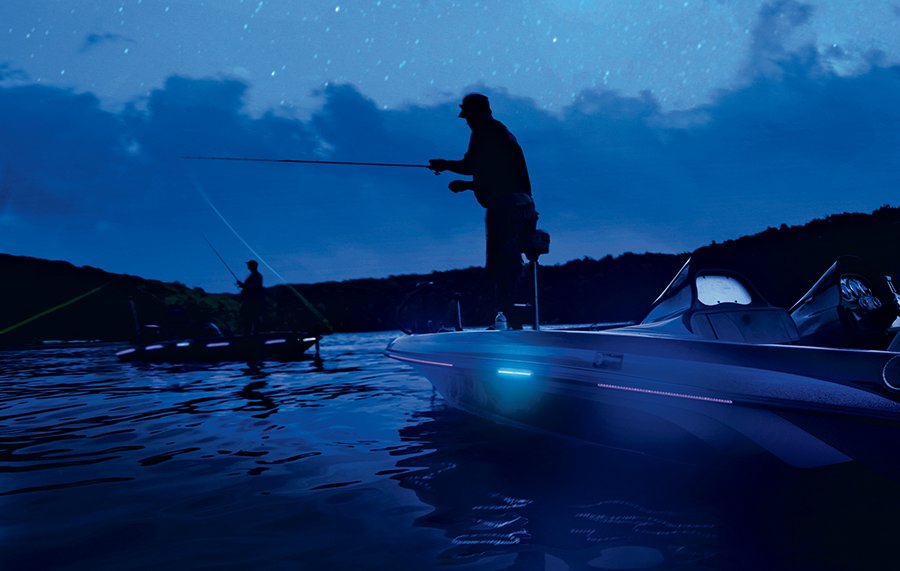
The hot and humid months of summer always turn bass fishing lakes into an absolute mess – ponds filled with oversized cabin cruisers, runabouts and jet-skis. However, once the sun sets, not many people go out fishing at night. The crowd usually dissipates and bass that were previously inactive begin feeding heavily again.
A few changes to your tackle and gear are all it takes to keep things going from dusk to dawn. When the sun goes down, turn on the lights and enjoy the best bass fishing of the summer.
1. Add a black light to your boat
One of the first steps in building a high-impact night fishing arsenal is to spool up with clear/blue fluorescent monofilament line. This type of line is inexpensive and shines like a bright blue laser on the surface when you use it with a black light – which is my secret weapon. Currently, there are a variety of black lights available to choose from.
Fully customizable black-light system (Like this from Precision Sonar) Fits directly onto your boat’s rub rail. During the day, it’s almost undetectable, but at night with the flip of a switch, a nearly 360-degree light illuminates every possible casting angle. Plus, it has a dimmer switch that allows you to adjust the intensity depending on the moonlight and fishing conditions.
tip: Avoid muddy lakes when fishing at night. Clear water with 2 to 4 feet of visibility is ideal for night bass fishing.
2. Tie on bold, loud lures
When daytime temperatures warm up, bass typically stop deeper into points, ledges, and submerged islands or humps. As temperatures drop at night, they move into shallow water to feed. I love to welcome them with loud and bold greed.
A large single Colorado-blade spinnerbait attached to a rubber-imitation craw or chunk trailer emits a great deal of fish-attracting vibration and can be fished at various depths. Another deadly night lure is a standard jig rigged with a chunk trailer that directly mimics the natural actions of shad and even crayfish. Crawfishing the jig on the bottom simulates crayfish emerging from beneath their rocky hides to feed at night. If the bass are aggressively eating the shad, switch to a swimming jig.
In the right conditions, nothing impacts the bite better than surface lures like prop-baits, jitterbugs and buzzbaits, or create much excitement. On a cool summer night a big bass is tearing up the top water, making for fishing dreams.
3. Match lure color with moonlight
The moon and cloud cover will guide your attractive color selection. On pitch black nights with little or no moonlight, use solid black, gray or blue. Under a bright moon or on a clear, starlit night, switch to bold color combinations like green/orange or even red/chartreuse. On partly cloudy nights, choose red/black, blue/black, or green/black.
4. Expert Night Fishing Tips from Top Bass Guides
Night fishing for bass is electric. First there’s the steady “zing” as you cast the line, then the calmness that comes with hearing the “kerplunk” that makes you tense. Your fingers then begin to turn the reel crank and you feel the bait pulsating through the water. This is when that unforgettable tingle – the anticipation of a hit – reaches your fingertips. You are charged for the strike.
Best Bass Lures: The Ultimate Guide to Every Type of Bass Bait
Summer night fishing for big bass is a long-standing tradition in the South, where daytime temperatures regularly reach triple digits, rain-forest-like humidity overwhelms even the most determined fishermen and jet skis run rampant. But the South isn’t the only place where nighttime bass fishing is profitable. When the weather is warm, big bass everywhere wait for the cover of darkness to feed.
Scoring big bites on bass after dark, however, demands a new perspective on fishing. Catching largemouth or smallmouth on a third-shift schedule requires an intimacy with the fish’s nocturnal habitats and habits, a few specific gear items, and the ability to read subtle changes in bottom structure and bank slope through your rod. Here are the strategies of three hardcore bass fishermen who love fishing on moonless nights.
Nashville Guide Jack Christian
Christian has introduced hundreds of clients to the mysterious world of nighttime bass fishing over his 25 year career. His favorite after-dark structure for both largemouth and smallmouth is offshore humps. Christian likes humps because they are harder to find than points, which means they are not as apt to be hammered by other fishermen, and because they draw larger bass from a wider area.
“Picture a hump as an underwater oasis,” says Christian. “The best summer humps are about ten feet deep; I avoid very shallow humps because they attract smaller fish.”
Christian says that in warm weather, schools of threadfin shad spend their days gathering around main-lake channel structure, which can be in water 40 or 50 feet deep. To deter bait fish, bass suspend long points in this deep water, saving energy while waiting to find the bait. But a different scenario emerges at night. Many of these bass climb onto nearby hummocks to hunt crayfish, which emerge in the dark to feed.
To catch fish in the hump at night one has to remain hidden. Christian approaches structure with his trolling motor or moves within casting range if there is sufficient wind. He makes a long cast with a crawdad imitator (like a jig with a pork-frog trailer) hit from the bottom over the top of the hump. At night he uses the reel handle more than the rod to move the lure, so that the jig keeps contact with the bottom as much as possible. It best imitates crawling crayfish.
Connected: best frog lure
Christian uses bait colors that have enough contrast so bass can distinguish the crayfish lure from the bottom. His favorite colors are a black jig with a brown pork frog and a purple jig with a red frog. He does not use brightly colored lures at night.
Christian has a black light fitted to his boat, which illuminates fluorescent line above the water, helping him detect subtle bites. He says, “If you feel the pull of the bass, it’s too late. As soon as the fish senses the pressure, it spits out the lure. The black light lets you see the line moving before you feel the fish and before the fish feels you.
Charlie Ingram of Columbia, Tennessee
Ingram is one of the top money winners on the professional bass circuit. But in warmer weather, you can usually find him fishing for smallies at Pickwick Lake at night. He has caught some whoppers from this river bank, including a handful of more than eight pounds. Charlie’s secret: Spinnerbaits for fishing shallow structure that drift in the water’s current.
At night, Ingram targets gravel bars that are filled with stumps near the old Tennessee River channel. “These bars drop down to about 10 feet and then drop off rapidly,” he says. “When they draw water over the dam (via generator turbines), the current pulls plankton into the slack-water pockets on the bars and the shad go in to feed on the plankton. Sometimes the bars are jammed wall to wall with bait, until a large smallmouth emerges. The wolf pack is not visible.”
Connected: Best Smallmouth Bass Lures: The Only Bait You Need to Catch Giant Smallies
Ingram’s favorite nighttime lure is a quarter-ounce spinnerbait with a No. 3 blade and a red and purple skirt adorned with a red pork frog. He makes a short cast on the bar, lets the lure settle to the bottom, raises the rod tip six inches, lowers it, picks up the slack and then raises it again.
“Sooner or later, a big smallmouth will end it,” says Ingram. “They travel in schools at night and can be incredibly aggressive. I’ve had them snatch the rod right out of my hands.”
However, when the stream closes, Ingram’s shallow technique evaporates as the bronzebacks retreat back to the sanctuary of the deeper river channel.
Fred McClintock of Celina, Tennessee
McClintock fishes after sunset in Dale Hollow Lake, a 29,000-acre upland reservoir known for large smallmouth. Its beautiful shorelines and exceptionally deep, clear waters make the lake a top choice for summer vacationers who flock to it to frolic on houseboats. However, after sunset, Del Hollow is a night-fisherman’s paradise, where you can find more points, humps and drop-offs than you could hope for in a lifetime.
Due to Dale Hollow’s extreme clarity, light penetration allows lush weed beds to grow up to 35 feet deep. With the lake warming into the mid-90s by August, the largest bass seek the coolness of deeper water and refuse to move into shallow water even at night. Instead, they stick to the deeper edges of the weed beds, where they find plenty of bait fish and crayfish.
McClintock targets weed beds that are located along the steep descent into the lake’s cavernous river channel. Grassy streambeds falling to depths of 30 to 80 feet are best. Fast-falling main lake points that have grass on them are also good places to fish – long, slow-falling points usually attract small bass.
“Changing lures in the dark can be painful, so I pre-rig several rods with a selection of jigs and spinnerbaits,”
McClintock says. “I’ve caught a lot of wall-hanger bass at night on spider jigs; these have long plastic legs that mimic the pinchers of crayfish, and a soft collar around a weighted head that moves and feels alive when the bass lands on it. Heavier spinnerbaits, up to an ounce, are also good. There aren’t many other lures you can rely on at night in the 30-foot zone.”
Connected: Old School Secrets to Catching Giant Bass at Night
McClintock found that, at night, smallmouth bass hung out on the tops and outer edges of weed beds, while largemouth bass were more likely to burrow into the vegetation. He begins combing the grass with a spinnerbait with a large No. 7 blade, moving it slowly and steadily across the cover.
McClintock says, “Some nights, they won’t hit the spinnerbait. When that happens, I’ll switch to a spider jig and crawl, strike and shake it through the vegetation.” “You need a stiff graphite rod to feel the light bites in extremely deep water. I like a seven-foot bait-caster, because it gets a lot of line going when I set the hook and enables me to pull a big fish out of the deep grass. But you won’t be able to land all of them. I’ve fished bass at night that have pulled the boat out before it sank. But again, I think that’s what keeps me coming back. “