There are fast cars, there are beautiful cars, and then there are machines that change the automotive world forever. A genuine supercar is rarely defined by its top speed alone. It is a statement of engineering ambition, an exercise in design without compromise and, occasionally, a rather expensive demonstration of what happens when exceptionally talented people are given the freedom to ignore convention. Over the decades, the supercar has evolved from an exotic machine built around a powerful engine into a technological showcase featuring advanced aerodynamics, lightweight materials, sophisticated electronics and extraordinary powertrains. Certain automobiles have done considerably more than impress enthusiasts or dominate racetracks. They have challenged established manufacturers, rewritten engineering rules and created entirely new expectations of what a road car can achieve. Six machines, in particular, deserve a place in this extraordinary history. Each arrived at a different moment, each brought something distinctive to the table, and each helped shape the supercar industry as we know it today.
Lamborghini Miura (1966)
Before the supercar became a symbol of excess, speed and automotive theatre, there was the Lamborghini Miura. Unveiled at the 1966 Geneva Motor Show, the Miura changed the established understanding of how a high performance road car should be engineered. Developed by a young team of engineers, including Gian Paolo Dallara and Paolo Stanzani, it introduced a transversely mounted 3.9 litre V12 engine positioned behind the driver and ahead of the rear wheels. This mid engine arrangement, previously associated largely with racing machinery, gave the Miura an extraordinary mechanical layout for a production road car.
Designed by Marcello Gandini at Bertone, its low roofline, sculpted bodywork, dramatic proportions and distinctive headlight eyelashes made it an instant design icon. The original P400 produced approximately 350 bhp and could reach speeds of around 280 km/h, remarkable figures for its era. More importantly, the Miura established the template for the modern mid engine supercar, influencing generations of performance machines that followed. It was not simply a beautiful Lamborghini; it was the car that helped create an entirely new automotive category.
Ferrari F40
If the Miura introduced the world to the modern supercar, the Ferrari F40 demonstrated just how uncompromising one could become. Introduced in 1987 to celebrate Ferrari’s 40th anniversary, the F40 was the last road car personally approved by company founder Enzo Ferrari before his death in 1988. Developed with a singular focus on performance, it discarded unnecessary luxuries in favour of speed, weight reduction and an unfiltered driving experience. Under its unmistakable bodywork sat a 2.9 litre twin turbocharged V8 producing 478 bhp, paired with a five speed manual gearbox. Extensive use of carbon fibre, Kevlar and other lightweight materials helped keep its weight remarkably low.
Its aggressive fixed rear wing, sculpted air intakes and aerodynamic bodywork gave it the appearance of a racing machine that had somehow escaped onto public roads. With a claimed top speed exceeding 320 km/h, the F40 became the first production road car to break the 200 mph barrier. Its significance extended beyond outright performance. It demonstrated how motorsport inspired materials, aerodynamic development and a stripped back approach could create an extraordinary road car. The F40 remains one of Ferrari’s most celebrated machines, representing an era when driving ability mattered considerably more than electronic assistance or creature comforts.
McLaren F1 (1992)
When McLaren introduced the F1 in 1992, it was attempting something rather ambitious: building what its creators believed could be the ultimate road car. Conceived by legendary designer Gordon Murray, the F1 approached automotive engineering with an almost obsessive attention to detail. Its most distinctive feature was the central driving position, flanked by two passenger seats, creating a layout that offered the driver an experience unlike anything else on the road. Power came from a naturally aspirated 6.1 litre BMW V12 producing 627 bhp. The engine bay featured gold foil insulation, while its carbon fibre monocoque made it exceptionally light and structurally advanced for a production road car.
Every aspect, including aerodynamics, cooling and weight distribution, was carefully considered. The F1 reached a record breaking top speed of approximately 386 km/h in its high speed configuration, becoming the world’s fastest production car at the time. Its engineering philosophy also translated successfully to motorsport, with the McLaren F1 GTR winning the 1995 24 Hours of Le Mans outright. Only 106 examples of the road and racing variants were built. The F1 proved that extraordinary speed did not necessarily require turbocharging or excessive electronic intervention. Sometimes, intelligent engineering and a naturally aspirated V12 were quite enough.
Pagani Zonda (1999)
Some cars are designed by engineers, others by artists. The Pagani Zonda was Horacio Pagani’s attempt to bring both disciplines together. Making its international debut at the 1999 Geneva International Motor Show, the Zonda C12 introduced the world to a relatively young Italian manufacturer with an unusually ambitious vision. Having previously worked with Lamborghini, Horacio Pagani wanted to create a machine that combined advanced engineering with the craftsmanship and attention to detail associated with fine Italian design. The original Zonda featured a naturally aspirated 6.0 litre Mercedes Benz AMG V12, producing approximately 394 bhp. Its carbon fibre monocoque, sculpted bodywork and distinctive four exhaust outlets established an identity that was immediately recognisable. Inspired partly by Group C racing machinery and the aerodynamic forms of fighter aircraft, the Zonda looked unlike anything else on the road. Its significance, however, went beyond its dramatic appearance. Pagani demonstrated that a relatively small independent manufacturer could compete with established supercar brands through bespoke engineering, advanced composite materials and meticulous craftsmanship. Each car became an expression of its owner’s personality, with extraordinary attention paid to its interior, materials and mechanical details. The Zonda helped establish the modern boutique hypercar movement, proving that exclusivity and engineering excellence could coexist beautifully.
Bugatti Veyron (2005)
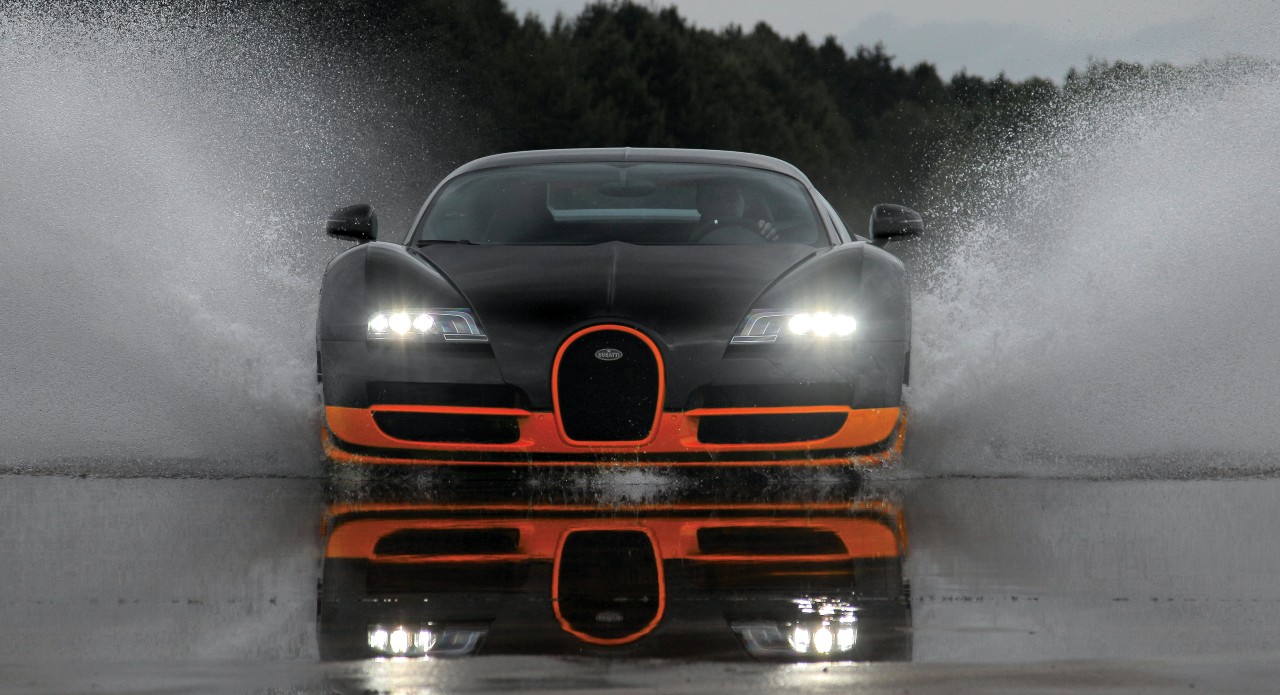
There was a time when the idea of a production road car crossing 400 km/h seemed almost absurd. Bugatti decided that it was a challenge worth pursuing. The Veyron 16.4, which entered production in 2005, was the result of an extraordinary engineering programme driven by Ferdinand Piëch’s ambition to create a car that could combine unprecedented speed with the comfort of a luxury grand tourer. Its centrepiece was an enormous 8.0 litre W16 engine featuring four turbochargers, producing 1,001 PS and 1,250 Nm of torque. Power was distributed through a seven speed dual clutch transmission and permanent all wheel drive. The Veyron could accelerate from zero to 100 km/h in approximately 2.5 seconds and achieve an officially recorded top speed of 407 km/h. Such performance demanded engineering solutions that went well beyond fitting a powerful engine into an exotic body. Bugatti had to develop sophisticated cooling systems, specialised tyres, advanced aerodynamics and an intricate four wheel drive setup to ensure stability at extraordinary speeds. The Veyron became the first series production car to cross the 400 km/h threshold, establishing a new benchmark for the hypercar industry. It also changed the expectations surrounding automotive luxury, demonstrating that extreme performance and remarkable refinement could exist in the same machine.
Koenigsegg Agera (2010)
The Machines That Changed Everything
The Lamborghini Miura introduced the world to a new supercar layout. The Ferrari F40 brought motorsport intensity to the road. The McLaren F1 redefined engineering precision, while the Pagani Zonda established a new relationship between automotive art and technology. Bugatti’s Veyron made 400 km/h a production car reality, and Koenigsegg’s Agera demonstrated how independent engineering could challenge the industry’s biggest names.
These six automobiles represent different eras, philosophies and approaches to performance. Yet they share one important characteristic: none was content with simply following the rules. Their influence can still be seen in today’s most extraordinary performance cars, where speed, design, innovation and exclusivity continue to compete for attention. Perhaps that is what makes a genuine automotive legend. It does not merely arrive, make headlines and disappear into history. It changes what the next generation believes is possible.
Published At: 13 November 2026 04:36 PM
Legendary supercarsMost influential supercarsSupercar engineeringSupercars in automotive history