

A Canadian study looks at fishing patterns and nekton communities to determine whether restored marshes are actually providing habitat value.
Salt marshes are very calming for fish. They serve as nurseries for juvenile species, feeding grounds for adults during high tide, and shelter for the small prey on which larger fish depend. But knowing whether restored marshes are actually working well has been a scientific challenge. A new research paper from Maritime Canada is trying to change that.
Published on biorxiv In November 2025, the study is titled “Integrating nekton communities, salt pool dynamics and fish foraging patterns to assess the success of salt marsh restoration in Marine Canada.” Researchers evaluated two salt marsh restoration projects in Marine Canada between 2022 and 2023, using a combination of ecological survey methods to build a clearer picture of habitat quality.
What did the researchers measure?
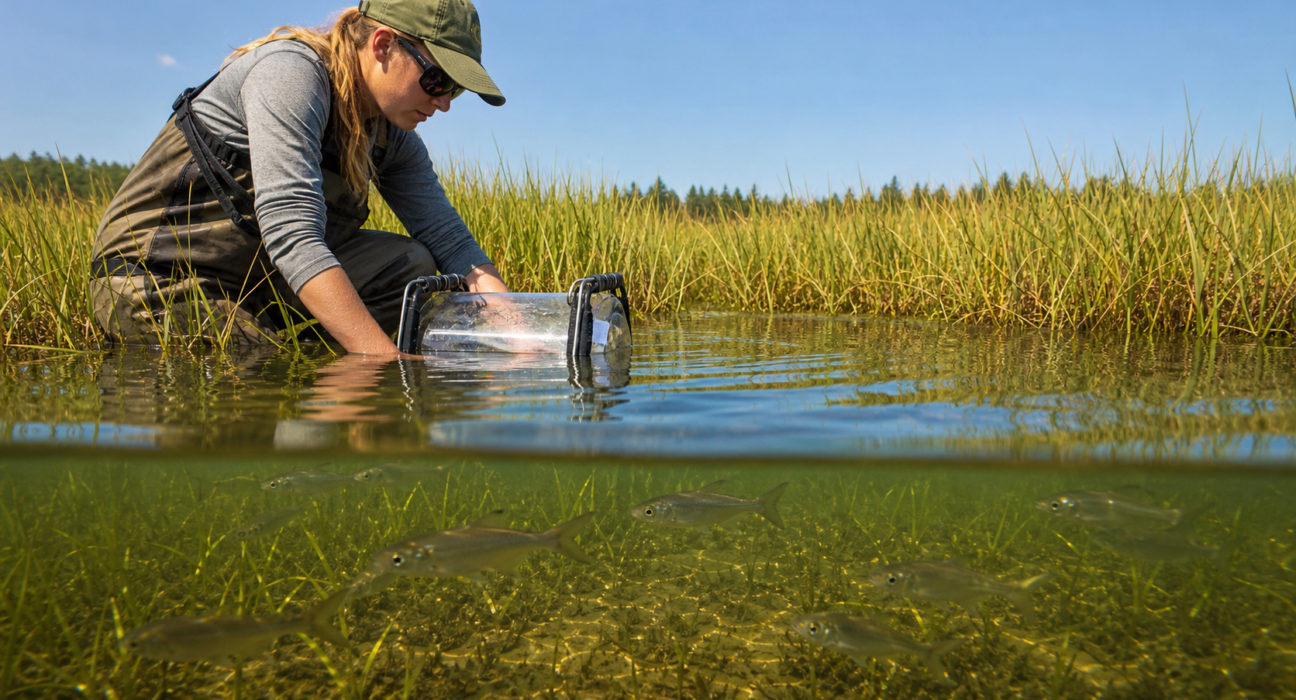
The team focused on three interconnected pieces of the salt marsh ecosystem. First, they surveyed nekton communities in intertidal bays and on the marshy platform. Nekton refers to fishes and crustaceans that actively swim in habitat rather than drifting with currents.
Second, they assessed the abiotic conditions and faunal communities in the salt pools. Salt pools are isolated or semi- isolated areas of water within marshes that have different temperatures, salinity, and dissolved oxygen levels than the surrounding tidal channels. These conditions matter greatly for which species can use habitat when and how.
Third, and perhaps most interesting from a fisheries perspective, they tracked the foraging patterns of focal fish species. How fish actually feed within the marsh tells you whether the restoration is creating the prey base and structure that the fish need, not just whether the right plants are growing.
Why it matters to fishermen and fisheries
Salt marshes on the Atlantic coast of North America have been drained, filled, and eroded for more than a century. Restoration efforts have accelerated in recent decades, but evaluating whether these projects are successful depends largely on measuring plant cover and soil characteristics rather than fish utilization.
This research takes a more integrated approach. If a restored marsh has the right vegetation but fish are not using it as they do in a natural marsh, this is important information for restoration managers. Conversely, if fishing patterns closely match those of reference wetlands, it is a meaningful indicator that ecosystem functions are coming back online.
For fishermen in coastal areas, this type of research supports the long-term logic of funding wetland conservation and restoration. Healthy salt marshes produce small fish, shrimp and crustaceans that are pursued by game fish. The relationship between marsh restoration and recreational fishing quality is real, even if it lasts for years rather than immediately.
Comprehensive reference in Maritime Canada
Maritime Canada, which includes New Brunswick, Nova Scotia, and Prince Edward Island, has extensive tidal wetland systems that have seen significant change since European settlement. Dams built to drain swamps for agriculture have been a major driver of habitat loss. Restoration in the area often involves removing or breaching these dams to restore tidal flow.
The 2022 to 2023 field season collected data across multiple tidal cycles and seasons, giving researchers a more complete picture of the performance of restored sites under different conditions. The dynamics of salt pools in particular can change significantly with temperature and rainfall, affecting fish access and prey availability.
This paper adds to the growing body of research focused on making fish and wildlife outcomes the primary measure of restoration success rather than solely physical habitat metrics. For the fishing community, the change in approach is noticeable as federal and state conservation funding decisions increasingly depend on demonstrated ecological returns.
sources say


to Mr
Tom is a former Navy corpsman who spent some time in the deserts of Iraq with a Marine Recon unit, kicking in tent flaps and tending sheep. Before that, he was a paramedic somewhere in DFW, also doing some executive security work between shifts. Now that those adventure days are behind him, he’s embraced his inner “warrior hippie” and tackles 14er in his sandals, taking on adventure challenges while drinking copious amounts of water. To finance these adventures, he writes all kinds of content (has also held editor positions at several publications) and teaches wilderness medicine and off-road skills. He hopes his post will help you find gear that will survive whatever you throw at it (and the training to use it). Learn from your mistakes – He is known (in some circles) for his curse…ahem, ability…to find the breaking point of anything. You can follow him here https://linktr.ee/docrader.