Revenue 2025 (US$B)
21.9 Bn
Forecast 2035 (US$B)
34.8 Bn
CAGR 2026-2035
4.7%
Leading Region
Asia-Pacific
Report Overview
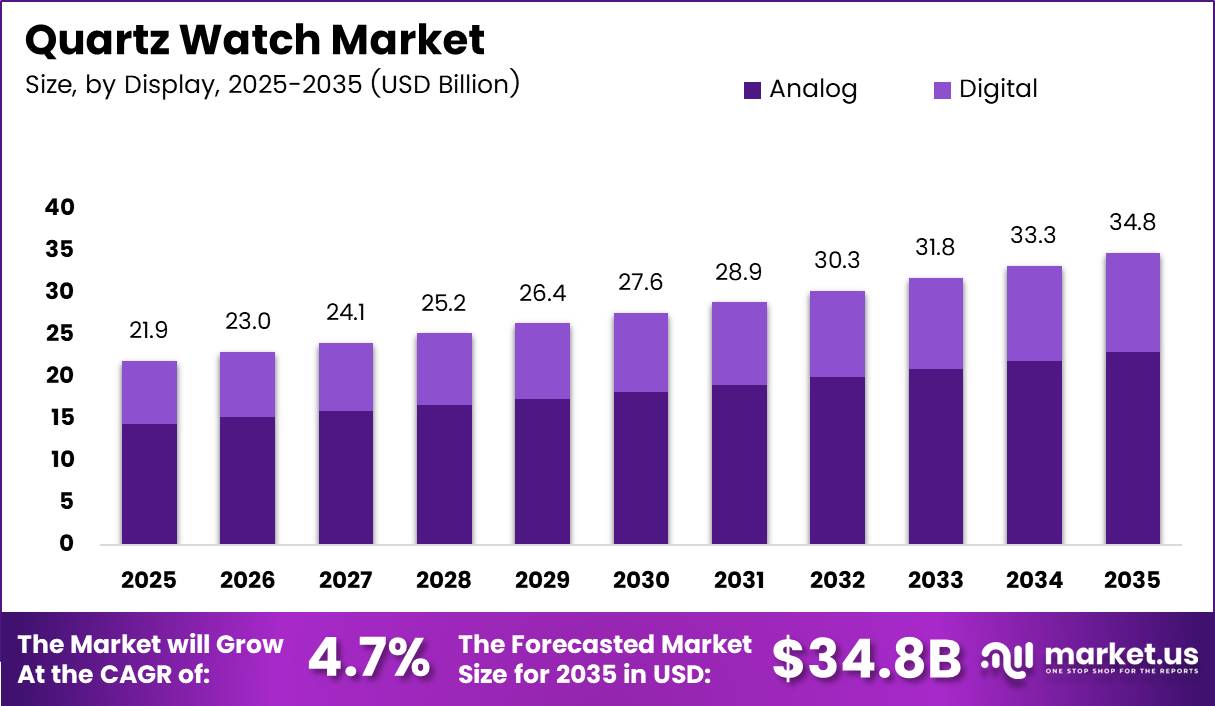
Global Quartz Watch Market size is expected to be worth around USD 34.8 Billion by 2035 from USD 21.9 Billion in 2025, growing at a CAGR of 4.7% during the forecast period 2026 to 2035. Quartz watches use an electronic oscillator regulated by a tiny quartz crystal to keep accurate time with minimal daily drift. Manufacturers pair these battery or solar powered movements with analog dials or digital screens for daily consumer wear.
Global watchmakers serve mass fashion retail, specialty jewelry chains, and corporate gifting channels across both developed and emerging economies. According to the Federation of the Swiss Watch Industry, Swiss watch exports totaled CHF 25.6 Billion in 2025 across 14.6 Million wristwatches, declining 1.7% year over year. This reflects tighter luxury volumes and pushes brands to protect profits through higher ticket quartz collections rather than relying on low margin unit shipments.
Key Takeaways
- The global quartz watch market stood at USD 21.9 Billion in 2025.
- Market revenue is forecast to reach USD 34.8 Billion by 2035.
- The market grows at a CAGR of 4.7% from 2026 to 2035.
- Analog displays led the display segment with a 65.78% share in 2025.
- Premium watches held the largest price range share at 41.23% in 2025.
- Men accounted for the leading end user share at 67.89% in 2025.
- Offline stores dominated sales channels with a 76.56% share in 2025.
- Asia-Pacific led regional revenue with a 43.12% share valued at USD 9.41 Billion in 2025.
Trade policies and currency shifts directly shape export pricing and factory investment decisions across major watchmaking hubs. As reported by the Japan Clock and Watch Association, Japanese watch export value rose 10% year over year to ¥207.9 Billion in 2025. Consequently, Japanese producers gain pricing leverage in overseas markets while competitors face margin pressure from tariff adjustments and stricter customs compliance rules.
Leading brands now use limited edition releases and retail expansion to capture affluent buyers seeking screen free timepieces. In 2026, Seiko Watch Corporation launched the Seiko Astron 145th Anniversary Limited Edition GPS Solar timepiece, capped at 1,450 pieces at USD 3,300. Similarly, in November 2026, Titan Company announced plans to expand its Helios network from 316 to 500 stores over 3 years, confirming strong capital commitment to physical premium retail.
Asia-Pacific dominated the global market in 2025 with a 43.12% share, valued at USD 9.41 Billion. Data from the International Monetary Fund shows global real GDP growth reaching 3.1% in 2026 and 3.4% in 2027, supporting steady discretionary spending. Regional dominance stems from integrated Japanese movement manufacturing, dense Chinese component supply chains, and rising middle class gifting demand across India and Southeast Asia.
Display Analysis
Analog dominates with 65.78% share in 2025 due to classic styling and smartwatch fatigue.
In 2025, Analog held a 65.78% share in the Display segment of the Quartz Watch Market. The Federation of the Swiss Watch Industry found that Swiss electronic quartz wristwatch exports reached 9.39 Million units in 2025, compared with 5.21 Million mechanical units. Analog quartz movements drive physical hands using low power stepper motors that run for years without daily charging. Therefore, brands prioritize analog collections to win back consumers tired of constant digital notifications.
Digital quartz watches serve utility buyers, athletes, and value focused consumers seeking shock resistance, alarms, and stopwatch functions. Based on Japan Clock and Watch Association data, Japanese digital quartz watch shipment volumes fell 31% in 2025 while mechanical volumes rose 29%. Digital modules rely on liquid crystal displays that face direct substitution from budget smartwatches in entry price tiers. Consequently, digital producers must pivot toward rugged outdoor models and collector collaborations to defend average selling prices.
Price Range Analysis
Premium dominates with 41.23% share in 2025 due to strong brand equity and accessible pricing.
In 2025, Premium held a 41.23% share in the Price Range segment of the Quartz Watch Market. The Federation of the Swiss Watch Industry indicates that Swiss steel watch exports rose 11.2% in value in October 2026, while bimetallic models climbed 28.3%. Stainless steel cases paired with sapphire glass and solar quartz calibers deliver luxury aesthetics at accessible retail price points. This creates higher gross margins for brands that upgrade standard collections into premium tiers.
Luxury quartz timepieces target collectors seeking high precision thermo compensated movements, precious metal finishes, and heritage dial craftsmanship. Figures from the Federation of the Swiss Watch Industry show luxury watches priced above CHF 500 represented 95% of global Swiss watch export value in 2025. High accuracy quartz calibers require hand assembled components and strict thermal calibration that justify four figure retail prices. As a result, luxury quartz offerings give watchmakers a resilient profit buffer during broader retail slowdowns.
Mid-Range quartz watches bridge everyday utility and fashion branding for price sensitive shoppers across department stores and online marketplaces. According to the Federation of the Swiss Watch Industry, China exported 589.5 Million wristwatches in 2025 at an average export price of USD 4 per unit. High volume automated assembly keeps bill of materials low, enabling rapid seasonal styling updates for mass market buyers. However, intense price competition forces mid-range brands to rely on licensed fashion names to protect shelf space.
End User Analysis
Men dominates with 67.89% share in 2025 due to higher average prices and collector demand.
In 2025, Men held a 67.89% share in the End User segment of the Quartz Watch Market. As reported by the Federation of the Swiss Watch Industry, Swiss wristwatch exports rose 9.5% in value and nearly 13% in volume to 1.55 Million units in October 2026. Men’s watches typically feature larger steel cases, chronograph complications, and higher water resistance ratings that command higher retail tickets. This means brands allocate the largest share of research budgets toward men’s sports and dress quartz lines.
Women buyers treat quartz watches as versatile fashion accessories that complement jewelry across workplace, formal, and casual settings. Data from Fossil Group SEC filings shows Q1 2026 net sales totaled USD 224.8 Million across 193 global retail stores while operating expenses fell 18.1%. Compact quartz movements allow ultra thin case profiles and slim bracelets that mechanical calibers cannot match at affordable prices. Consequently, women’s collections represent the fastest growing opportunity for brands investing in slim, jewelry inspired designs.
Sales Channel Analysis
Offline dominates with 76.56% share in 2025 due to in person fitting and gifting.
In 2025, Offline held a 76.56% share in the Sales Channel segment of the Quartz Watch Market. The U.S. Census Bureau found that total U.S. retail sales reached USD 1,941.9 Billion in Q3 2026, up 5.6% year over year, with offline retail holding an 82.1% share. Watch buyers prefer physical boutiques to inspect dial textures, test bracelet sizing, and verify authenticity before paying. Therefore, brick and mortar boutiques remain essential for converting high ticket premium and luxury quartz purchases.
Online channels drive rapid discovery for fashion, digital, and entry premium quartz watches through brand websites and social commerce. Based on Eurostat data, 78% of EU individuals aged 16 to 74 shopped online in 2025, while e-sales generated 19% of EU business turnover. Direct to consumer portals cut wholesale distributor markups and give brands immediate access to buyer purchase data. As a result, watchmakers invest heavily in virtual try on tools and direct digital launches to capture younger shoppers.
Key Market Segments
- Analog
- Digital
- Premium
- Luxury
- Economy
- Mid-Range
- Ultra Luxury
- Men
- Women
- Offline
- Online
Regional Analysis
Asia-Pacific Dominates the Quartz Watch Market with a Market Share of 43.12% in 2025, Valued at USD 9.41 Billion
Asia-Pacific held a 43.12% market share in 2025, generating USD 9.41 Billion in regional quartz watch revenue. The International Monetary Fund indicates that Asia and Pacific real GDP will expand 4.7% in 2026, led by India at 7.0% and China at 4.5%. Strong domestic manufacturing in Japan and China lowers local distribution costs while rising incomes fuel gifting demand across India. This creates a durable revenue base for both mass market and premium regional watchmakers.
Europe stands out as the fastest growing regional market, supported by heritage retail tourism and rebounding luxury export demand. Figures from the Federation of the Swiss Watch Industry show cumulative Swiss watch exports reached nearly CHF 22 Billion in the first 10 months of 2026, up 3.4% year over year, with UK shipments rising 6.5% in October. Strict sustainability rules also push European buyers toward solar powered quartz models. Consequently, brands with strong European boutique networks capture superior pricing power.
North America remains a high value destination where omnichannel retail and direct digital sales drive steady quartz replacement demand. According to the U.S. Census Bureau, U.S. retail e-commerce sales reached USD 347.3 Billion in Q3 2026, rising 10.4% year over year to represent 17.9% of total retail sales. American buyers increasingly pair classic analog quartz watches with casual and business attire. However, shifting import tariffs require distributors to manage inventory carefully to protect wholesale margins.
Key Regions and Countries
- US
- Canada
- Germany
- France
- The UK
- Spain
- Italy
- Rest of Europe
- China
- Japan
- South Korea
- India
- Australia
- Rest of APAC
- Brazil
- Mexico
- Rest of Latin America
- GCC
- South Africa
- Rest of MEA
Market Dynamics
Global quartz watchmakers balance strong premium brand demand against shifting trade tariffs, currency swings, and volatile precious metal costs. As reported by Swatch Group, full-year 2025 sales reached CHF 6.28 Billion with profits down 89% as management preserved factory jobs, before H1 2026 local-currency sales rebounded 8.5%. This signals a clear industry split where disciplined pricing and brand equity outperform pure volume manufacturing. Investors now reward watchmakers that protect operating margins through higher ticket collections.
Drivers
Japan’s three largest quartz groups are shifting from volume output toward higher ticket branded collections after Swiss exports fell 2.8% in 2024 and 1.7% in 2025. Seiko lifted its operating margin from 7.0% to 9.2% in the year to March 2026, reaching a 49.6% gross margin in April to September 2026. Citizen earned a 16.2% watch operating margin excluding tariff refunds, while Casio grew watch sales 25.8% in the same half.
Price led mix now generates more revenue than raw unit volume, allowing groups to absorb U.S. duty exposure without margin dilution. Each 1 point of mix shift toward premium lines adds 40 to 60 basis points of group operating margin. This makes brand led repositioning the largest contributor to the 4.7% baseline CAGR. However, investors should normalize reported gains for a weaker yen averaging 159.5 per U.S. dollar versus 146.0 a year earlier.
| Driver | (~) % Impact on CAGR Forecast | Geographic Relevance | Impact Timeline |
|---|---|---|---|
| Premium Brand-Led Quartz Repositioning | +0.9% | Japan, North America, Europe | Short term (≤ 2 years) |
| Smartwatch Fatigue and Analog Rebound | +0.8% | Global, India, North America | Short term (≤ 2 years) |
| Emerging-Market Volume Expansion | +0.7% | India, Mexico, Southeast Asia | Medium term (2–4 years) |
| Quartz Movement and ODM Demand | +0.5% | Japan, Switzerland, Greater China | Short term (≤ 2 years) |
| Collaboration-Led Collectible Launches | +0.4% | Europe, North America, India | Short term (≤ 2 years) |
| Inbound Tourism and Travel Retail | +0.4% | Japan, Europe, North America | Short term (≤ 2 years) |
Restraints
Unsettled U.S. tariff rules create severe planning friction for global watch exporters. After cutting a 39% Swiss rate to 15% in November 2025, a 10% Section 122 surcharge ran from February to July 2026. Since July 2026, a Section 301 tariff caps combined duty at 12.5% for Switzerland and Japan while adding 12.5% on Chinese origins. A separate Section 301 overcapacity probe opened in March 2026 across 16 economies keeps further duty risks alive.
Order timing volatility directly disrupts wholesale inventory planning across the United States, which represents 17% of Swiss watch exports. Shipments to the U.S. dropped 19.4% in August 2026 before surging 85.7% in September and 60.8% in October on distorted bases. Citizen also booked non recurring customs refunds for 2018 to 2021 that temporarily flatter margins. Consequently, brands face repeated price resets, pre loading costs, and working capital strain.
| Restraint | (~) % Impact on CAGR Forecast | Geographic Relevance | Impact Timeline |
|---|---|---|---|
| US Section 301 Tariff Overhang | -0.7% | North America, Switzerland, Japan, Greater China | Short term (≤ 2 years) |
| Middle East Conflict Demand Disruption | -0.5% | Gulf Cooperation Council, Europe, South Asia | Short term (≤ 2 years) |
| Mainland China Demand Contraction | -0.5% | Greater China | Medium term (2–4 years) |
| Swiss Franc Price Barrier | -0.4% | Switzerland, Europe, North America | Short term (≤ 2 years) |
| Mid-Price Segment Squeeze | -0.3% | Europe, North America, Japan | Medium term (2–4 years) |
Challenges
Precious metal volatility creates sharp bill of materials swings for quartz watchmakers within a single pricing season. Silver averaged 42% higher in 2025, hit a record in January 2026, fell 31.4% in one day, and traded 66% below that peak by November 2026. Gold also sat 35.5% below its January record while silver heads toward a sixth straight annual deficit in 2026. Silver oxide batteries, gold plated finishes, and precious cases all reprice along this curve.
Swiss precious metal watch exports fell 6.5% in value during H1 2026 while bimetallic models rose 20.0%. Price lists set during early 2026 spikes overshoot demand after metal prices drop, and peak hedges lock in negative spreads. Manufacturers must therefore adopt rolling 6 to 12 month metal hedging and indexed supplier contracts. Shifting toward lithium cell alternatives and flexible non precious collections protects gross margins from sudden commodity shocks.
| Challenge | (~) % CAGR Friction Drag | Geographic Relevance | Mitigation Horizon |
|---|---|---|---|
| Silver and Gold Input Volatility | -0.5% | Global, Switzerland, Japan | Medium term (2–4 years) |
| Production Capacity Under-Utilization | -0.4% | Switzerland, Europe | Medium term (2–4 years) |
| Subcontractor Supply Chain Fragility | -0.3% | Switzerland, Japan, Greater China | Medium term (2–4 years) |
| EU Battery Regulation Compliance | -0.2% | European Union | Short term (≤ 2 years) |
| Forced-Labour Traceability Compliance | -0.2% | European Union, North America | Medium term (2–4 years) |
Opportunities
Hybrid analog health tracking quartz watches represent unserved white space because leading incumbents still monetize hardware alone. In the quarter ended December 2025, Titan’s analog watches grew 17% while its smartwatch value fell 26%, and smartwatch shipments contracted again through Q2 and Q3 2026. This leaves a large pool of lapsed smartwatch owners who dislike daily charging and screen fatigue yet still want sleep, activity, and heart rate tracking.
Pairing a solar or lithium quartz core with a low power sensor module adds an estimated 9% to 14% to bill of materials. Early movers can capture premium pricing while building recurring companion app engagement around multi year battery life. Brands that launch dedicated non display health quartz lines first can win high retention customers away from traditional smartwatches without cannibalizing classic dress collections.
| Opportunity | (~) % Potential CAGR Upside | Geographic Relevance | Execution Window |
|---|---|---|---|
| Hybrid Analog Health-Tracking Quartz | +0.8% | North America, Europe, Greater China, India | Medium term (2–4 years) |
| Solar-Powered Quartz Eco-Premium | +0.5% | Europe, Japan, North America | Medium term (2–4 years) |
| Social and Live-Commerce Scaling | +0.4% | India, Southeast Asia, Greater China | Short term (≤ 2 years) |
| Lifetime Battery-Service Subscriptions | +0.3% | North America, Europe, Japan | Medium term (2–4 years) |
| Sub-Saharan Africa Mass Distribution | +0.3% | Sub-Saharan Africa, Central Asia | Long term (≥ 4 years) |
Key Company Insights
Seiko
Seiko Group Corporation operates as a vertically integrated Japanese watchmaker spanning quartz, solar GPS, and mechanical timepieces across global retail networks. Data from Seiko Group Corporation shows FY25 Watches Business net sales reached ¥196.8 Billion, while segment operating profit climbed 28.7% year over year to ¥28.6 Billion. Strong demand for higher priced global collections lifts profitability and reduces reliance on low margin entry level movements.
In July 2026, Plus9Time reported that Seiko Watch Corporation released 99 new watch models during H1 2026, including 42 limited editions totaling 76,321 individual units across Prospex, Astron, and Seiko Selection lines. High frequency limited releases create scarcity and drive full price sell through at global boutiques. This strategy helps Seiko capture collector spending while defending average selling prices against Swiss rivals.
Citizen
Citizen Watch Co., Ltd. leads the global light powered quartz category through its proprietary Eco-Drive technology and vertical Miyota movement supply chain. Citizen Watch Co., Ltd. found that FY2025 consolidated net sales reached ¥346.808 Billion, generating ¥38.456 Billion in ordinary profit. Broad distribution across Japan, North America, and Europe allows Citizen to scale solar quartz innovations while balancing finished watch sales with external movement shipments.
In November 2026, Citizen Watch launched The Citizen AQ4100-65F flagship Eco-Drive timepiece featuring a charcoal Tosa washi dial and Caliber A060 with plus or minus 5 seconds annual accuracy, limited to 250 pieces at ¥440,000. As this release positions Eco-Drive directly in the luxury tier. Consequently, Citizen strengthens brand prestige and expands high margin revenue beyond mass market solar models
Key Players
- Seiko
- Citizen
- Casio
- Timex
- Tissot
- Longines
- Fossil
- Swatch
- Titan
- SKMEI
- Other Key Players
Recent Developments
- November 2026: Fossil Group, Inc. agreement signed a 5 year extension of its Michael Kors global watch and jewelry license through 2032 across 130 countries, Business Wire.
- November 2026: Fossil Group, Inc. agreement renewed its Diesel global watch and jewelry license for 5 years through 2032 alongside Q3 2026 revenue of USD 271.2 Million, Yahoo Finance.
- November 2026: Casio Computer Co., Ltd. product launch introduced the analog G-SHOCK GAC-2500 with a rolling date window in India at ₹9,995 after a USD 145 U.S. debut, The Gadgeteer.
- September 2026: Citizen Watch Co., Ltd. innovation launched 2 Eco-Drive Tosa Washi Paper models achieving plus or minus 5 seconds annual accuracy for Eco-Drive’s 50th anniversary, Citizen Watch Global Network.
- September 2026: Swatch partnership rolled out 6 artist collaboration timepieces globally to celebrate the 15th anniversary of Swatch Art Peace Hotel, WWD.
- May 2026: Titan Company Ltd. acquisition completed a 67% stake purchase in GCC heritage brand Damas Jewellery in Q4 FY26, adding 123 international stores, Titan Company.
- 2026: Titan Company Ltd. partnership launched 43 Ducati watch SKUs in India priced from ₹16,000 to ₹25,000, targeting 1,000 outlets within 18 months, Business Standard.
- 2026: Seiko Watch Corporation product launch introduced the Seiko Astron GPS Solar 2026 Limited Edition SSJ039 limited to 1,500 pieces globally at USD 2,400, Seiko Watch Corporation.
- 2026: Casio America product launch unveiled the G-SHOCK MRGD5000 Blue Sapphire luxury digital watch limited to 20 pieces worldwide, StockTitan.
- 2026: Seiko Watch Corporation expansion announced an India growth plan targeting 2x revenue in 3 years and 30 exclusive Seiko boutiques by 2028, Business Standard.
Geopolitical Impact Analysis
Shifting trade barriers and regional conflicts directly reshape cross border supply chains for quartz movements, watch cases, and finished timepieces. According to the World Trade Organization, world merchandise trade volume will grow 3.9% in 2026 and 4.1% in 2027, while Asia exports rise 9.9% and Middle East exports contract 17.2%. Based on World Trade Organization data, tariff actions through February 2026 affect 11% of global trade and cut Most-Favoured-Nation trade share from 80% to 72%. These trade shifts raise landed duties on Chinese stainless steel cases, Hong Kong dials, and Japanese quartz modules entering Western markets. Consequently, watchmakers must diversify assembly hubs and adjust regional pricing to protect wholesale margins.
Maritime chokepoints and freight rate spikes add persistent logistics friction for global watch distributors shipping high value seasonal inventory. Figures from UNCTAD show the Shanghai Containerized Freight Index averaged 2,496 points in 2024, rising 149% over 2023 amid Red Sea rerouting. UNCTAD indicates that global seaborne trade will expand 2.0% annually while containerized trade grows 2.3% annually from 2026 to 2030. Longer ocean transit times delay deliveries of silver oxide batteries, printed circuit boards, and finished quartz watches moving between Asian factories and European boutiques. Therefore, brands hold higher safety stock and shift urgent luxury launches to air freight, increasing working capital requirements.
Report Scope
| Report Features | Description |
|---|---|
| Market Value (2025) | USD 21.9 Billion |
| Forecast Revenue (2035) | USD 34.8 Billion |
| CAGR (2026-2035) | 4.7% |
| Base Year for Estimation | 2025 |
| Historic Period | 2021-2025 |
| Forecast Period | 2026-2035 |
| Report Coverage | Revenue Forecast, Market Dynamics, Market Opportunity Analysis, Technology and Innovation Landscape, Competitive Landscape, Recent Developments |
| Segments Covered | By Display (Analog, Digital), By Price Range (Premium, Luxury, Economy, Mid-Range, Ultra Luxury), By End User (Men, Women), By Sales Channel (Offline, Online) |
| Regional Analysis | North America (US and Canada), Europe (Germany, France, The UK, Spain, Italy, and Rest of Europe), Asia Pacific (China, Japan, South Korea, India, Australia, and Rest of APAC), Latin America (Brazil, Mexico, and Rest of Latin America), Middle East and Africa (GCC, South Africa, and Rest of MEA) |
| Competitive Landscape | Seiko, Citizen, Casio, Timex, Tissot, Longines, Fossil, Swatch, Titan, SKMEI, Other Key Players |
| Customization Scope | Customization for segments, region / country-level will be provided. Additional customization can be done based on requirements. |
| Purchase Options | We have three licenses to opt for: Single User License | Multi-User License (Up to 5 Users) | Corporate Use License (Unlimited User and Printable PDF) |