I used to think I was pretty cool because I was the first foreigner to pass the entrance exam for a Japanese newspaper and work as a regular reporter for over a decade. I wrote hundreds of articles in Japanese, covered petty crimes and terrible tragedies, chased gangsters, annoyed politicians, and occasionally managed to write something that was actually good. I thought that was quite an accomplishment.
Meh. But now there’s a new generation of foreigners writing Japanese so well that they’re winning some of the country’s most prestigious literary prizes—although the much coveted Akutagawa Prize is still out of reach. We are talking about novels. Not newspaper articles. Actual novels. The kind that Japanese people read voluntarily, enjoy, and sometimes give awards to. We’ve come a long way, baby.
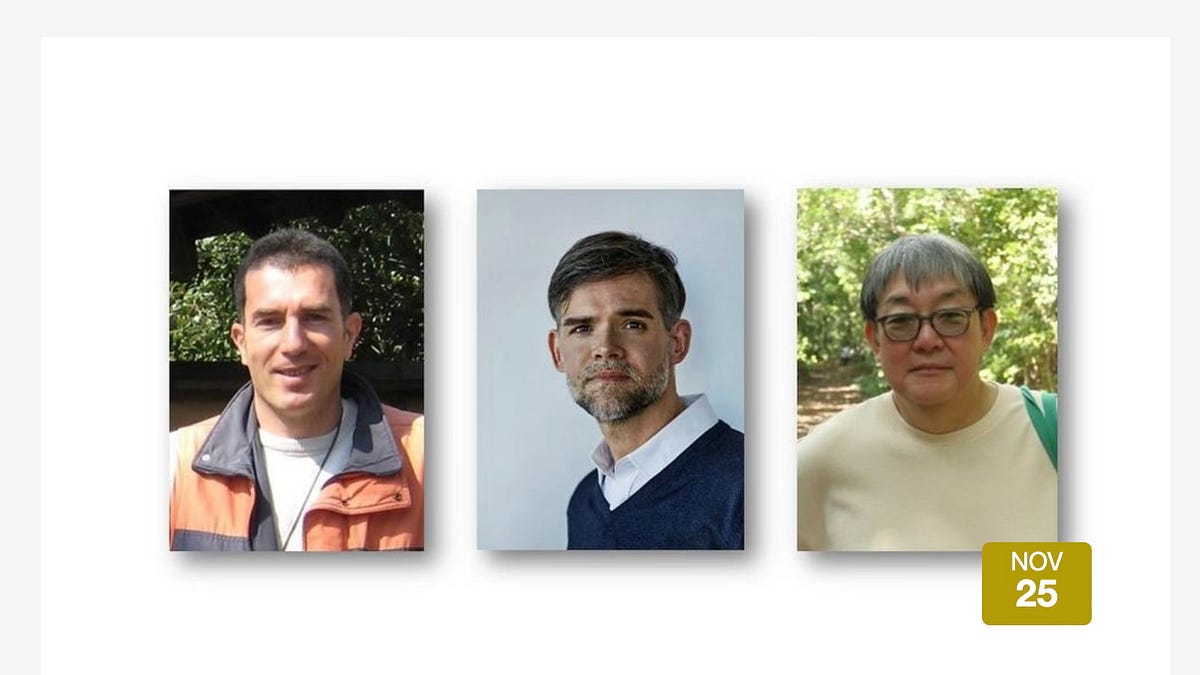
And on Wednesday, November 25, 2026, you have a wonderful chance to meet two of these extraordinary writers, hear their stories, and find out how they managed to do something that most foreigners living in Japan would never even dream of attempting.The Foreign Correspondents’ Club of Japan is hosting a special Book Break dinner called “Prize-winning Foreign Writers in Japanese.” The guests are novelists David Zoppetti and Gregory Khezrnejat, along with veteran Japanese editor and publishing expert Satoshi Gunji.Get your tickets now.
The deadline for non-members to reserve and pay
The deadline for non-members to reserve and pay is Friday, November 20. Seats are limited, and this is one of those events that deserves a full house. Details are available through the FCCJ, and I’ve included all the information at the bottom of this post.Writing Japanese is not easy. Writing Japanese that sounds natural is harder. Writing Japanese that sounds natural, conveys complicated ideas, and survives the scrutiny of a professional editor is a minor miracle.And writing Japanese literature that wins prizes?
That’s a different level altogether.A reporter needs clarity, accuracy, and speed. In the old days, you wrote in a reverse pyramid style, so the article could be cut from the bottom if space was needed. Who, what, where, when, how, and sometimes “why”. A novelist needs those things too, but also imagination, rhythm, and a voice that readers want to follow. The best fiction makes you forget you’re reading words on a page.Doing that in your native language is difficult enough.
Doing it in Japanese, when you weren’t born speaking Japanese, is something I find almost supernatural.Which brings us to our two guests.David Zoppetti was born in Geneva, Switzerland, in 1962. He studied Japanese literature at Doshisha University and went on to accomplish something remarkable.His debut novel, Ichigen-san, won the Subaru Literary Prize in 1996. It was also shortlisted for the Akutagawa Prize, one of Japan’s most prestigious literary honors.Think about that.A Swiss writer produced a novel in Japanese that was good enough to compete for an award that generations of native Japanese writers have spent their lives hoping to win.
His novel was also adapted into a film.Zoppetti
His novel was also adapted into a film.Zoppetti has published nine books in Japanese. His forthcoming novel, Reiwa-Ishi, explores Japan’s population decline through an alternative history of the Reiwa era.That’s an ambitious subject. It’s also a very Japanese one.Japan’s aging population, declining birthrate, and uncertain future are subjects that politicians discuss endlessly, usually without saying anything particularly useful.
A novelist can approach these issues differently. Fiction allows us to imagine what might happen, rather than simply arguing about what should happen.I’m particularly interested in how Zoppetti sees Japan after so many years of writing about it. Does writing in Japanese change the way you think? Does it change your personality? Do you become a different writer when you change languages?And after all these years, does he still feel like an outsider?
I suspect the answers will be fascinating.Gregory Khezrnejat represents a younger generation of foreign writers who have made Japanese their literary language. He was born in South Carolina in 1984 and earned his Ph.D. in Japanese literature from Doshisha University in 2017. He is now an associate professor at Hosei University.His debut novel “Kamogawa Runner” (鴨川ランナー) won the second Kyoto Literature Award.
In 2023, he received the ninth Waseda University
In 2023, he received the ninth Waseda University Tsubouchi Shoyo Encouragement Award.Two of his works, Kaikonchi and Trajectory, were shortlisted for the Akutagawa Prize.Not once, but twice.For those unfamiliar with Japanese publishing, the Akutagawa Prize is a very big deal. It can turn an obscure writer into a national literary figure almost overnight. It also attracts intense scrutiny.Japanese literary critics can be merciless.
They are not famous for handing out prizes because somebody made a charming effort to learn their language.You have to be good. Very good.What interests me about Gregory is that he didn’t simply learn Japanese well enough to live and work here. He learned it well enough to create literature that Japanese judges considered worthy of national recognition.That’s quite an achievement.
And it raises an interesting question.What does a foreign writer bring to Japanese literature that a Japanese writer might not? Perhaps it’s a different perspective. Perhaps it’s a willingness to break rules that native speakers don’t even realize they’re following.Or perhaps the answer is simpler.A good writer is a good writer; the language is the instrument, not the music.I’d like to hear what Gregory thinks.The third speaker is Satoshi Gunji, a veteran editor with nearly 40 years of experience in Japanese publishing.
Gunji is Senior Managing Director of the Japan
Gunji is Senior Managing Director of the Japan P.E.N. Club, a visiting professor at Kobe City University of Foreign Studies, and an adviser to ZEN University’s publishing and archival projects.In other words, he’s someone who understands how Japanese literature gets made, published, judged, and sometimes ignored. This is an important part of the evening.Japan has a complicated literary culture.
Prizes matter enormously. Publishers have considerable influence. Literary magazines still play a role that can be difficult for outsiders to understand.And getting published is only the beginning.Gunji will explain how Japan’s literary prizes work, why they matter, and how the publishing industry is changing. He’ll also discuss the extraordinary surge in entries in the age of artificial intelligence.That’s a subject worth exploring.If a computer can produce a reasonably convincing Japanese novel in a few minutes, what happens to writers who have spent years mastering the language?
How do editors recognize originality? And what exactly makes literature human?I don’t know whether AI will ever write a truly great novel. It’s not impossible. I do know that it has made the business of distinguishing good writing from competent imitation considerably more interesting.Having a veteran editor explain what is happening behind the scenes should be worth the price of admission alone.Japan is a country that often makes a sharp distinction between insiders and outsiders.
You can live here for decades, speak
You can live here for decades, speak the language fluently, pay taxes, raise a family, and still be asked whether you can use chopsticks. I can’t. After 30 years, I still hold chopsticks (o-hashi) like a 7-year-old. No one has ever said to me, “お箸上手ですね” and meant it. But if you can eat a bowl of rice with two wooden sticks, sometimes the question is well meant.
Sometimes it’s exhausting.But literature offers a different kind of belonging. When someone writes a great novel in Japanese, readers can judge the work on its merits. They may know the author is foreign. They may even find that interesting.But ultimately, the words have to stand on their own.That’s what makes the accomplishments of Zoppetti and Khezrnejat so impressive. They didn’t just learn to communicate in Japanese.
They learned to move people with it.I have enormous respect for that. I also think these writers have something important to teach the rest of us. Learning another language is not simply about memorizing vocabulary and mastering grammar. It’s about learning another way of seeing the world.And sometimes, if you’re very talented and work very hard, you can use that new perspective to create something that even native speakers have never seen before.That’s worth celebrating.One of the pleasures of the Foreign Correspondents’ Club is that it brings together people who might otherwise never meet.
Journalists, writers, academics, editors, diplomats, and people who
Journalists, writers, academics, editors, diplomats, and people who simply love Japan and its culture can sit down together and have a real conversation.This event should be particularly enjoyable because it’s not just a lecture. It’s a dinner.Doors open at 6:00 p.m. for a casual Meet the Author cocktail gathering. Dinner begins at 6:30 p.m., and the discussion starts at 7:15 p.m.The talk will be in English, so you don’t need to read Japanese to enjoy it.
You can meet the authors, ask questions, and learn something about the Japanese literary world that you probably won’t find in a guidebook.And you get dinner. That’s a pretty good deal in Tokyo.I hope you’ll come. Bring a friend. Bring someone who loves books. Bring someone who has spent years studying Japanese and needs a reminder that the language can be used for something more rewarding than filling out government forms.And if you’re an aspiring writer, you should definitely attend.
You might leave inspired. Or slightly intimidated. Possibly both.The event is on Wednesday, November 25, but non-members must reserve and pay by Friday, November 20. That’s only two days away.Members have until 2:00 p.m. on November 25 to reserve, subject to availability. Don’t wait until the last minute and discover that all the seats have disappeared.I regret that I’ll miss the dinner.
I hope those of you who can attend
I hope those of you who can attend will ask some of these questions for me.Sign up now. Come hear their stories. And let’s give these remarkable writers the audience they deserve.Event Details and ReservationsPrize-winning Foreign Writers in JapaneseDate: Wednesday, November 25, 2026Venue: Foreign Correspondents’ Club of Japan (FCCJ), Marunouchi, TokyoSpeakers: David Zoppetti, Gregory Khezrnejat, and Satoshi GunjiSchedule:6:00 p.m.
Doors open and Meet the Author cocktails6:30 p.m. Dinner7:15 p.m. Discussion begins8:30 p.m. Event concludesAdmission:FCCJ members: ¥3,000Non-members: ¥4,000Online attendanceked salmon with lemon, onion, and capers; grilled chicken thigh, Diavola-style; bread and butter; panna cotta with blueberry sauce; coffee or tea
A vegetarian option is available.Reservation deadlines:Non-members: Friday, November 20, 2026. Advance payment required.Members: Wednesday, November 25, at 2:00 p.m.No cancellations after Sunday, November 22.Reservations and inquiries: front@fccj.or.jpFCCJ website: https://www.fccj.or.jpAddress: 5F Marunouchi Nijubashi Building, 3-2-3 Marunouchi, Chiyoda-ku, Tokyo 100-0005Telephone: 03-3211-3161Please contact the FCCJ directly to reserve your place and confirm availability.Don’t miss it.
November 25. Great writers, good food, and a rare opportunity to meet people who have mastered one of the most difficult literary challenges imaginable, next to writing in traditional Mongolian script.