


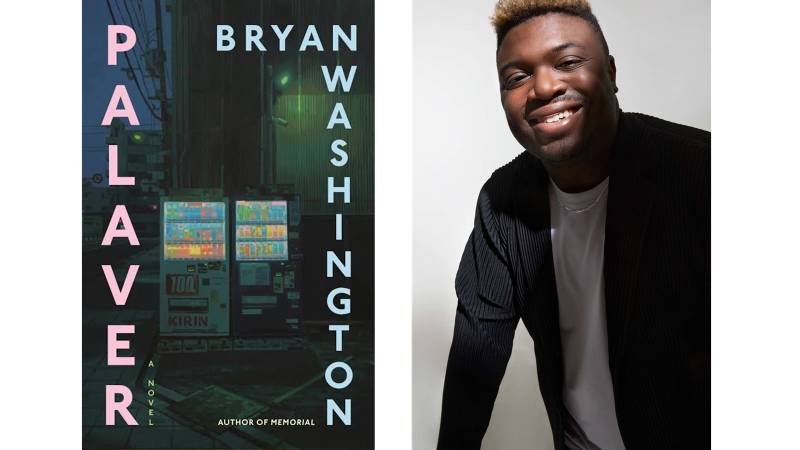
Bryan Washington is the author of the story collection Lot and the novels Memorial and Family Meal. A National Book Award 5 Under 35 honouree, he is the winner of the Dylan Thomas Prize, the NYPL Young Lions Fiction Award, two Lambda Literary Awards, and an O Henry Prize, and he has been a finalist for the National Book Critics Circle Award for Fiction, the Aspen Words Literary Prize, the Center for Fiction First Novel Prize, the Andrew Carnegie Medal for Excellence, and the James Tait Black Prize.
A frequent contributor to The New Yorker and the New York Times food section, his writing has also appeared in The New York Times Magazine, Time, and The Paris Review Daily. Raised in Texas, he lives in Houston and Japan.
Palaver examines a nervous, long-distance reunion between an unnamed Jamaican-American mother and her distant, queer adult son in Tokyo. The main characters are the mother, a Jamaican-born dental technician living in Houston, Texas, who flies to Japan unannounced after a troubling late-night phone call from her son. The son is a queer Black American man who has lived in Tokyo for over a decade, working as a private English tutor while navigating a fragile life and a casual relationship with a married man named Taku. Supporting figures include the son’s brother, Chris; his queer circle at a bar called Friendly in Tokyo’s Ni-chome district (managed by a trans man named Alan); and a local bistro owner named Ben, who makes friends with the mother and is romantically interested in her.
The story begins with the mother arriving unexpectedly
The story begins with the mother arriving unexpectedly at her son’s cramped apartment located above a Taiwanese restaurant in Shin-Ōkubo (near Shinjuku). They immediately experience friction, embarrassing silences, and conflicting temperaments. The storyline alternates between their tense week-and-a-half together in Tokyo and flashbacks to their histories across Jamaica, Toronto, and Houston. These memories touch upon the mother’s past departure from Jamaica, the pain surrounding her gay brother Stefan (who later died of AIDS), and the childhood emotional and physical abuse and homophobia that ruptured her relationship with her son.
Washington Owes Pakistan More Than A Counter Terrorism Dialogue
Washington explores how unspoken grief, displacement, and generational trauma manifest in everyday habits rather than direct confrontations with each other
While the son moves through his English lessons, nights out in the queer nightlife district, and a trip to Nara, the mother explores Tokyo on her own, forms a tender bond with Ben, and discovers hidden objects—including old unsent letters to Chris and a poetry notebook—in the midst of an earthquake.
Rather than a neat or dramatic resolution, the two slowly move toward understanding each other more and forgiving each other. On her final morning in Japan, the son buys food from Hong Lo and takes his mother for a picnic in Yoyogi Park, leaving the question of “home” open-ended and shared.
The key themes of the novel are examining
The key themes of the novel are examining whether loyalties to chosen queer communities can bridge or replace broken familial blood ties, and examining the weight of silence in families and communities. It explores how unspoken grief, displacement, and generational trauma manifest in everyday habits rather than direct confrontations with each other. The novel has unique stylistic traits; for example, it lacks quotation marks. Also, every chapter starts with beautiful photos of buildings, apartments, restaurants, and train stations, which are all in black and white, and so you view the inside world of the mother and the son through these photos.
There are two quotes that I found important in the novel; one was when the mother turns to Ben and this exchange happens:
“It’s not you, said the mother. Really. It’s just that, you know, we’re only people. Just bodies. And no matter what happens, how much we try, we’ll never be more than that.”
Reducing the human condition to mere bodies seemed
Reducing the human condition to mere bodies seemed rather an interesting phenomenon and way of thinking to me.
Then there is the exchange between Taku and the son where they are apologising as follows:
“Yeah, said Taku. And I’m sorry about that.
Pakistan Caught Between Washington And The Widening War
Okay, said the son. I’m sorry, too.
Maybe that’s just life. Repeating sorry, every single day until you die.”
I really felt the above quote, because maybe as humans we keep making mistakes, messing up, and saying sorry each day of our lives, and maybe that is what life is.
All in all, the novel was a wonderful insight into queer life, alienation, Japanese culture, fraught mother-son dynamics, and the frailty of life. It isn’t exactly a happy book, and the parts where it delves into the relationship of the two brothers and goes back into Chris’s history are extremely difficult to read, so I would recommend it with caution to those who want to learn about the world with an open mind. However, it is a book from which one will learn and grow, and keeping that in mind, I think it should be read by most who can read about family disputes, alienation, and how “home” is never really one place.


