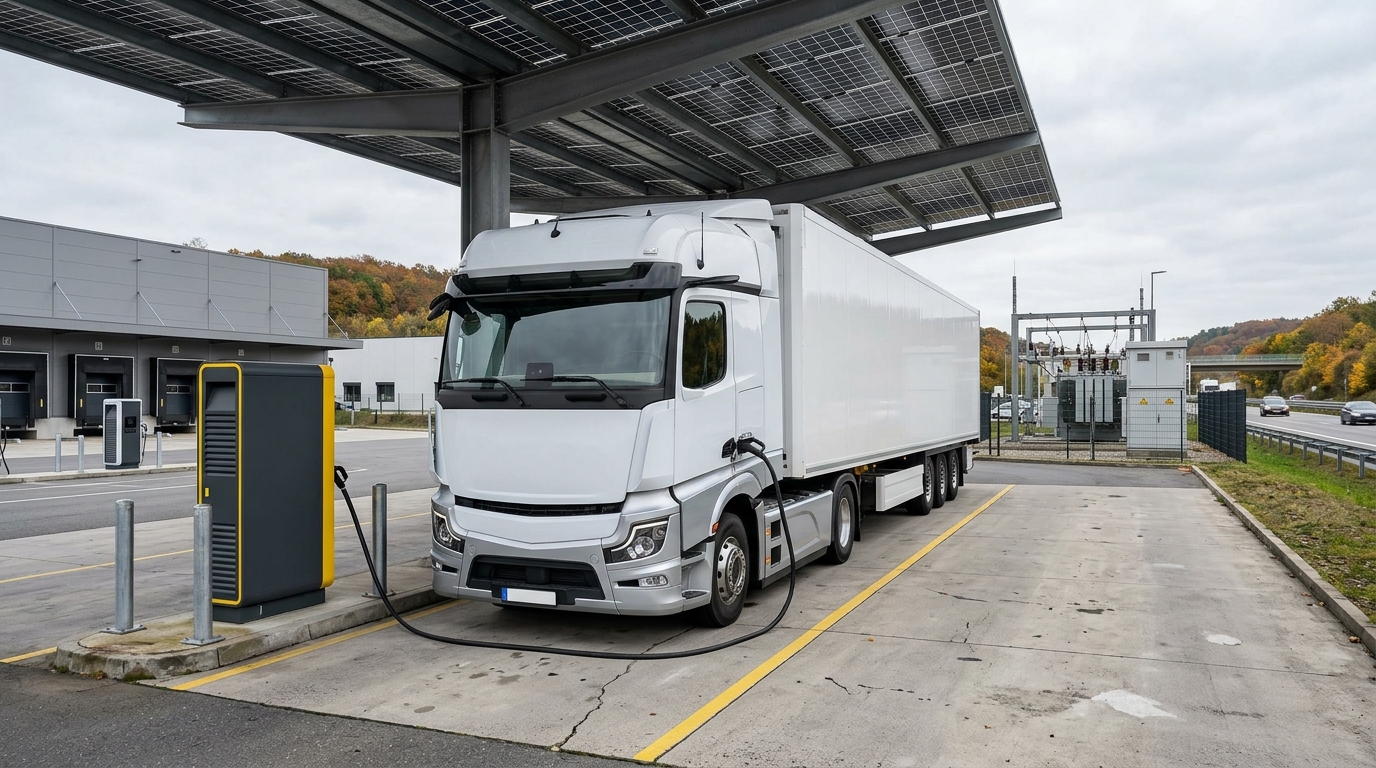
A research team from KTH Royal Institute of Technology in collaboration with commercial vehicle manufacturer Scania AB has developed an open-source, web-based simulation model named CHARGE-IT to estimate the upfront capital investment required for heavy-duty battery-electric vehicle charging infrastructure across Europe. Documented by researchers Davide Ferraro, Carolina Gil Ribeiro, and Jagruti Thakur, the software addresses a significant analytical gap in commercial fleet electrification by modeling fifteen distinct physical and civil cost components from the medium-voltage utility grid connection directly to the dispenser plug. Operating through an interactive browser interface, the tool calculates complete balance-of-system expenditures using component pricing benchmarks calibrated in 2024 euros derived from industrial equipment catalogs, supplier price sheets, published literature, and interviews with nine European industry professionals. By evaluating site-specific electrical constraints, physical layouts, and depot operating parameters, the model provides fleet operators, infrastructure developers, and transport planners with transparent financial estimates before initiating capital-intensive civil construction or utility grid interconnection requests.
The deployment of heavy-duty charging infrastructure occurs against stringent European Union decarbonization mandates aimed at freight transportation. Heavy-duty vehicles represent roughly six percent of total greenhouse gas emissions across the European Union and account for more than one-quarter of all road transport emissions despite comprising only a minor fraction of the overall vehicle fleet. To curb these sectoral emissions, the European Union’s Fit for 55 legislative package establishes binding fleet-wide carbon dioxide reduction targets for newly registered heavy-duty vehicles, demanding reductions of 45 percent by 2030, 65 percent by 2035, and 90 percent by 2040 relative to historical baselines. Because battery-electric trucks generate zero tailpipe emissions, commercial vehicle manufacturers and freight operators are incentivized to transition directly away from diesel powertrains. Falling battery pack production costs have enabled electric trucks to become technically viable across diverse freight duty cycles, with market research indicating that commercial fleet operators will predominantly favor overnight depot charging regimes to exploit predictable parking schedules and cheaper off-peak electricity tariffs.
Despite the operational suitability of electric freight, physical charging infrastructure rollouts face severe grid integration and capacity bottlenecks. A standard long-haul battery-electric truck incorporates an on-board traction pack storing between 300 and 800 kilowatt-hours of electrical energy, meaning that a medium or large logistics depot charging dozens of commercial vehicles simultaneously can demand multiple megawatts of instantaneous electrical capacity from the distribution network. Under the European Alternative Fuels Infrastructure Regulation, member states are legally obligated to install a minimum of 3.6 megawatts of dedicated truck charging capacity at regular 60-kilometer intervals along core trans-European road networks by 2030. While Europe possessed approximately 10,000 public truck charging points in 2023, regional networks must expand to roughly 300,000 operational points by the close of the decade, requiring a cumulative capital deployment estimated at seven billion euros. Existing commercial depots rarely possess sufficient spare electrical capacity, and acquiring distribution grid upgrades involves protracted administrative permitting, engineering design, and utility interconnections that frequently span multiple years.
Prior computational tools and academic literature have left
Prior computational tools and academic literature have left capital expenditure calculations for heavy-duty European depot stations largely unaddressed. Existing software platforms broadly fall into three categories that bypass the specific balance-of-plant capital needs of European fleet depots. One class of software evaluates the levelized cost of charging, such as the open-source lcoc-ldevs model developed for United States passenger cars, European country-level models that omit utility grid interconnections, and policy calculators focused exclusively on dynamic electricity bills. A second group includes simulation environments from the United States Department of Energy EVI-X suite, including EVI-FAST, datafev, and EV-EcoSim, alongside commercial microgrid tools like HOMER and XENDEE, which model charging demand profiles, dispatch schedules, or levelized distributed generation without generating bottom-up capital equipment breakdowns. Finally, static published literature provides component breakdown tables that are either roughly a decade old, confined to North American light-duty passenger vehicles, or structured as non-reusable regional case studies that omit interactive station design capabilities.
To overcome these limitations, CHARGE-IT is implemented as an open-source Python application utilizing the Streamlit framework, structured into a clean three-layer software architecture. The presentation layer, spanning approximately 995 lines of code in app.py, collects seventeen user configuration variables via an interactive widget form, dynamically re-rendering the graphical interface and exporting tabular results to Excel spreadsheets or structured PDF project summaries. The orchestration layer, contained in utils/calls.py across roughly 325 lines of code, runs validation routines including medium_requirement and hard_requirement to evaluate whether the local grid can absorb the planned charging demand, subsequently executing case_definition to classify the project and compute_all_costs to coordinate the downstream financial subroutines. The underlying computational layer, implemented in utils/cost.py across roughly 490 lines of code, houses the fifteen dedicated cost functions mapping physical dimensions, electrical ratings, and site characteristics into euro expenditures based on lookup tables and fitted analytical equations that users can inspect and modify.
The model requires fourteen numerical parameters and three categorical inputs to characterize a station’s electrical, spatial, and mechanical design. Charger specifications include the total dispenser count, individual dispenser power ratings ranging between 10 and 350 kilowatts, the electrical load power factor, and a simultaneity factor denoting the maximum proportion of installed charger capacity operating concurrently from the utility grid. Sizing calculations begin by computing the planned apparent load in kilovolt-amperes, calculated as the simultaneity factor multiplied by charger count and power rating, divided by the load power factor. Comparing this apparent load against the facility’s existing utility connection capacity automatically assigns the project into one of four standardized installation categories. Type 1 represents facilities where existing grid capacity fully satisfies charging demand; Type 2 applies where minor low-voltage connection upgrades bridge the deficit; Type 3 denotes sites requiring a supplemental medium-voltage connection alongside an existing transformer; and Type 4 indicates locations lacking electrical infrastructure, requiring a complete medium-voltage substation buildout from scratch.
The computational engine calculates specific physical sizing parameters
The computational engine calculates specific physical sizing parameters before executing the fifteen cost functions. The required intermediate engineering calculations size alternating current and direct current conductors, transformer ratings with user-defined percentage safety margins, and modular rectifier units sized in 200-kilowatt blocks using ceiling integer division. Low-voltage and direct-current cabling costs scale linearly with electric current and physical trench distance at 0.276 euros per ampere-meter, while medium-voltage alternating-current cables are priced via an exponential function of current multiplied by distance. Low-voltage distribution cabinets scale linearly with current, whereas central rectifiers cost 44,400 euros per 200-kilowatt module for chargers rated at or above 40 kilowatts. Sized transformers, medium-voltage switchgear, and surge arresters are evaluated using voltage-indexed and apparent-power catalog lookup tables. Civil works and soft costs are incorporated via linear empirical regressions for charger engineering planning and site installation based on unit count and power capacity, combined with surface preparation rates set at 45.2, 55.2, or 150.6 euros per square meter.
The authors validated the computational model across nine empirical case studies situated at commercial truck stops and parking facilities across Germany, Italy, and the United Kingdom. Candidate locations were identified through spatial cross-referencing between established heavy-duty truck parking facilities and high-power Combined Charging System dispensers registered in the Open Charge Map database to ensure nearby medium-voltage grid availability. Evaluated cases spanned all four installation categories, encompassing installations ranging from three 200-kilowatt dispensers at an Italian facility with 650 kilovolt-amperes of existing capacity to forty 20-kilowatt plugs at a German site with only 50 kilovolt-amperes of supply. Total investment figures exhibited pronounced variance depending on electrical infrastructure requirements, ranging from approximately 20,000 euros per dispenser plug for expansive Type 1 installations with abundant surplus grid headroom to more than 80,000 euros per plug for compact Type 4 projects burdened by complete greenfield medium-voltage substation construction.
Across all evaluated scenarios, specific capital investment measured in euros per installed kilowatt dropped sharply as facility capacity expanded, although fixed equipment costs established an irreducible financial baseline. In Type 1 configurations, direct-current dispensers, power rectifiers, and electrical installation labor constituted the majority of project expenditures, with specific capital costs declining from over 1,500 euros per kilowatt for 10-kilowatt chargers to below 800 euros per kilowatt for 150-kilowatt units. Conversely, Type 4 projects required substantial upfront expenditures for utility transformers, medium-voltage switchgear, specialized cabling, and civil trenching, causing specific capital costs to level off at approximately 1,000 to 1,100 euros per kilowatt. When comparing Type 1 and Type 4 installations at equivalent power levels, the resulting expenditure discrepancy was attributed to medium-voltage electrical hardware accounting for roughly 60 percent of the cost gap and specialized installation labor comprising the remaining 40 percent.
The resulting modeling architecture equips commercial fleet operators,
The resulting modeling architecture equips commercial fleet operators, distribution system operators, and infrastructure planners with a rapid method to evaluate capital trade-offs prior to project commitment. By adjusting simultaneity factors, operators can analyze managed charging configurations that avoid costly medium-voltage substation buildouts by capping coincident peak demand. Furthermore, the tool operates complementarily with operational scheduling frameworks such as FleetRL, enabling comprehensive life-cycle assessments spanning capital expenditure and ongoing charging energy costs. As noted in the study published in SoftwareX, future expansions of the codebase are planned to incorporate levelized cost of charging algorithms, permitting lead-time estimation models across regulatory jurisdictions, support for emerging Megawatt Charging System hardware standards, and regional fleet deployment planning capabilities to support Europe’s statutory commercial transport electrification targets.
Subject of Research: Capital investment cost modeling for European heavy-duty battery-electric vehicle charging depots
Article Title: CHARGE-IT: Investment cost estimation tool for charging infrastructure of heavy-duty vehicles
Article References: Ferraro, D., Gil Ribeiro, C., & Thakur, J. (2026). CHARGE-IT: Investment cost estimation tool for charging infrastructure of heavy-duty vehicles. SoftwareX, 36, Article 103192. https://doi.org/10.1016/j.softx.2026.103192
DOI:10.1016/j.softx.2026.103192
Keywords: heavy-duty vehicles, electric trucks, charging infrastructure, capital expenditure, cost estimation, open-Infrastructure Regulation, Fit for 55, depot charging, transformer sizing, electrical engineering, Europe, Scania AB, KTH Royal Institute of Technology
News. Openre Investment Costs. Scienmag