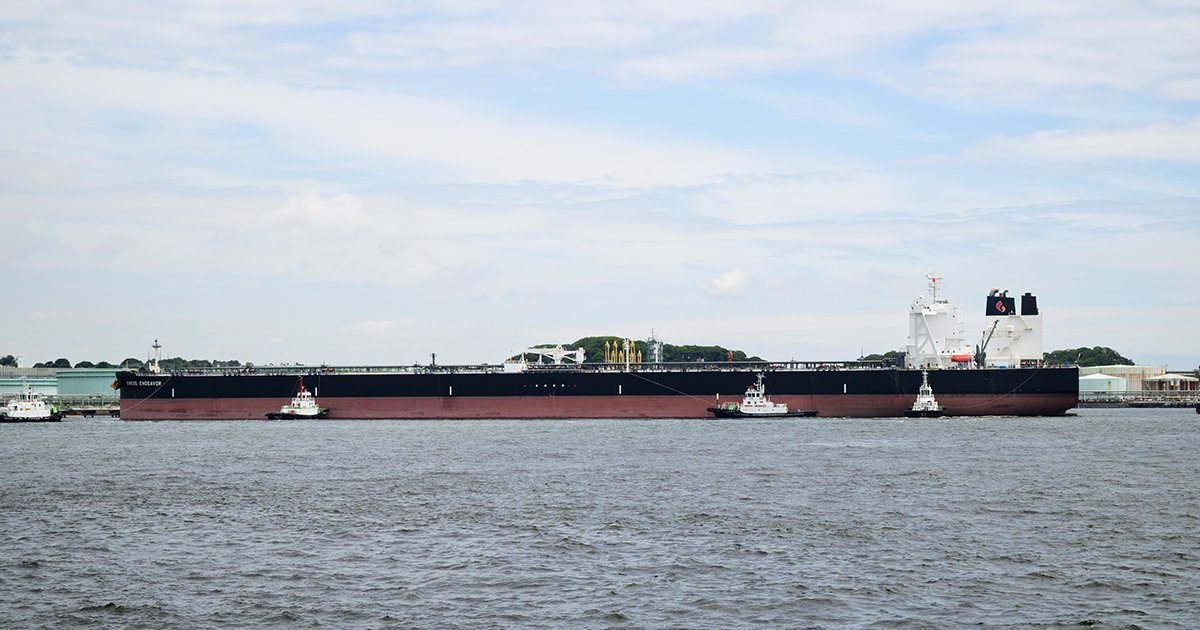
After a rare dark transit through the Strait of Hormuz in May, the Eneos Endeavor supertanker approaches the Eneos Corp. Negishi oil refinery in Yokohama, Japan, on June 6. (Akio Kon/Bloomberg)
key takeaways:
- Oil prices edged lower in early trade after the US and Iran reached a tentative deal to restart global flows of crude.
- Analysts are urging caution, noting that many issues remain uncertain.
- Talks with Iran are expected to continue for the next 60 days.
TOKYO – Global shares mostly advanced and Japan’s benchmark Nikkei 225 surpassed 70,000 for the first time on June 16, but early gains were pared after the Bank of Japan raised its key interest rate to 1%.
The quarterly percentage point increase took the benchmark rate to its highest level in three decades.
On June 15, stock markets around the world rose and oil prices edged lower after the United States and Iran reached a temporary agreement to restart global flows of crude oil. The S&P 500 rose 1.7% and the Dow rose 0.9% to a record high. The Nasdaq Composite jumped 3.1%.
Brent crude fell 4.8% on hopes that the US-Iran deal could reopen the Strait of Hormuz, which supplies oil to most of Asia. But some analysts have urged caution, noting that many issues remain uncertain. Talks with Iran are expected to continue for the next 60 days. Even after the Strait of Hormuz reopens as expected on June 19, it will take several months for the energy industry to get back to full speed.
Oil prices have recently fallen from levels above $100 a few weeks ago on hopes of an extension of the ceasefire in the war. Before the war, oil was trading at around $70 per barrel.
Early on June 15, benchmark US crude was down $2.03 at $78.72 a barrel. Brent crude, the international benchmark, fell $1.82 to $81.35 a barrel.
France’s CAC 40 jumped 0.7% to 8,446.06 in early trading, while the German DAX rose 0.8% to 25,102.01. Britain’s FTSE 100 rose 0.6% to 10,492.11.
The S&P 500 futures were almost unchanged while the Dow Jones Industrial Average was 0.1% higher.
Japan’s Nikkei 225 rose 0.1% to close at 69,404.50, while South Korea’s Kospi advanced 2.1% into record territory at 8,726.60.
In Hong Kong, the Hang Seng fell 1.4% to 24,493.95, while the Shanghai Composite dropped 0.1% to 4,091.89.
Australia’s S&P/ASX 200 was little changed, rising less than 0.1% to 8,917.70.
Taiwan’s Taiex rose 0.9%, while India’s Sensex rose 0.7%.
In currency trading, the US dollar fell to 160.32 JPY from 160.33 yen. The euro rose to $1.1604 from $1.1594.