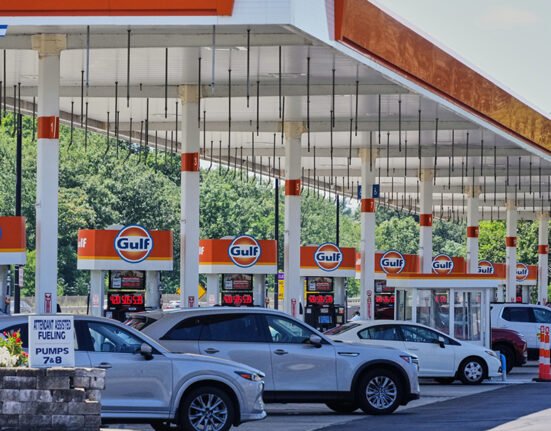
A customer prepares to pump diesel fuel at a Madison, Miss., Sam’s Club. (Rogelio V. Solis/AP/File)
| Update:
key takeaways:
- Oil prices continued to fall after the US and Iran signed a preliminary deal to end the war.
- Due to falling oil prices, travel-related companies continued to grow.
- U.S. markets rose, clawing back losses from a day earlier, driven by speculation the Federal Reserve could raise interest rates this year to curb persistent inflation.
NEW YORK – Stocks rose on Wall Street on June 18, giving back most of their losses from a day earlier and putting them on track to post a weekly gain.
Crude oil prices continued to fall after the United States and Iran signed a deal to end their war and reopen the Strait of Hormuz to oil tanker traffic. Brent crude, the international benchmark, fell 2% to $77.96 a barrel. U.S. benchmark crude fell 2.3% to $74.23 a barrel.
Lower oil prices are reducing pressure on companies that are heavily dependent on the fuel. Airlines made some big gains. American Airlines rose 3.6% and United Airlines rose 2.7%. Cruise line company Carnival jumped 3.8%.
However, energy companies have suffered losses due to falling oil prices. Exxon Mobil fell 2.8% and Chevron fell 2.6%.
Crude oil prices are still above about $70 a barrel before the war, but well below the more than $100 prices of a few weeks ago.
High oil prices during the US war with Iran were affecting the markets. The current agreement between the nations waives sanctions against Iran and allows it to sell its oil freely. It also opens the Strait of Hormuz, where one-fifth of the world’s oil supply is sent.
The S&P 500 rose 1%. As of 12:31 p.m. Eastern, the Dow Jones Industrial Average rose 169 points, or 0.3%. The Nasdaq Composite jumped 1.4%. Every major index is on track for weekly gains. US markets will be closed on June 19 for Juneteenth.
The gain helped offset losses from a day earlier that were driven by expectations that the Federal Reserve would raise interest rates this year in an effort to fight inflation. Bond yields are falling. Coupled with falling oil prices, there is considerable relief from pressure on stocks.
Gains were broad-based and led by technology stocks. Intel rose 9.9% after President Donald Trump announced the semiconductor giant would make chips for Apple in the U.S. Other big semiconductor companies led the gains. Nvidia rose 2.7% and Micron Technology rose 7.6%.
Following its strong debut on the US stock market last week, SpaceX fell for the second consecutive day. The Elon Musk-led rocket maker and AI company fell 10.1%, following a 4.9% loss on June 17.
“While investors are welcoming the agreement as a constructive step forward for geopolitical risk, uncertainty remains over potential flare-ups, the pace of shipping normalization, control over the waterway, the cost of access, and the path forward for Iran’s nuclear program.” Adam Turnquist, chief technical strategist at LPL Financial, said in a research note.
Rising energy costs are putting further pressure on already hot inflation. The average price of gasoline in the US has dropped by $4 per gallon, but is still 25% higher than a year ago. The prices of a variety of goods are increasing due to high shipping costs.
Rising inflation prompted the Federal Reserve to potentially raise rates by the end of the year rather than cut its benchmark interest rate. Low interest rates can boost the economy by making it easier for businesses and households to borrow, but they also increase inflation.
The Fed is trying to balance its work of curbing inflation while supporting employment growth. The jobs market remains relatively strong, with low unemployment and solid job growth amid rising inflation.


Eaton’s Jason DiNardo and Leah Bogle address common misconceptions about automated manual transmissions and examine what today’s drivetrain service environment requires. Tune in by going above or RoadSigns.ttnews.com.
The central bank closed its two-day meeting on June 17 by keeping its benchmark interest rate at the current level. But it indicated it may raise rates at least once by December.
“This shift in the risk distribution helps explain why about half of the committee thought an interest rate hike might be needed this year,” James McCann, senior economist at Edward Jones, said in a research note.
The Fed’s strong signal for a final rate hike sent bond yields soaring on June 17, but they eased on June 18.
The yield on 10-year Treasuries fell to 4.44% from 4.49% at the end of June 17. The yield on 2-year Treasuries, which more closely tracks the Fed’s actions, fell to 4.16% from 4.20% at the end of June 17.
Markets in Europe and Asia were mixed.
Senior producer Mayuko Ono contributed to this report.