Picture yourself on a hike: You’re walking along a trail through a beautiful forest, but then something rips you from the moment — a piece of trash, a pile of dog poop, or empty cans strewn around. Not only is this a negative experience, but none of these things are good for the environment. In this vein, most outdoor-lovers will have heard the phrase “leave no trace” at least once. It represents an ethos for enjoying the outdoors that sits among the things rangers wish you knew before visiting a state or national park. The Leave No Trace Center for Outdoor Ethics (LNT) is also a non-profit organization that formed in 1994, “dedicated to protecting the outdoors through science-based education that inspires responsible recreation.”
At the core of Leave No Trace are seven principles that establish a framework for being outside responsibly, no matter if it’s a local city park or one of The Mighty 5. Based in Boulder, Colorado, the organization works with an array of federal bodies including the National Park Service (NPS), the U.S. Forest Service (USFS), and the Bureau of Land Management (BLM). “Our mission is to ensure a sustainable future in the outdoors — and the planet,” Subaru/Leave No Trace traveling team member Jeanelle Soland told The Parks Podcast. In our national parks, the principles are widely adopted so visitors also learn how to be good stewards of protected landscapes.
Soland is also careful to point out that the principles “are not rules. It’s not about being perfect. Really, it’s about learning some of these things and then putting some small, actionable goals into your life when you’re in the outdoors,” she says. Below, discover the seven principles of Leave No Trace, which go well beyond the simple phrase, “pack it in, pack it out.”
1. Plan ahead and prepare
Poor planning and preparedness can mean a stressful trip. The wrong shoes could leave you wet and cold, and lack of water will leave you dehydrated. These same issues can be bonafide safety problems, especially amid challenging terrain in inclement weather. Among the most common mistakes first-timers make while visiting a national park: not planning well enough in advance. “Make a plan … and a backup plan,” say NPS rangers. There are plenty of things you can’t control, so focus on the things you can, like what equipment to bring. It usually takes a lot more research than you think, but if you embrace the excitement, planning can be a highly enjoyable experience.
Leave No Trace suggests looking at planning and preparing in a few different ways. You should always check on the regulations and announcements for the place you’re visiting. Parks often publish updates about closures or weather on their websites and the NPS app. If you can, avoid visiting during periods when the park is really busy, and ideally, stick to small groups, as high volume has a bigger impact on the environment. And as you’re packing, consider the 10 Essentials, the NPS’ suggested list of must-haves for any visit to a national park. It’s also good practice to let someone know where you’re going, especially if you’re visiting a remote place or somewhere you’ve never been before. The remote Needles District in Canyonlands National Park, for example, can be a challenge, and there are lots of trails. Law enforcement ranger Sara Shoemaker tells the Dear Bob and Sue podcast that it’s important to stick to any plan you tell others about: “If you say you’re going to Chesler Park, don’t go to Druid.”
2. Travel and camp on durable surfaces
Camping and traveling on durable surfaces is an important Leave No Trace principle because the less of a mark you make on the landscape, the more you protect animals, plants, and their habitats. Stick to already-cleared campsites, gravel and dirt tracks that are established and packed down, and trails that are clearly marked. It’s best not to follow wildlife or so-called “social” trails. Both backcountry and frontcountry camping are prime places to implement this principle, whether remotely camping in the mountains or in a busy campground.
“When you pull up to your site, park your car on pavement or gravel rather than plants. The same goes for your tent,” says a ranger at Glacier National Park in an NPS video. “Pitch it only on a designated tent pad or a durable surface if your site doesn’t have a tent pad. Staying on durable surfaces helps keep the campsite green for everyone.” In addition to the plants, keep local waters in mind, too. It’s best to camp at least 200 feet from lakes and streams in undeveloped areas, and it’s always a good idea to keep campsites as small as possible. Even in the backcountry, stick to designated sites to avoid creating further impacts.
Even when walking, it’s ideal practice to stick to the middle of a trail as much as possible. It might not seem like a big deal to make a brief detour around a root or a rock, but damage to ground cover can happen quickly. Parks’ terrain varies a lot. “Just a few steps off the trail during the short growing season can harm or even kill rare plants, endanger toads and frogs, and ground nesting birds,” shares a ranger named Connie at Yosemite National Park in a video.
3. Dispose of waste properly
Disposing of waste — of all kinds — isn’t something we prefer to think about, but when it comes to Leave No Trace principles, it’s one of the most important. Leaving trash at a site is litter, just like it is anywhere else. Not only does it endanger wildlife and the local ecology, it’s a drag to come across someone else’s ditched garbage. That also goes for dog waste, which should always be collected in a bag, and human waste, which should be disposed of properly by digging a cat hole or packing it out in a waste-alleviation and gelling (WAG) bag designed expressly for that purpose.
As you’re exploring a national park, make sure your items are secure so you don’t inadvertently litter. According to National Geographic, Margery Price, a National Park Service geologist, has had a hand in documenting more than 23,000 pieces of trash — plus nearly 370 hats — found in Yellowstone National Park’s hydrothermal features as of October 2026. Trash can have a big impact, even if it’s left there accidentally.
There are also other impacts to keep in mind, such as toothpaste and using soap on a camping trip. You won’t want to spit toothpaste into the brush. “The art of LNT tooth-brushing is in the spray,” writes Backpacker Magazine editor Annette McGivney, who wrote a book about Leave No Trace. You want to avoid spitting it out in a glob because animals will eat it, and they could get sick. She adds, “But you don’t want to swallow the toothpaste, either. So after you swish, stand at the far edge of camp and spray with all your might, spewing the spit and toothpaste over as vast an area as possible to diffuse any potential environmental impacts.” Sounds like a fun game!
4. Leave what you find
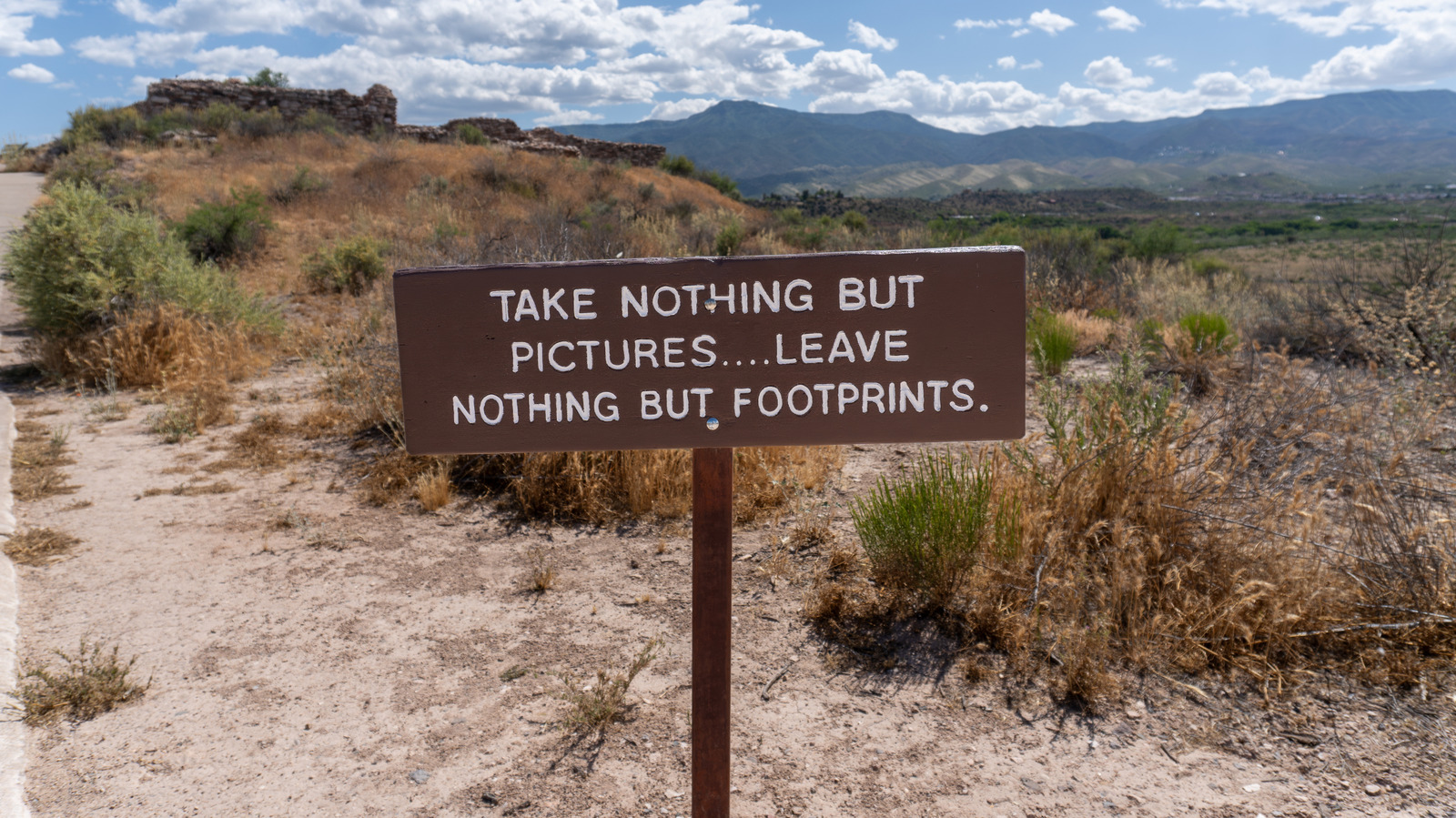
It doesn’t matter what you’ve spotted — a rock, a plant, an archaeological artifact — don’t remove it! Leave it exactly where you found it. Removing artifacts is illegal to begin with, and don’t even think about bringing a metal detector on your visit, because it will get confiscated in a national park. But in terms of LNT principles, it’s just good practice to not disturb the landscape. If you come across what looks like an illegal dig site, report it to rangers as soon as you can. “Disturbed archeological sites often look like fresh, small pits dug by a shovel or pick,” the NPS website explains. LNT principles provide a teachable opportunity if a ranger is brought an object. “When artifacts are removed from sites, we lose clues about the activities that took place there,” ranger training guidance says. “Thank the visitor, but advise that if there’s a next time, they should take a picture and leave the artifact behind.”
Avoid disturbing the ground, including moving stones and other features around. Building cairns is both prohibited and dangerous in a national park because on one hand, the practice can cause erosion when done in excess. On the other, cairns are maintained as navigational aids in places where a marked trail isn’t visible, such as across open swaths of sandstone. “The rock cairns at national parks like El Malpais, Hawaii Volcanoes, and Acadia are carefully maintained by park staff to keep hikers like you on the correct path,” an NPS article says. They’re carefully designed, so leave them alone. By following the LNT principle of “leave what you find,” just carry on. Don’t tamper with, add to, or knock down existing cairns. Let a ranger know if you notice any out-of-place disturbances in the landscape.
5. Minimize campfire impacts
Over the past several years, as wildfires have increased in magnitude due to climate change, campers and hikers hear a lot about fire restrictions and best practices for keeping sparks from igniting into something that blows out of control. “The vast majority of wildfires are caused by humans. Some of them are caused by poorly managed campfires,” says Ranger Brad at Redwood National and State Parks in a “Flat Hats at Home” series on YouTube. When it comes to LNT principles, there are some basic guidelines that help to reduce your impact on the landscape and campsite and, by extension, help protect forests, too.
Firstly, fires should always be small. Where there’s a ring provided, use it. It’s also ideal to follow the “Four D’s” for gathering firewood: dead, down, dinky, and distant. In other words, only use wood that’s already dead and fallen to the ground, is no bigger than the diameter of your wrist, and is collected both far away from your campsite and from across a dispersed area.
Campfires are one of those things we deeply associate with the joy of camping. But if you can, use a lantern for light and a stove for cooking instead of making a fire, as neither of those leave a lasting impact on the ground. If you do build a fire, do it safely. Don’t leave it unattended, clear brush or any flammables from the immediate vicinity, and keep it contained. “This will significantly reduce the possibility of a brush fire,” says Ranger Donovan at Joshua Tree National Park in an NPS video. Also, make sure the fire is put out completely using the “drown, stir, drown, feel” method, per Smokey Bear.
6. Respect wildlife
Respecting wildlife’s space is paramount for your safety and enjoyment, but it also applies to Leave No Trace principles. Be careful not to send messages, even inadvertently, to animals that they can rely on humans for food, which can be reinforced by leaving snacks out overnight, for example, or not disposing of your trash properly. You should also never feed animals, and that runs the gamut of large to small creatures. Yes, that includes the very cute rock squirrels on the Grand Canyon’s South Rim or the coyotes at Death Valley National Park.
At the Grand Canyon, squirrels cause the most injuries in the park. And on the Safe Travels Podcast, Death Valley ranger Elyscia Letterman says, “One of our biggest messages is: Please don’t feed the coyotes.” That’s because they’ll “actually stop traffic by walking out into the middle of the road and just [stand] there,” she says. Obviously, that’s a danger to the animals and to visitors. Getting too close to wildlife at Yellowstone National Park is also among the most upsetting mistakes people make when visiting. It’s actually illegal to feed or disturb any wildlife in any national park, sometimes because of series safety reasons. That’s why Glacier National Park prohibits intentionally approaching a wolf or bear within 100 yards. Only use binoculars or a zoom lens on your camera to get “close” to animals. Keep them wild!
One additional note is to keep your dog under control so it doesn’t disturb animals and their habitats, or better yet, leave them at home. “It’s really important for your dog to stay on-leash because your dog could get hurt, other people could get hurt, and the rea National Park B.A.R.K. Ranger video
7. Be considerate of others
Being considerate of other visitors is not just good practice for visiting national parks; it’s a good rule of thumb anywhere we go. The other six Leave No Principles all converge in this final guideline, too. Just like we want to protect wildlife and the natural landscape, we also want to ensure that others’ experiences are enjoyable and safe. There are some simple and effective ways to do this, such as leaving your campsite so tidy that it looks like no one was ever there. Don’t leave your trash. Let uphill hikers have the right of way on trails. “With so many of us participating in a wide range of activities, it really helps when we are considerate of each other,” say the rangers at Grand Canyon National Park, where its famous trails can get very busy with day hikers, backpackers, and pack mule trips.
Another important facet of this principle is to mind your volume, and that includes bringing speakers along. Ideally, you’ll leave them at home. Sound travels very far across lakes, for example, and if you’re in a busier camping area, it doesn’t take much for noise to impact the experience of your neighbors. “If you choose to listen to music as part of your time outdoors, wear one earbud not to disturb others but still be aware of your surroundings,” says official Leave No Trace guidance on the 7th principle. Also, be aware of how much space you’re giving to others at camp. No one likes to feel crowded, and in nature, people want to feel like they have their own little slice of it. If you expect that for yourself, it’s certainly worth extending the courtesy to others.