John Stockwell, who publicly resigned from the Central Intelligence Agency in 1977 amid accusations of fraud and illegality after building a career as a covert operative in Vietnam and Africa, died this month in Austin, Texas. He was 88 years old.
Kristen Dark, a spokeswoman for the Travis County Sheriff’s Office, said Mr. Stockwell’s body was found June 14 in a wooded area near his home, a day after a bulletin known as a Silver Alert was issued asking for the public’s help in finding a missing veteran. He said there was no indication of foul play, but the medical examiner was considering suicide as a possible cause of death.
His wife, Virginia Stockwell, declined to provide information about his death or life.
Mr. Stockwell’s ties to the CIA – during a period when many former officials published damaging accounts of what was informally known as “the Company” – were public and ostentatious.
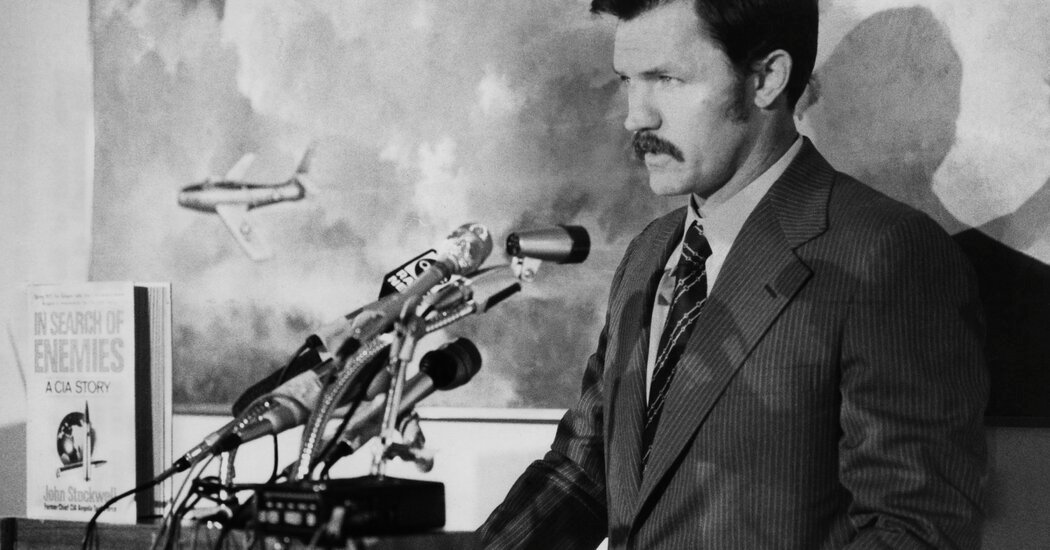
His resignation letter was published in the Washington Post. He wrote a tell-all book, “In Search of Enemies” (1978), which the CIA tried to suppress. He was interviewed on the CBS news program “60 Minutes” about his journey from Cold War idealist to sharp critic of America’s covert efforts at regime change abroad.
In the 1970s, congressional hearings and press investigations exposed CIA plots to assassinate foreign leaders, overthrow governments, and illegally monitor the mail and phone calls of American citizens. Senator Frank Church, Democrat of Idaho, who chaired the 1975 Senate investigation, described the agency as “a rogue elephant”.
Mr Stockwell’s 12-year career as a case officer included recruiting spies, harassing embassies and undermining foreign governments. He concluded that the CIA’s covert operations did nothing to protect the country’s national security.
He wrote in his book, “Over the past few years, a deep, egregious moral corruption has set in.”
“Ultimately, like any secret police,” he said, referring to the CIA’s secret services, “they began to abuse people: they drugged American citizens, opened private mail, infiltrated the media with covert propaganda and disinformation, lied to our elected representatives and put themselves above the law and our Constitution.”
After resigning, he spent five days testifying before congressional committees.
Mr. Stockwell, who spent most of his childhood with his missionary parents in the Belgian Congo (now the Democratic Republic of the Congo), served for three years in the Marine Corps before being recruited by the CIA in 1964, when he was 27.
“I was ready for selection,” he told The Post in 1978. “I was very naive. I saw the world as divided between good guys and bad guys.”
After a few low-risk postings in Africa, he was sent to Vietnam in 1973 as officer in charge of Tay Ninh province. In Vietnam, the CIA was dominated by “fraud and deception”, he later wrote. According to Mr. Stockwell, when South Vietnam fell to the Communists in 1975, CIA leaders “fled in panic”, abandoning thousands of Vietnamese operatives they had recruited and then exposed.
However, he acknowledged that his separation with the CIA was not a clean case of conscience triumphing over agency corruption. Lured by the prestige and pay of the job, he spent years torn between whether he should leave or not.
“I want to present myself as a man of strong principle who saw bad things and immediately resigned in disgust,” he said. told Filmmaker Saul Landau of the Institute for Policy Studies, a Washington think tank, in 1978. “But my career was apparently going quite well.”
His former wife, Betty Jane, was a true moral compass. He said in the same 1978 film, “The job of the CIA is to go out and corrupt individuals in their own country, and that’s something that corrupts itself.”
She repeatedly asked her husband to resign, she said. “It’s going to be the CIA, or it’s going to be our wedding,” she recalled telling him. “And he chose the CIA.”
In 1975, once his marriage ended, Mr. Stockwell accepted an important assignment: head of the Angola Task Force, meant to run a covert CIA war in southern Africa.
President Gerald R. Ford and Secretary of State Henry A. Kissinger ordered the CIA to intervene against a military force backed by the Soviet Union and Cuba in oil-rich Angola, which was emerging from Portuguese colonial rule.
From CIA headquarters outside Washington, Mr. Stockwell directed the organization and covert funding of pro-American paramilitaries. The agency sent a shipment of $32 million and weapons to the Angolan guerrillas, who were led by the brother-in-law of Mobuto Sese Seko, president of neighboring Zaire, as Congo was then known.
As American-backed troops faltered, Mr. Kissinger ordered the secret transfer of another $28 million. In December 1975, Congress became aware of the funding and passed a law to end it.
Earlier, it had become clear to Mr. Stockwell that the CIA’s actions in Angola were ill-conceived and that the covert war had produced unnecessary bloodshed.
“I try to count the hundreds, thousands of lives that have been taken in the thoughtless little exploits of the CIA,” he wrote in his April 1977 memoir. resignation letter.
John Robert Stockwell was born on August 27, 1937, in Brazoria, Texas, the son of William F. He was one of three children of Stockwell and Willora (Baker) Stockwell.
His father, who trained as an engineer, was contracted to build a hydroelectric plant for the Presbyterian mission in the Belgian Congo. The family moved there in the 1940s, and young Bob, as he was known, attended school with African classmates for a decade. His mother supervised the boarding school at the mission station in Mutoto.
He received a bachelor’s degree from the University of Texas in 1959 and then joined the Marine Corps. That same year, he married college classmate Betty Jane McCallum.
A complete list of their survivors was not immediately available.
Mr. Stockwell’s public prominence came after the publication of “In Search of Enemies”.
In The New York Times Book Review, Newsweek’s former Saigon bureau chief Kevin Buckley described the book as “a consistently understated but powerful account of Mr. Stockwell’s changes in conscience, as well as a highly useful account of political and military failure.”
Profiling Mr. Stockwell for The Post, journalist Sally Quinn described him as “outspoken, articulate and humorless”, adding: “He’s quite handsome even at 40. In fact, if you didn’t know he was a former CIA agent, you might mistake him for a country singer.”
After leaving the agency, Mr. Stockwell settled in Austin to live the writer’s life. She published a novel, “Red Sunset” (1982), about chess, infidelity and the wife of an American oil executive in Africa; and “The Praetorian Guard: The US Role in the New World Order” (1991), a collection of essays warning that the United States had continued to covertly support foreign wars after the end of the Cold War.
When Mr. Stockwell published “In Search of Enemies,” the CIA sued him, claiming breach of confidentiality. He filed for bankruptcy in an attempt to thwart agency efforts to seize his profits, but won the right to collect 65 cents for each copy sold.
“For the same reason,” he told The Gazette of Cedar Rapids, Iowa in 1989, “I always urge people to get the book from the library.”