


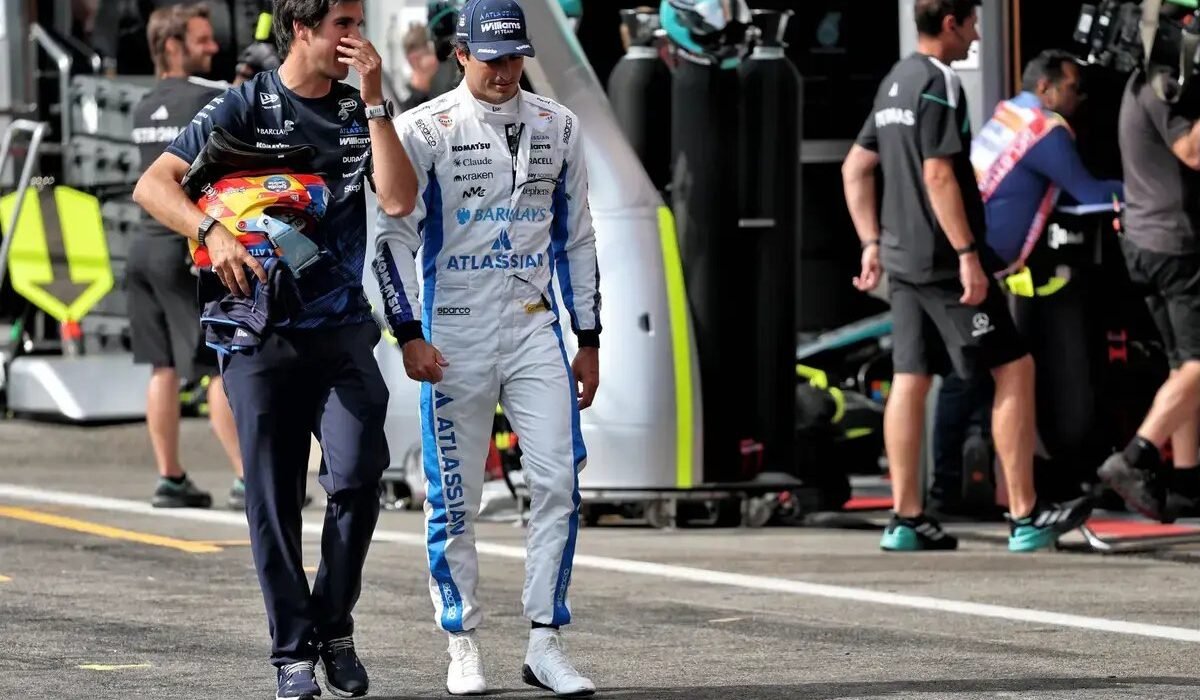
Carlos Sainz has sharply criticized Formula 1’s 2026 technical regulations, and openly questioned the direction of the sport after damaging simulation data was revealed at the Belgian Grand Prix. The Williams driver expressed deep concerns over the performance and handling capability of the next generation of cars, highlighting a worrying decline in speed and energy management issues that threaten to sap the spark and competitiveness of F1’s new era.
Recent races at Silverstone and Spa-Francorchamps have highlighted glaring weaknesses in current and future regulations, particularly around energy deployment. Both circuits, renowned for their fast corners and extended straight lines, have become testing grounds for the limits of hybrid power units. Despite recent changes in electric power generation and more aggressive superclipping strategies, the cars’ speed continues to drop, particularly at the end of Spa’s famous Blanchimont, where a 50 km/h drop has been recorded due to the MGU-K’s lack of energy. The situation is complicated in high-speed sections like Pauhon, with Sainz referencing an obvious comparison: Lando Norris’ pole lap last year dwarfs Kimi Antonelli’s 2026 simulation lap, revealing a 40km/h deficit as teams avoid deploying through sweeping double-lefts.
Saenz did not hold back in analyzing the consequences of these technological choices. He highlighted the diminishing enthusiasm and performances around Spa, saying, “I think no one there is enjoying the qualifying laps as much as we did last year.” “I think it’s clear that we’ve lost a lot with these cars… I don’t want to underestimate our game because it’s not going to help. I think we all know it’s not good enough. It needs to change. It will change. It will evolve. But yes, hopefully next year will be a step better and next year will be another step better.”
He went on to question the decision-making process that allowed such rules to move forward unchecked: “Whoever looked at these simulations in 2022, 2023 looked and said, how can we accept this? There needs to be a review of what happened there because it should never have happened. But now we’re here, we’re having some exciting races, the sport is still growing, so it’s time to move on.”
Watching the race, Sainz predicted a “sketchy” opening lap, especially with the activation of the aerodynamics on the Kemel Strait. Set to start 14th side by side with the penalized Norris, Sainz admitted, “It’s going to be difficult. I think it’s going to be a big challenge. I think lap one is also going to be difficult with Eau Rouge and SLM (Straight Line Mode) and everything that happens there. But let’s see. Try and stay awake, try and be smart and play your cards. Let’s see.”
Lewis Hamilton echoed Sainz’s uneasiness when asked about the Spaniard’s comments, confirming that teams and drivers had predicted these issues from the start. Hamilton commented, “It’s just not good in a straight line, but the cars are very good through corners. It’s just that in a straight line it’s not very good.” “I’m pretty sure we saw it right away. I don’t know who made that decision, but whoever it was, they still got their job.”
As F1 moves into a new era, growing criticism of its stars signals a turning point for the series’ technical leadership and the future of the racing spectacle.
Don’t miss a second with the new app where you can watch live timing of MotoGP, Formula 1, NASCAR, IndyCar and much more: just press – Here (Free for all users)